


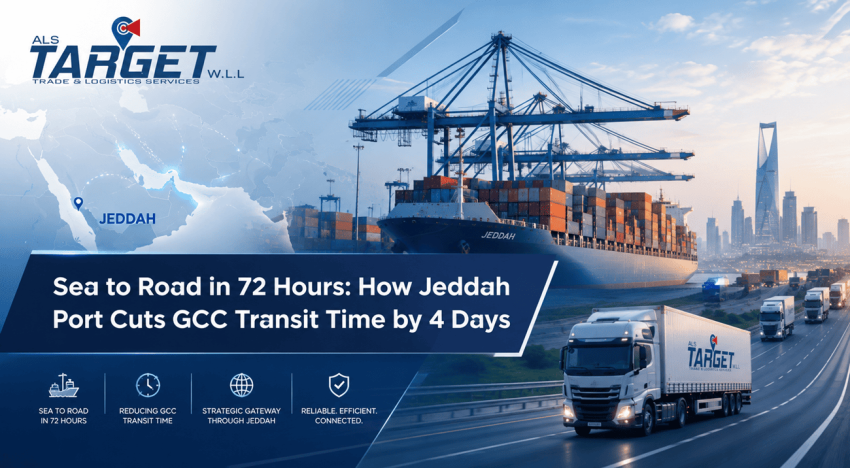
For importers moving cargo into the Gulf, four days can decide whether stock reaches a customer or sits unavailable during a sales rush. It can also determine whether a factory continues production or pays for an emergency air shipment. That’s why Jeddah Port sea-to-road freight has become an important option for businesses serving Saudi Arabia, Bahrain and other GCC markets.
A well-planned shipment can move from vessel discharge to an outbound truck within approximately 72 hours. However, that result doesn’t happen simply because a container arrives at Jeddah Islamic Port. It needs advance customs filing, correct product approvals, a ready truck and close communication between the shipping line, terminal, customs broker and road freight team.
At ALS TARGET, we view Jeddah as more than a Saudi import gateway. When the route suits the shipment, it becomes a practical sea-road freight hub for GCC distribution. Compared with slower feeder-vessel or transshipment arrangements, the model may shorten the overall journey by as much as four days.
Why Jeddah Islamic Port Matters to GCC Supply Chains
Jeddah Islamic Port straddles Saudi Arabia’s Red Sea coast, largely on major shipping routes between Asia and Europe, East Africa and the Middle East. This means that international cargo can travel directly to western Saudi Arabia, avoiding the need first to sail upstream into the shallow waters of the Arabian Gulf.
The port has large container terminals, logistics facilities, customs services and direct road connections. Therefore, cargo doesn’t need to remain tied to the sea after arrival. Once customs releases it, a truck can collect the container or cargo and begin the inland journey.
This creates a useful alternative for shipments destined for:
- Riyadh and central Saudi Arabia
- Dammam, Al Khobar and the Eastern Province
- Bahrain through the King Fahd Causeway
- Kuwait through Saudi road corridors
- Qatar through the Abu Samra border
- The UAE and Oman, depending on the final destination and commercial route
For some GCC destinations, a direct Gulf port will remain the better choice. However, when vessel schedules, congestion or transshipment delays weaken that option, shipping through Jeddah Port can provide a faster and more controlled route. Get details on Sea Freight Cargo Service from Bahrain.
What Does “Sea to Road in 72 Hours” Actually Mean?
The 72-hour period usually starts when the vessel completes discharge or makes the container available for customs and terminal processing. It ends when the cargo leaves the port by road.
A typical fast-moving workflow may look like this:
| Operational stage | Target time | Main requirement |
| Vessel discharge and container availability | 6–12 hours | Berth availability and quick terminal handling |
| Customs assessment and cargo release | 12–30 hours | Advance declaration and accurate documents |
| Terminal payment and release order | 4–10 hours | Charges settled without approval delays |
| Truck allocation and gate appointment | 4–12 hours | Driver, trailer and permits arranged early |
| Container collection and port exit | 4–8 hours | No inspection hold or terminal discrepancy |
| Total target | 30–72 hours | Coordinated pre-arrival planning |
These numbers are estimates of what they can operate, not hard commitments. Custom inspections and lab tests, missing certificates or non-payment of terminal charges could take the collection process above 72 hours.
However, the target is achievable for compliant cargo when all parties work to get their job done prior to vessel arrival.
How Jeddah Can Cut GCC Transit Time by Four Days
Traditional port-to-port routing often looks simple on paper. Yet feeder schedules can add several days to the actual journey. A container may arrive at a regional hub, wait for connection, load onto a smaller vessel and then face another discharge process at the destination port.
In contrast, the Jeddah sea-road model replaces the final marine leg with trucking. Looking for a Bonded Warehousing Services in Bahrain?
Indicative route comparison
| Routing model | Typical post-arrival process | Indicative additional time |
| Hub port plus feeder vessel | Transshipment wait, feeder sailing and second port clearance | 5–8 days |
| Direct sea service to destination port | Discharge, clearance and local delivery | 3–6 days |
| Jeddah discharge plus GCC road freight | Clearance, truck collection and cross-border movement | 2–4 days |
| Possible time saving | Compared with slower feeder routing | Up to 4 days |
The greatest saving usually comes from removing schedule dependency. Trucks can depart daily, while feeder vessels operate according to fixed sailing windows. Consequently, missing one feeder connection could mean waiting several more days.
Road freight also gives the logistics team more control. They can select a driver, confirm a border route, track the truck and communicate directly with the consignee. That visibility matters when cargo has a delivery deadline.
Advance Customs Filing Is the Real Time-Saver
Fast port handling begins before the ship reaches Jeddah. Saudi import procedures require the customs declaration and supporting documents to be submitted in advance. Therefore, waiting for the arrival notice before starting customs work defeats the purpose of an express sea-road plan.
The freight team should review the shipment documents at least several days before arrival. Common requirements include:
- Commercial invoice
- Packing list
- Bill of lading
- Certificate of origin
- Correct HS classification
- Importer registration details
- Product conformity documents
- SABER certification where applicable
- SFDA approval for regulated food, cosmetics or medical cargo
- Dangerous goods documents when relevant
A small mismatch can create a big delay. For instance, the invoice may describe the product as “machine parts,” while the packing list provides a more technical description. Customs may then request clarification before approving the declaration.
Accurate data matters more than rushed paperwork. In fact, one careful document review before vessel arrival can save far more time than repeated calls after the container enters a customs hold. Get details on Import Cargo Storage & Distribution Services in Bahrain.
How ALS TARGET Plans the 72-Hour Handover
At ALS TARGET, we divide the movement into linked tasks rather than treating sea freight and road transport as separate bookings. That approach helps us identify delays before they reach the port gate.
1. We check route suitability
First, we compare Jeddah routing with other available gateways. We consider vessel frequency, final destination, cargo type, customs requirements, truck availability and border conditions. Although Jeddah can reduce transit time, it needs to make commercial sense for the shipment.
2. We prepare before arrival
Next, our team coordinates documentation, cargo details and customs requirements. We also confirm whether the goods need SABER, SFDA or another regulatory approval.
Meanwhile, the trucking team receives the container number, estimated discharge date, cargo weight and delivery location. This early preparation prevents the common problem of obtaining customs release but having no suitable truck available.
3. We monitor discharge and customs status
Once the vessel arrives, we follow the container through discharge, availability and customs processing. If customs requests additional information, the team responds quickly rather than letting the query remain unanswered.
4. We arrange immediate road collection
After release, the assigned truck moves into the port collection process. The driver then proceeds towards the Saudi destination or the selected GCC border.
5. We manage cross-border documents
For cargo continuing beyond Saudi Arabia, the road file must match the import, export or transit arrangement. Therefore, we check truck papers, driver documents, cargo permits and destination clearance requirements before departure. Get details on Re-Export Cargo Warehousing Services in Bahrain.
Estimated Jeddah-to-GCC Road Transit Times
Road times vary according to the border, driver regulations, weather, traffic and customs procedures. Nevertheless, the following estimates help importers understand the likely delivery window after the truck exits Jeddah Port.
| Destination | Indicative road transit after port exit | Common routing note |
| Riyadh | 1–2 days | Direct inland Saudi delivery |
| Dammam or Al Khobar | 2–3 days | Cross-country Saudi route |
| Bahrain | 2–4 days | Via Eastern Province and King Fahd Causeway |
| Kuwait | 3–5 days | Northern Saudi border route |
| Doha, Qatar | 3–5 days | Via Saudi Arabia and Abu Samra |
| Dubai, UAE | 4–6 days | Long-haul road movement with border formalities |
| Muscat, Oman | 5–7 days | Route depends on UAE transit arrangements |
The estimates don’t include unusual inspection holds or holiday congestion. Moreover, dangerous goods, oversized cargo and temperature-controlled shipments may need additional permits or specialist vehicles.
Cargo That Benefits Most From the Jeddah Sea-Road Route
Not every container needs an accelerated connection. However, several cargo categories gain clear value from shorter dwell time and faster GCC distribution.
Retail and e-commerce stock often works against fixed launch dates or promotional seasons. Therefore, saving four days can protect a campaign from stock shortages.
Automotive parts and industrial spares may support workshops, construction projects or production lines. A delayed component can stop equipment worth far more than the freight itself.
Food and temperature-sensitive goods are sensitive goods, but the shipper must still coordinate all regulatory approvals and refer to trucking carefully.
Project cargo may face installation deadlines, crane bookings and site-access restrictions. Consequently, a controlled sea-road handover can help the consignee maintain the wider project programme.
Additionally, consolidated and LCL cargo may use the route when fast deconsolidation, customs clearance and onward trucking are available. However, LCL usually needs more handling than a sealed full container. Looking for a Bonded-to-Bonded Trucking & Warehousing Services in Bahrain?
What Commonly Breaks the 72-Hour Target?
Most delays don’t start at the truck gate. They begin much earlier with incomplete information or late decisions.
Common causes include:
- Incorrect HS codes
- Missing conformity certificates
- Differences between invoice and packing-list data
- Late customs declaration submission
- Unpaid shipping-line or terminal charges
- No original or electronic cargo release
- Importer registration problems
- Unexpected customs inspection
- Truck weight or trailer mismatch
- Border paperwork prepared after collection
- Delivery restrictions at the consignee’s warehouse
For example, a container may clear customs on time but still remain inside the terminal because the shipping line hasn’t issued its release. Similarly, a truck may collect the cargo promptly but lose a day at the border because the transit declaration contains the wrong seal number.
Fast logistics requires discipline. Speed alone won’t fix an inaccurate file.
Related Services:
» Duty-Suspended Warehousing Services in Bahrain
» Customs-Controlled Cargo Handling Services in Bahrain
» Bonded Trucking from Bahrain Port to Warehouse
» Bonded Trucking from Bahrain Airport to Warehouse
» Customs Clearance, Bonded Storage and Local Delivery in Bahrain
» 3PL Bonded Warehousing Services in Bahrain
» Bonded Warehousing Near Khalifa Bin Salman Port
» Bonded Warehousing in Bahrain Logistics Zone
» Bonded Warehousing for FMCG Goods in Bahrain
» Bonded Warehouse and Fulfilment Services in Bahrain
Cost Versus Transit-Time Value
Routing cargo through Jeddah and moving it by road may cost more than waiting for the cheapest feeder connection. However, freight cost should not be viewed in isolation.
Importers also need to consider inventory shortages, production stoppages, demurrage, storage charges, missed deliveries and emergency air freight. In many cases, preventing one stock-out covers the additional cost of an expedited road connection.
| Business consideration | Slow feeder routing | Jeddah sea-road routing |
| Freight price | Often lower | May be moderately higher |
| Schedule control | Depends on vessel connection | Truck can leave after release |
| Visibility | Split across ports and carriers | Stronger control over final leg |
| Risk of missed connection | Medium to high | No feeder connection required |
| Best use | Flexible, non-urgent cargo | Time-sensitive GCC shipments |
Therefore, the best route isn’t always the one with the lowest freight quote. It’s the route with the most sensible total landed cost and delivery risk.
Related Articles:
» Why Air Cargo Demand Is Surging in the GCC?
» Sea Freight Documentation Guide for Bahrain Importers
» Groupage Shipping: Cost-Saving Sea Freight for Small Businesses in Bahrain
» Air, Sea, and Land Freight: Choosing the Right Shipping Method for Your Cargo
» Bahrain Logistics Solutions: Seamless Air Freight, Sea Freight & Warehousing
Building a More Reliable GCC Freight Strategy
Jeddah Port won’t replace every GCC gateway. Instead, it gives importers another strong routing option. Businesses that rely on one port, one shipping line or one transport mode often struggle when schedules change.
A better strategy uses route flexibility. For example, regular stock may follow the lowest-cost port-to-port service, while urgent inventory moves through Jeddah and continues by road. Likewise, a company may use Jeddah as a backup during congestion at another regional port.
At ALS TARGET, we coordinate sea freight, customs support and Jeddah-to-GCC road transport as one connected movement. That reduces handover gaps, improves shipment visibility and gives importers a clearer delivery plan.
The 72-hour target starts with early preparation. When documentation, customs filing, cargo release and trucking line up properly, Jeddah Islamic Port can turn a Red Sea arrival into a fast GCC road connection—and potentially remove four costly days from the supply chain.