


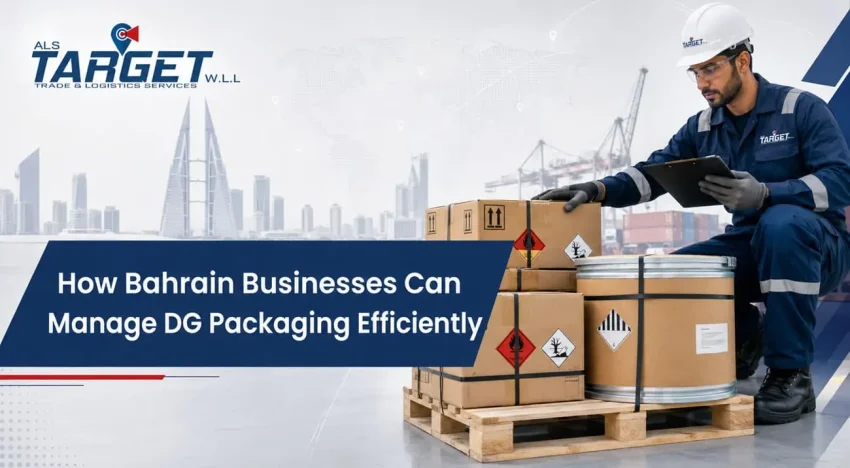
Dangerous packaging is not just a matter for Bahrain companies that import, export, manufacture or distribute chemicals, batteries, paints and industrial products and other regulated cargo on a regular basis. The packing must be in accordance with hazard classification, amount, transport mode and applicable packing instruction. A slight mismatch might end in cargo rejection, packing charges, missed vessel or flight cut-offs and extra storage costs.
This is an issue of particular importance for Bahrain, where access to international supply chains through Khalifa Bin Salman Port, Bahrain International Airport and regional Road Network are crucial to many businesses. Consequently, companies transporting Dangerous Goods (DG) need to consider that compliance in packaging is part of shipment planning and should not be checked after cargo arrives at the terminal. An efficient DG package is a critical process that firms use to minimize avoidable handling and free up hazardous cargo for shipment with more predictability.
Air shipments are still subject to the IATA Dangerous Goods Regulations as they exist today (as of 2026) and there is no International Maritime Dangerous Goods (IMDG) Code requirement for dangerous goods carried by sea. According to the International Maritime Organisation (IMO) IMDG Code Amendment 42–24 entered into force on January 1, 2026. IATA’s 67th Edition DGR also took effect on 1 January 2026.
Why DG Packaging Causes Costly Shipping Delays
Many shipment delays begin before cargo even leaves the warehouse. For example, a company may correctly identify its cargo as dangerous goods but select packaging that does not meet the applicable packing instruction.
In addition, the packaging may have an incorrect UN performance rating, missing closure components or labels positioned incorrectly.
Common DG packaging mistakes include:
- Using packaging that is not approved for the relevant substance
- Selecting a packaging performance level below the required packing group
- Exceeding permitted package quantity or gross weight
- Using damaged drums, cartons, jerricans or inner containers
- Applying incorrect hazard labels or UN numbers
- Failing to protect inner containers from movement
- Reusing packaging without removing irrelevant old labels
- Using incorrect absorbent or cushioning material
- Closing UN packaging differently from the manufacturer’s instructions
- Preparing an overpack without reproducing required marks and labels
IATA’s 2026 acceptance checklist specifically requires packages to remain free from damage or leakage and to comply with the applicable packing instruction. It also checks UN specification marks, permitted gross weight and required hazard labels.
Therefore, Bahrain businesses can save considerable time simply by checking these details before sending cargo for carrier acceptance. Get details on Dangerous Goods (DG) Logistics in Bahrain.
Start With Correct Dangerous Goods Classification
Good packaging begins with correct classification.
A business should identify the product’s:
UN number
Proper Shipping Name
Dangerous Goods Class
Subsidiary Risk, if applicable
Packing Group
Physical form
Quantity per package
For example, a flammable liquid classified under Class 3 may have packaging requirements completely different from those applying to corrosive goods under Class 8.
Furthermore, Packing Groups generally communicate the degree of danger:
| Packing Group | General Hazard Level | Typical Packaging Performance Requirement |
| PG I | High danger | X-rated packaging may be required |
| PG II | Medium danger | X or Y-rated packaging, depending on instruction |
| PG III | Lower danger | X, Y or Z may be permitted depending on requirements |
However, businesses should never select packaging from this general table alone. The specific UN entry, packing instruction, quantity and mode of transport must always be checked. Looking for a Warehousing & Storage Services in Bahrain?
Select the Correct UN Specification Packaging
Certain dangerous goods require UN specification packaging, which has passed prescribed performance tests.
A UN packaging code can look complicated at first glance. However, it provides important information about the packaging type, construction material and tested performance.
Typical DG packaging formats may include:
| Packaging Type | Common DG Application |
| Steel drum | Chemicals, liquids and industrial materials |
| Plastic drum | Compatible liquid or solid chemicals |
| Plastic jerrican | Smaller liquid shipments |
| Fibreboard box | Combination packaging |
| Wooden box | Selected industrial goods |
| Composite packaging | Products needing multiple containment layers |
| IBC | Larger authorised liquid or solid quantities |
IATA explains that some dangerous goods require tested UN specification packaging, although certain lower-risk products and limited quantities may qualify for alternative packaging provisions.
Consequently, Bahrain exporters should confirm packaging specifications before purchasing containers in bulk.
Follow the Packaging Manufacturer’s Closure Instructions
One detail companies often overlook is how the packaging must be closed.
A UN-certified drum, for example, was tested using a specific closure arrangement. Therefore, simply tightening the cap “as much as possible” may not reproduce the tested configuration.
Businesses should retain and follow packaging manufacturer’s instructions covering matters such as:
closure method, torque requirements, sealing components, gaskets and assembly procedure.
IATA’s competency-based DG training guidance specifically includes following packaging manufacturer’s instructions when UN specification packaging is used.
Therefore, warehouse teams should keep these instructions readily available instead of relying only on experience. Get details on Duty-Suspended Warehousing Services in Bahrain.
Use Correct Inner Packaging, Cushioning and Absorbent Material
Outer packaging receives much attention, although inner packaging is equally important.
Glass bottles, plastic containers, cans or other inner receptacles must remain secured against movement during normal transport.
Moreover, where regulations require it, suitable absorbent material should be able to contain leakage.
Cushioning should also:
- Prevent direct contact between fragile inner containers
- Reduce movement during handling
- Remain compatible with the dangerous substance
- Avoid reacting with leaked product
- Maintain package integrity throughout transportation
For liquid DG cargo, insufficient absorbent material can quickly turn a minor leak into a shipment rejection.
Never Ignore Quantity Limits
One of the quickest ways to create a DG delay is exceeding the permitted quantity per package.
Air freight rules can be especially restrictive because Passenger Aircraft and Cargo Aircraft Only (CAO) shipments may have different maximum quantities.
Therefore, before packing, companies should calculate:
Net quantity per inner packaging → Net quantity per outer package → Gross package weight
This simple sequence catches many errors before packing begins.
For sea freight, businesses must also check the current IMDG packing instruction and any applicable special provisions. The IMDG Code governs dangerous goods carried in packaged form internationally and aims to harmonise safe transport while protecting people, vessels and the environment.
Check Marks and Labels Before Cargo Leaves the Warehouse
Correct packaging can still be rejected because of incorrect marking.
Depending on the shipment, packages may need:
UN number
Proper Shipping Name
Hazard label
Subsidiary risk label
Cargo Aircraft Only label
Orientation arrows
Lithium battery mark
Environmentally hazardous substance mark
Limited Quantity mark
Overpack marking
Furthermore, old or irrelevant hazard labels must be removed or completely covered.
IATA’s current acceptance checklist requires relevant hazard and handling labels to be correctly applied and irrelevant marks to be removed or obliterated.
A simple photograph of every finished DG package before collection can also provide useful internal evidence if questions later arise. Get details on Warehousing for FMCG Goods in Bahrain.
Manage Overpacks Correctly
Businesses commonly consolidate several dangerous goods packages onto one pallet and wrap them together.
This creates an overpack.
However, shrink-wrapping packages does not remove the original marking requirements.
If required package markings or labels cannot be seen through the overpack, the applicable information must generally appear on the exterior, along with the word “OVERPACK” where required.
Additionally, businesses using several overpacks should maintain clear identification so that documentation can be matched with the correct cargo.
Align Packaging With Documentation
DG packaging and DG documents should tell exactly the same story.
For example, if the Dangerous Goods Declaration describes four fibreboard boxes, the carrier should not receive three fibreboard boxes and one drum.
Before dispatch, compare:
| Packaging Check | Documentation Check |
| UN number | Matches declaration |
| Proper Shipping Name | Matches declaration |
| Number of packages | Matches physical cargo |
| Packaging type | Matches declaration |
| Net quantity | Matches declaration |
| Hazard class | Correctly stated |
| Packing instruction | Correctly followed |
This final comparison takes only a few minutes. Nevertheless, it can prevent hours or even days of corrective work.
Related Services:
» Cargo Shipping Between Bahrain and Australia Ports
» Cargo Shipping between Bahrain & New Zealand Ports
» Cargo Shipping Between Bahrain & Peru Ports
» Cargo Shipping between Bahrain and Chile Ports
» Cargo Shipping Between Bahrain and Brazil Ports
Build a DG Pre-Dispatch Checklist
Bahrain businesses that ship hazardous materials frequently should use a formal Dangerous Goods pre-dispatch checklist.
Before collection, verify that:
- DG classification has been confirmed.
- Current regulations have been checked.
- Correct packing instruction has been identified.
- Suitable UN-certified packaging has been selected where required.
- Inner packaging is secure.
- Quantity limits have not been exceeded.
- Closures follow manufacturer’s specifications.
- Correct labels and markings are attached.
- Old labels have been removed.
- Overpack requirements have been checked.
- Documentation matches the physical shipment.
- Carrier or operator variations have been reviewed.
This final point matters because IATA acceptance requirements also require compliance with State and Operator variations.
Related Articles:
» Bahrain Checklist for E-Commerce Inventory in Air Freight
» Bahrain Checklist for High-Value Electronics in Air Freight
» Jeddah Port Customs Documents Checklist for US & EU Exporters
» LCL Groupage Shipping in Sea Freight: Export Guide
» FCL vs LCL to Jeddah: Cost Breakdown for GCC Importers
How ALS TARGET Can Support Dangerous Goods Shipping in Bahrain
Transporting dangerous goods is complex because of the need to coordinate issues for classification, packing, documentation and transport (carrier acceptance). Thus, many companies find it best to leave their Dangerous Goods shipping in Bahrain with a logistics team familiar with the regulations.
ALS TARGET allows businesses to effectively plan movement of dangerous goods through air, sea and road freight channels and facilitates order fulfilments with customers in terms of packaging and shipping requirements that meet the right logistics channel.
For the typical exporter, their main benefit comes from preemptively stopping issues on the ground prior to reaching the airport, port or carrier’s warehouse. In fact, correct DG packaging, labelling and documentation alignment can prevent lashed cargo, extra handling and missed departures.
So, to sum it up, an effective dangerous goods shipment is not about having more boxers. It is about choosing the right packaging, using it in the correct manner (including handling and labelling), for the appropriate classification of dangerous goods, and transport mode.
FAQs: How Bahrain Businesses Can Manage DG Packaging Efficiently
DG packaging is the kind of packaging that you design or choose, which ensures the safe transport of Dangerous Goods in accordance with relevant regulations and packing instructions.
Yes. Air dangerous goods shipments generally follow ICAO/IATA requirements, while maritime shipments follow the IMDG Code. Therefore, packaging acceptable for sea transport may not automatically be acceptable by air.