


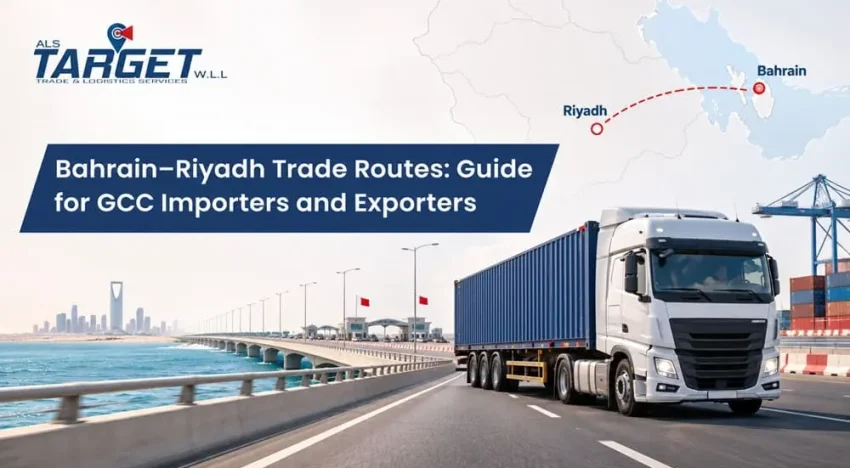
The development of a commercial alliance between Bahrain and Saudi Arabia is providing manufacturers, distributors, wholesalers and many other types of businesses with new avenues for expansion. The primary trade corridor that connects Bahrain to Riyadh serves as an essential link for moving products manufactured in Bahrain to the capital city of Saudi Arabia.
The Riyadh Market provides a wonderful opportunity for Bahraini companies to find numerous prospective clients. In addition, the Riyadh Market is the perfect venue for companies to create new products, expand their existing retail businesses, and establish a network of distributors. Although a method has to be developed in order to transfer goods from Bahrain to Saudi Arabia (for example, via truck) in order to allow for international trade to occur, there are other issues that need to be addressed.
1. Why Is the Bahrain–Riyadh Trade Route Important?
Riyadh’s continued growth as an industrial city, construction hub, retail center and service provider means that it will continue to require increasing amounts of imported goods and regional supply chain networks. Additionally, Riyadh has become one of the country’s most significant commercial centers and remains the political capital of Saudi Arabia.
The corridor supports several business activities, including:
- Manufacturing exports: Final goods, industrial parts, and manufacturing input.
- Wholesale distributions sell to other business units like consumers, packagers, and business inventory.
- The building materials, the electrical systems and the mechanical systems are all structural components.
- Retail replenishment: Regular stock deliveries to Saudi distributors.
- Import operations: Goods moving from Riyadh suppliers to Bahrain businesses.
Those people that run small companies and consistently use large vehicles to send products can now select from a second route. Get details on Bahrain to Saudi Arabia road freight Service.
2. Understanding the Bahrain to Riyadh Road Freight Route
The King Fahd Causeway is the shortest and most direct route connecting Bahrain and Saudi Arabia by land.
Commercial trucks typically move from Bahrain’s industrial/warehouse areas toward the causeway. Once commercial trucks pass the border, they will be traveling west on Highway 5, through Al Khobar and the Eastern Province, on their way to Riyadh.
Bahrain–Riyadh Road Freight Overview
| Route information | General details |
| Origin | Manama, Hidd, Sitra, Bahrain Logistics Zone, or other Bahrain locations |
| Destination | Riyadh, Saudi Arabia |
| Main border crossing | King Fahd Causeway |
| Saudi road corridor | Al Khobar / Dammam region towards Riyadh |
| Primary transport mode | Road freight |
| Approximate driving distance | 500–550 km, depending on collection and delivery points |
| Indicative freight planning window | 1–3 working days for suitable direct shipments, subject to clearance and operational conditions |
| Common shipment types | Commercial goods, equipment, pallets, machinery, and general cargo |
3. How Does the King Fahd Causeway Support GCC Trade?
Bahrain is connected directly to Saudi Arabia by the King Fahd Causeway, so it plays an important role in transporting goods within this area.
Commercial shipments are imported and exported on both sides of the transaction.
Before the truck is allowed to enter, all required paperwork for the freight carrier will be completed. This paperwork includes documentation proving that the driver is qualified to operate the truck; proof that the truck has received authorization to cross; proof of what type of goods are being transported by the truck; and lastly, proof that the customs process was completed.
The causeway provides two different types of services – passenger and commercial. Due to public holidays, a large number of people traveling on similar days, vehicle inspections and other operational limitations, the amount of freight that can be transported via the causeway will vary.
Therefore, as an exporter you should allow yourself enough time to fulfill each of the customs regulations prior to informing your customer when they can expect to receive the item(s). Get details on Bonded Warehousing in Bahrain Logistics Zone.
5. GCC Customs Duties and VAT: What Traders Should Understand
Bahrain and Saudi Arabia are both members of the Gulf Cooperation Council (GCC) customs union. Therefore, you should not expect that all products being shipped across borders within this region will be able to enter duty-free.
Customs will decide what country the product was made in, the type of product (based upon the HS code), whether or not the product has an exemption, the customs status of the product, and what documentation is needed for the product.
The process of importing products into the Gulf Cooperation Council (GCC) by a third-party organization, may result in an additional documentation review prior to delivery of the products to the end-consumer in Saudi Arabia, despite the fact that the product was purchased from a company located within the Kingdom of Bahrain.
Bahrain charges a 10% value-added tax on all imports, while Saudi Arabia charges 15% value-added tax on all imports. Although these two nations charge the same type of tax, there are instances when each nation does not impose the tax on some shipments.
The company will consult either its custom’s broker or tax professional to ensure that the correct export, import and VAT regulations are being followed in every transaction.
6. Full Truckload vs Less Than Truckload Shipping
Choosing the correct freight arrangement helps Bahrain importers and exporters balance transportation expenses with delivery requirements.
Two common options include Full Truckload (FTL) and Less Than Truckload (LTL) transportation.
| Freight option | FTL road freight | LTL / shared freight |
| Cargo volume | Larger shipments | Smaller consignments |
| Vehicle arrangement | Dedicated truck | Shared vehicle capacity |
| Cost structure | Generally charged for the vehicle | Generally based on cargo size, weight, and service |
| Delivery scheduling | More direct control | Depends on consolidation schedules |
| Suitable businesses | Manufacturers, wholesalers | SMEs, retailers, smaller traders |
| Handling requirements | Often fewer consolidation movements | May involve additional handling |
For businesses transporting several pallets every week, shared road freight may offer a practical solution.
Conversely, companies moving machinery, production equipment, or large inventory quantities may prefer dedicated trucks.
Ultimately, the right option depends on cargo volume, urgency, handling requirements, and the total landed cost. Get details on Bonded Warehousing for FMCG Goods in Bahrain.
7. What Determines Bahrain to Riyadh Transport Costs?
There is no single fixed rate for every Bahrain–Riyadh cargo shipment.
The creation of a freight quote usually takes into account multiple operational factors rather than a single factor.
Cargo Weight and Dimensions
Specialty vehicles can also be utilized to move extremely heavy or large items. If you have to move something that has an unusual shape, the available space in your moving vehicle will be limited.
Type of Goods
The way general merchandise is moved depends on what kind of product is being moved. There are several ways to move products such as general merchandise, refrigerated products, fragile products, and hazardous materials.
Customs and Clearance Requirements
The cost of shipping might also rise due to additional inspections, regulatory approvals, storage of goods and/or processing across borders.
Collection and Delivery Locations
The cost of shipping a load from Hidd to a central point in Riyadh will likely be much different than the cost of shipping a load from one remote industrial location to another.
Transport Arrangement
Pricing is handled differently for each form of freight transportation (e.g. FTL, LTL, temperature controlled trucks, and specialty equipment).
The importer should obtain an itemized list of estimated costs associated with the shipment of goods, as well as the documents required to clear customs, what they are responsible for when clearing customs, and any potential added costs.
Related Services:
» Bonded Warehousing for Automotive Spare Parts in Bahrain
» Bonded Warehousing for Retail Cargo in Bahrain
» Bonded Warehousing for Healthcare Supplies in Bahrain
» Bonded Cargo Delivery in Bahrain
» Short-Term & Long-Term Bonded Warehouse Rental in Bahrain
9. Practical Freight Planning Tips for Bahrain Importers and Exporters
Reliability of your supply chain begins before the truck arrives at the dock to load.
First obtain the customer’s complete delivery address, contact details and off-loading specifications.
At this point, you should review all of the information about every item that will be included in your shipment. You will need to check the item descriptions, the Harmonized System Codes for those items, the total value of each item, and how large each item is.
In addition, be certain that the Saudi Arabian import company possesses all necessary registration and approval.
In addition, exporters must indicate clearly the party that has to deliver the goods by using the correct invoice where appropriate. A clear definition of who will obtain the import clearance and pay the import duty is a good way to prevent potential disputes in the future.
In addition, keep in communication with your freight company throughout the duration of your journey.
The use of this method provides companies with the ability to respond quickly to requests by Customs Authorities for additional data.
Related Articles:
» Bahrain Checklist for Customs Clearance in Door-to-Door Logistics
» Bahrain Import Permits: Avoiding Customs Clearance Delays
» Long-Term Storage in Warehousing & Storage
» Bahrain Checklist for Final Delivery in Door-to-Door Logistics
» LCL Groupage Shipping in Sea Freight
10. How ALS TARGET Supports Bahrain–Riyadh Freight Coordination
The ALS Target team will assist customers in identifying the type of transportation needed for their shipments from Bahrain to Riyadh, as well as the point of pickup and delivery of those shipments, along with the method of transport.
Commercial freight transport planning, vehicle selection, document preparation, and using logistics service providers can be done depending upon the amount of goods that you require to transport (cargo requirements) and if there are commercial freight transport options available to you (service availability).
In addition, early consultations give both importers and exporters the opportunity to identify potential issues before they develop delivery schedules.
Prior to booking, business owners should confirm the specific types of services that will be provided by their customs broker, what the customs broker’s responsibilities will be, and how much it will cost to ship the goods.
FAQs: Bahrain–Riyadh Trade Routes: Guide for GCC Importers and Exporters
1. What is the main road freight route from Bahrain to Riyadh?
2. How long does Bahrain to Riyadh cargo transportation take?
3. What documents are required to export goods from Bahrain to Saudi Arabia?
4. Is road freight cheaper than air freight from Bahrain to Riyadh?
5. Does ALS TARGET provide Bahrain to Saudi Arabia logistics assistance?
Target Trade & Logistics Services WLL helps companies investigate the feasibility of using freight and logistics arrangements between Bahrain and other countries in the region. Customers can call the company to find out if there are any available Bahrain-Riyadh services; what type of transportation is available; and how they can get a price estimate.