


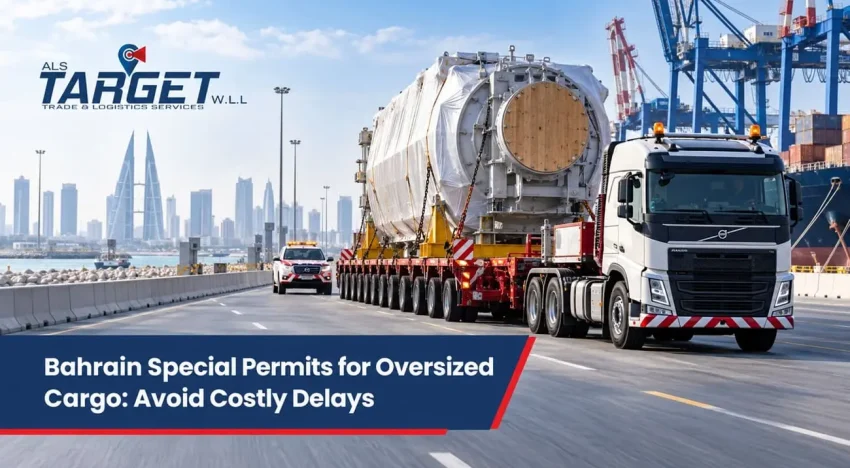
Standard pallet movement within Bahrain is usually quite simple. Transporting a 45-tonne industrial unit, an oversized transformer or long steel structures or heavy construction machinery is a whole other job entirely. Bahrain project and oversized cargo permits are an essential part of the logistics plan once a shipment goes beyond standard road dimensions or weight limits.
Most businesses are unlikely to get delayed by transport alone, when it comes to infrastructure, construction, oil and gas, manufacturing power or marine or industrial projects. Instead, problems often arise sooner: incomplete drawings, cargo measurements that were done incorrectly, an inappropriate trailer choice, or non-approved route/permit submissions happening too near the time of delivery.
This means that companies have to view permitting as part of the project schedule rather than an administrative activity at the end. However, effective communication between the cargo owner, freight forwarder/heavy-haul transporter, port team and relevant authorities can prevent unnecessary storage charges; equipment standby costs; as well as disruption to the project.
When Does Cargo Become an Abnormal Load in Bahrain?
Bahrain’s Ministry of Works classifies a load as abnormal when the combined trailer and cargo exceeds any of the following general limits:
| Measurement | Abnormal Load Threshold |
| Gross weight | Over 40 tonnes |
| Overall length | Over 18 metres |
| Overall height | Over 4 metres |
| Overall width | Over 2.5 metres |
Consequently, even a cargo item that looks manageable inside a project site may require special approval once its transport configuration exceeds one of these limits.
Businesses should calculate the transport dimensions, not simply the dimensions of the cargo itself. For example, a machine that stands 3.4 metres high could exceed the permitted road height after loading onto a trailer. Get details on Warehousing & Storage Services in Bahrain.
Start Permit Planning Before the Cargo Arrives
One of the most common mistakes in oversized cargo transportation in Bahrain is waiting until the shipment reaches the port before reviewing its road transport requirements.
Instead, permit planning should start when the shipping method and equipment dimensions become known.
At an early stage, confirm:
- cargo length, width, height and weight;
- final loaded height on the proposed trailer;
- axle configuration;
- pickup and delivery locations;
- proposed transportation route;
- bridge and road restrictions;
- crane or lifting requirements;
- escort requirements; and
- expected delivery date.
This early assessment gives the logistics team enough time to identify problems while alternatives are still available.
Prepare Accurate Cargo and Trailer Drawings
For abnormal-load applications, technical accuracy matters.
The Ministry of Works abnormal-load application information identifies documents such as the application form, a sketch showing the trailer and load configuration, and a movement route plan where applicable.
Therefore, businesses should avoid submitting approximate measurements simply to start the process.
A useful oversized cargo transport drawing should clearly show the trailer, cargo position, overall dimensions, axle arrangement and relevant load details.
Why does this matter? Because the authority evaluates the complete moving configuration rather than the cargo in isolation.
A wrong trailer selection may change the overall height, axle loading or turning characteristics. Consequently, what initially looked like a suitable route may no longer be practical.
Conduct a Route Survey Before Finalising the Movement
A proper heavy haul route survey in Bahrain can save considerably more money than it costs.
Oversized shipments may encounter obstacles such as:
- bridges and culverts;
- overhead structures;
- traffic signs;
- street lighting;
- narrow junctions;
- roundabouts;
- restricted turning areas;
- overhead cables;
- road works;
- temporary diversions; and
- limited access near the final project site.
Furthermore, extremely heavy cargo requires additional attention to axle loads and structural limits.
The Ministry’s published abnormal-load requirements include conditions concerning bridges, culverts, axle loads and the route followed by heavy cargo. Therefore, transport planning should consider infrastructure capability rather than relying only on road width.
For complicated project cargo, a physical route survey before mobilisation can identify a problem that satellite maps or ordinary navigation software will not show. Looking for a Air Freight Service in Bahrain?
Match the Trailer to the Cargo and Route
Trailer selection directly affects whether a permit application works smoothly.
For instance, low-bed, hydraulic modular and multi-axle trailers distribute heavy cargo differently. A suitable configuration can help control loaded height and axle loading while improving stability.
However, businesses should not select equipment only by asking, “Can this trailer carry the weight?”
The better questions are:
Can it carry the weight while satisfying axle-load requirements, bridge restrictions, route geometry and overall transport dimensions?
This is particularly important for heavy machinery transportation, transformer transport, industrial equipment relocation and project cargo logistics in Bahrain.
Build Permit Lead Time Into the Project Schedule
Bahrain’s Ministry of Works states that abnormal-load applications normally require three working days for processing, calculated from the day following submission. Nevertheless, businesses should avoid treating three working days as the entire planning window.
Complex cargo may require technical clarification, revised documentation, changes to route planning or coordination with other parties.
A practical internal planning schedule could look like this:
| Planning Activity | Suggested Project Allowance* |
| Cargo data verification | 1–2 days |
| Trailer engineering/configuration | 1–3 days |
| Route survey | 1–3 days |
| Permit documentation preparation | 1–2 days |
| Ministry processing reference | 3 working days |
| Final movement coordination | Allow contingency |
*Project allowances are planning examples rather than official government processing commitments.
Therefore, whenever possible, businesses should begin the process well before vessel arrival or the contractual installation date. Get details on Bonded Warehousing Services in Bahrain.
Coordinate Police Escort and Movement Timing
An abnormal-load permit is not simply permission to drive anywhere at any time.
The Ministry’s published conditions state that abnormal-load movements involve police escort and that the General Directorate of Traffic determines movement times and delays. Certain restrictions also apply when oversized cargo crosses bridges or occupies more than one normal traffic lane.
As a result, the approved movement window must align with:
port release → trailer mobilisation → cargo loading → escort arrangement → permitted road movement → site access → unloading.
If just one stage is not ready, the entire operation can slip.
For example, sending a heavy-haul trailer to the port before customs release could create unnecessary standby charges. Similarly, releasing cargo without confirming site crane availability may leave expensive transport equipment waiting.
Keep Customs and Road Permits on Separate Checklists
Another important point is that customs clearance and abnormal-load road approval serve different purposes.
Customs documentation deals primarily with importing and releasing the cargo. Meanwhile, oversized-load permissions relate to safely moving that cargo through the road network.
Accordingly, project managers should maintain separate but coordinated checklists for:
- shipping documentation;
- customs documentation;
- commodity-specific approvals where relevant;
- abnormal-load transport approval;
- traffic or escort coordination;
- site-entry approvals; and
- lifting and unloading arrangements.
This reduces the chance of a team assuming that customs clearance automatically means the cargo is ready for road transport.
Watch Weather and Road Conditions
Project schedules also need operational contingency.
The Ministry’s abnormal-load conditions include restrictions relating to rain, including requirements concerning laden journeys during and after rainfall.
Consequently, a planned movement may sometimes require rescheduling even when documentation has already been completed.
Businesses should therefore avoid creating installation plans with zero float between port release and site delivery.
A small contingency window can prevent major disruption later. Get details on Cargo Shipping Between Bahrain & New Zealand Ports.
Avoid These Common Causes of Permit Delays
Many project cargo delays in Bahrain can be reduced through basic preparation.
Incorrect cargo dimensions
Using manufacturing dimensions rather than loaded transport dimensions can make a permit application inaccurate.
Last-minute permit submissions
Waiting until the vessel arrives increases the risk of port storage, trailer detention and labour rescheduling.
Changing trailers after approval
A different trailer may alter axle configuration, total height or overall length. Therefore, equipment changes should always be reviewed carefully.
Poor route information
A route that works for an ordinary truck may not work for a 30-metre combination.
Missing stakeholder coordination
The port operator, transporter, customs team, escort team, crane contractor and receiving site should all work from the same movement schedule.
How ALS TARGET Supports Project and Oversized Cargo Planning
Managing project cargo in Bahrain requires more than arranging a truck. The movement has to connect international freight, documentation, customs processes, specialised transport equipment and final-site delivery.
ALS TARGET can support businesses by coordinating these logistics stages around the movement plan. Early involvement is especially useful for industrial machinery, construction equipment, plant components and other cargo with non-standard dimensions.
Instead of treating sea freight, customs clearance and inland transport as isolated jobs, businesses can plan the cargo journey as one connected operation.
That approach helps identify permit requirements earlier and reduces unpleasant surprises after cargo reaches Bahrain.
Related Services:
» Cargo Shipping Between Bahrain & Finland Ports
» Cargo Shipping between Bahrain and Denmark Ports
» Cargo Shipping Between Bahrain and Sweden Ports
» Cargo Shipping between Bahrain & Slovenia Ports
» Cargo Shipping between Bahrain and Greece Ports
A Practical Oversized Cargo Planning Checklist
Before approving the transport date, businesses should verify the following:
| Check | Status |
| Final cargo dimensions confirmed | ✓ |
| Gross cargo weight confirmed | ✓ |
| Trailer configuration selected | ✓ |
| Overall loaded dimensions calculated | ✓ |
| Axle configuration reviewed | ✓ |
| Route survey completed where required | ✓ |
| Abnormal-load application submitted | ✓ |
| Traffic/escort coordination confirmed | ✓ |
| Customs release coordinated | ✓ |
| Crane and unloading team confirmed | ✓ |
| Site access checked | ✓ |
| Contingency time included | ✓ |
Although every shipment differs, following a structured process can substantially reduce operational uncertainty.
Related Articles:
» Bahrain Checklist for Urgent Commercial Cargo in Air Freight
» Why Air Cargo Demand Is Surging in the GCC?
» Air Freight vs Sea Freight: Which is Right for Your Shipment?
» Air Cargo Documentation Guide for Bahrain Shippers
» Project Cargo in Bahrain: Planning Heavy or Oversized Shipments Properly
Secure Bahrain Oversized Cargo Permits and Avoid Delays
In the case of Bahrain, moving oversized and project cargo is much more about preparation than speed.
Businesses must determine the right dimensions, appropriate heavy-haul equipment that reviews axle loading, survey the route intended and submit all necessary permit documents within a timely fashion. Simultaneously, single realistic schedule has to be followed by customs clearance, escort arrangements, site access and lifting operations.
For the most part, there is no time until the truck moves for costly delays to start. These start days before when you miss a small requirement.
It can help protect project timelines and transport budgets for companies that have integrated planning permits into their overall logistics strategy as well. Now, by receiving data from incoming ships to cargo feet under coordinated support of ALS TARGET, businesses could lower complexity in managing complicated cargo moves with improved visibility from arrival until final project-site delivery.
FAQs: Bahrain Special Permits for Oversized Cargo: Avoid Costly Delays
ALS TARGET can coordinate key logistics activities surrounding project and oversized cargo, including freight planning, documentation support, customs coordination, specialised transportation planning and delivery scheduling. For abnormal loads, early cargo dimensions and route information are particularly important.
Yes. ALS TARGET can support businesses with coordinated project cargo logistics involving port handling, customs-related planning and specialised inland delivery, depending on the shipment requirements and final destination.
ALS TARGET can assist with logistics planning for heavy machinery and industrial cargo, including coordination of suitable transport arrangements, documentation and delivery requirements according to the characteristics of the shipment.
Ideally, contact ALS TARGET before the cargo leaves its origin, particularly when its dimensions or weight exceed normal transport limits. Earlier planning gives more time to review equipment, routing, documentation and delivery arrangements.
Not necessarily. Abnormal-load movements can be subject to approved timings, escort arrangements, road conditions and other safety requirements. The transport schedule should therefore follow the conditions attached to the relevant approval.
Prepare the cargo description, dimensions, gross weight, photographs or drawings, pickup location, delivery address, expected arrival date and any special lifting requirements. Providing complete information allows the logistics provider to evaluate trailers, routing and permit requirements much more accurately.