


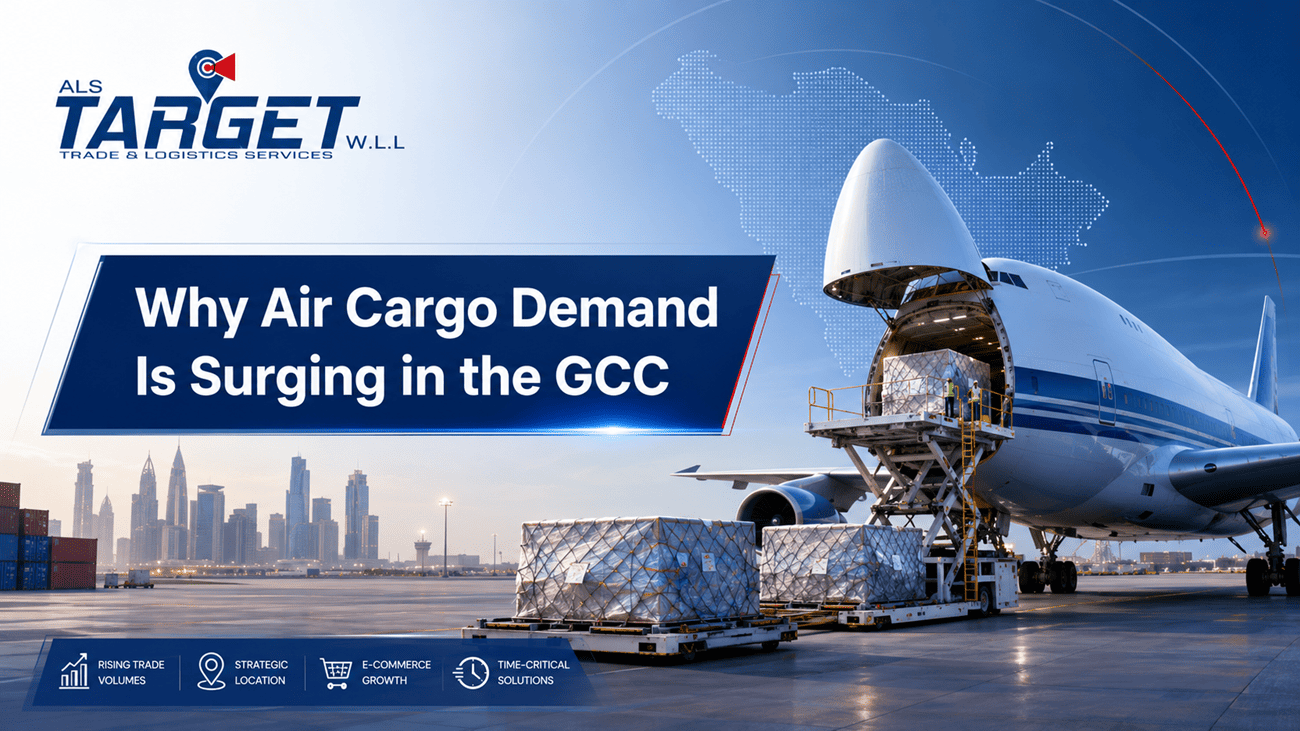
The GCC air cargo market is seeing one of its busier periods in a number of years. No longer are businesses in Bahrain and Saudi Arabia using air freight only to ship critical items. As a result, numerous companies today rely on air cargo services in the GCC for e-commerce fulfillment, pharmaceuticals, automotive parts, electronics, perishables and luxury retail business as well as for urgent industrial supplies.
This is significant for businesses like ALS TARGET, as GCC shippers require quicker turnaround times while making sure their documents and shipments are handled securely from airport to door. Additionally, customers throughout the Gulf have come to anticipate timely delivery, precise tracking and decreased delays in the supply chain. Henceforth, air cargo in the GCC lays out a strategic logistics option and is no more just an expensive fallback solution.
The GCC Has Become a Global Air Freight Crossroad
The Gulf sits between Africa, Asia, and Europe. It therefore has a natural advantage for air cargo operations between nations. Your shipment can clear Mumbai, Beijing or the mainland into a degree of contention (GCC) airstrip and afterward continue to Europe, Africa, or the Levant in close timing.
In addition, the major Gulf airports are also investing in cargo terminals, bonded zones, temperature-controlled facilities and digital customs systems. Importers and exporters can have even more confidence when moving time-sensitive cargo.
An example could be a distributor in Bahrain bringing electronics from Asia that does not wish to await a few weeks for sea freight. In the same vein, a healthcare firm transporting critical medical supplies across the Gulf would select air cargo logistics because it prioritizes speed and securing of products over lowest freight expense. Get details on Air Freight Service in Bahrain.
Key Reasons Air Cargo Demand Is Rising in the GCC
Several forces are pushing demand upward at the same time. However, the biggest drivers are speed, consumer demand, supply chain pressure, and high-value trade.
| Growth Driver | How It Increases Air Cargo Demand | Common Cargo Types |
| E-commerce growth | Faster delivery expectations push sellers towards air freight | Fashion, electronics, small parcels |
| Healthcare expansion | Medical goods need controlled, quick movement | Medicines, devices, lab items |
| Perishable imports | Fresh food needs short transit times | Seafood, fruits, flowers, dairy |
| Industrial projects | Urgent parts reduce downtime | Machinery parts, oil & gas equipment |
| Regional distribution | GCC hubs serve Africa, Asia and Europe | Mixed commercial cargo |
| Sea freight delays | Companies shift urgent stock to air | Retail, spare parts, documents |
E-Commerce Is Changing GCC Freight Patterns
The huge rise can largely be attributed to the GCC cross border e-commerce. Now customers every day order from global websites with the expectation of receiving this merchandise to their doorsteps within days, not weeks. As a result, retailers, market places and fulfillment companies need to move their cargo more quickly.
In addition to this, because online sellers cannot foretell demand accurately all the time. Things can go viral at any moment, stock could run out or a seasonal campaign might put pressure on. In such situations, air freight forwarding assists the businesses in replenishing their stocks on time.
Although sea freight remains cheaper for bulk goods, it does not always suit fast-moving retail. Therefore, companies use air cargo for urgent stock, launch products, premium items and smaller shipments. This trend is especially visible in electronics, cosmetics, fashion accessories and branded consumer goods.
Pharmaceuticals and Healthcare Cargo Need Speed
Healthcare logistics is another strong factor. GCC countries are investing heavily in hospitals, clinics, diagnostics, medical technology and pharmaceutical distribution. Consequently, pharmaceutical air cargo has become more important across the region.
There are many healthcare products that require tightly controlled temperatures. Certain medicines, vaccines, lab samples and medical devices cannot remain in transit for extended periods of time. In addition, delays could result in problems with product quality and patient care.
That’s why logistics providers should provide you proper coordination from pickup to delivery. They require specific documentation, custom assistance, packaging instructions and constant supervision. Within this industry, air cargo is not only quicker but also most of the times, the safest alternative. Looking for a Sea Freight Service in Bahrain?
Perishables Are Moving Faster by Air
The GCC imports a vast amount of its food. Since freshness is key, fresh seafood, fruits, vegetables, flowers as well as meat and dairy and specialty products sometimes travel by air. Businesses such as restaurants, hotels, supermarkets and food distributors rely on accurate delivery.
Premium products – such as fruits from Asia, seafood from India and chilled items from Europe, for example – risk depreciation if the transit takes too long. Consequently, perishables cargo air freight bolsters the Gulf’s hospitality and food services as well as retail sectors.
Consumers in the GCC are also growing increasingly discerning. They want new products, more options and availability, year-round. That is why air cargo is a huge player for ensuring quality and shelf life.
Sea Freight Delays Are Pushing Some Cargo to Air
Although sea freight will always play a role in large cargo shipments, recent supply chain disruptions have prompted many companies to turn to air cargo more than ever before. However, if ocean freight is challenged with route adjustments, port congestion and container delays or longer transit times then the businesses simply cannot afford to wait.
Therefore, importers often split shipments. You will be aware of sending the bulk stock by sea and whenever you need an urgent stock then they send it through the airplane. This strategy safeguards sales, maintains production levels, and keeps in contact with key customers.
A manufacturer, for instance, might ship 90 percent of parts by sea but airlift replacement parts that are time sensitive. Similarly, a retailer may send the major inventory via container while utilizing air cargo for those items built to move fast. GCC freight forwarding for over a year is now commonplace with this blended strategy. Get details on Land Freight Service in Bahrain.
Industrial and Oil & Gas Cargo Needs Urgent Movement
Oil and gas, construction, manufacturing, aviation, marine services and infrastructure still have strong activity across the Gulf economy. Longer downtimes are not permitted in such sectors. Airfreight is how we get what we need whenever a machine part, electrical components or tool must arrive immediately.
In many instances, the cost of air freight is less than production delays. And that is why companies resort to use of time-bound air cargo facilities to keep operations flowing.
ALS TARGET has extensive experience with this style of logistics requirement Some goods especially industrial cargo require documentation basics, HS code clarification, coordination with customs at the airports for clearance and packing assistance then faster inland delivery from airport itself.
GCC Airports Are Building Stronger Cargo Ecosystems
Another reason demand is rising is the quality of GCC airport infrastructure. Airports in the region are not just passenger hubs. They are also cargo gateways with bonded facilities, free zones, cold chain areas and advanced ground handling systems.
This helps companies move cargo faster and with better control. In addition, many GCC countries are improving customs digitisation, trade documentation and logistics zones. As a result, air cargo clearance is becoming smoother when documents are prepared correctly. Get details on Local Distribution Services from Bonded Warehouse in Bahrain.
| GCC Cargo Advantage | Benefit for Businesses |
| Strategic location | Easy connection between Asia, Europe and Africa |
| Modern airports | Faster cargo handling and better capacity |
| Free zones and bonded areas | Easier storage, re-export and distribution |
| Digital customs | Faster document processing when compliant |
| Cold chain facilities | Safer movement for pharma and perishables |
| Road links across GCC | Smooth final-mile and regional trucking options |
Air Cargo Supports GCC Re-Export Trade
The GCC is not only an import market. It is also a re-export hub. Goods arrive from Asia, Europe or America, then move onward to Africa, the Middle East, South Asia or other Gulf markets.
This creates strong demand for air cargo consolidation, transshipment, bonded cargo handling and regional distribution. Moreover, many companies prefer to keep stock in GCC logistics zones because they can serve several markets from one location.
For example, a trader may import electronics into Bahrain or Dubai, store them temporarily, and then re-export to Saudi Arabia, Kuwait or Africa. In this model, speed and customs accuracy are vital.
High-Value Goods Prefer Air Freight
Air cargo is often used for goods that are small in size but high in value. These include electronics, luxury items, aviation parts, jewellery, medical equipment and branded products.
Because these goods carry higher financial risk, companies prefer secure and faster routes. Air freight reduces exposure time, improves tracking, and allows better control. Although the freight rate is higher, the overall risk may be lower.
This is why many businesses choose air freight services in Bahrain and GCC for cargo that cannot sit too long in warehouses, ports or vessels. Get details on Bonded Warehousing Services in Bahrain.
Better Tracking and Digital Visibility Build Trust
Modern shippers want visibility. They need updates, proof of movement, clear shipment status and quick response when something changes. Air cargo fits this need better than many slower modes of transport.
At the same time, freight forwarders now use digital systems for booking, documentation, customs follow-up and shipment communication. This improves planning and helps businesses manage customers more honestly.
For GCC importers and exporters, visibility is no longer a luxury. It is part of good supply chain service.
Cost Is Higher, But Value Can Be Better
Many companies still ask one question: “Is air freight worth the cost?” The answer depends on the cargo. Air cargo is not always the cheapest option. However, it can protect revenue, reduce delay costs, and prevent missed deadlines.
| Situation | Best Freight Choice | Why |
| Large low-value stock | Sea freight | Lower cost per unit |
| Urgent spare parts | Air freight | Prevents operational delays |
| Fresh food | Air freight | Protects shelf life |
| E-commerce orders | Air freight or express | Meets delivery expectations |
| Heavy machinery | Sea or land freight | Better for oversized cargo |
| Medical shipments | Air freight | Faster and safer movement |
Therefore, businesses should not compare only freight rates. They should also consider delay risk, stock value, customer promise, and product sensitivity. Looking for a Duty-Suspended Warehousing Services in Bahrain?
Why Businesses Need an Experienced GCC Air Freight Partner
As demand rises, air cargo also becomes more competitive. Space availability, customs rules, documentation, security screening and packaging requirements can affect the shipment. Therefore, choosing the right freight partner matters.
A reliable GCC air freight forwarder helps with:
- Shipment planning and route selection
- Export and import documentation
- Customs clearance support
- Cargo packing and labelling guidance
- Airport handling coordination
- Door-to-door delivery
- Consolidation and re-export support
- Time-sensitive cargo movement
For businesses moving cargo through Bahrain and the wider GCC, ALS TARGET provides practical freight forwarding support with a focus on compliance, speed and clear communication.
The Future of GCC Air Cargo Looks Strong
Air cargo demand in the GCC is likely to remain strong because the region is building a faster, more connected trade economy. E-commerce will keep growing. Healthcare logistics will need more cold chain movement. Industrial projects will continue to need urgent parts. Moreover, GCC hubs will remain important for global trade routes.
However, companies must plan smarter. They should prepare documents early, understand cargo restrictions, compare routes, and work with experienced forwarders. In today’s market, air cargo success depends on speed and accuracy together.
Related Articles:
» Customs-Controlled Cargo Handling Services in Bahrain
» Import Cargo Storage and Distribution Services in Bahrain
» How to Avoid Customs Delays: A Document Checklist for GCC Importers?
» Complete Checklist: Documents Needed for Air Freight Clearance in Bahrain
» Shipping Dangerous Goods (DG) in the GCC: Safe, Compliant Cargo Movement
The GCC Continues to Lead Air Cargo Growth
There is no single reason for the increase in air cargo demand in the GCC. This is due to the rapid-growth of e-commerce, healthcare needs, perishable imports, industrial urgency, and more efficient airport infrastructure. Time has now become a direct commercial asset as businesses across Bahrain, Saudi Arabia, UAE, Qatar, Kuwait and Oman prefer air freight.
ALS TARGET backs air freight solutions for businesses in need of speedy, safe and coordinated cargo movement across the GCC with pragmatic advice that keeps your logistics on point.
FAQs Why Air Cargo Demand Is Surging in the GCC
Yes. Compared to sea freight, airfreight is far quicker, invaluable for precious or time-critical cargo. But in bulk shipments, sea freight is always cheaper.
Typical goods are electronics, medicines and medical devices, fresh foodstuffs, luxury products, spare parts and documents; also fashion items and e-commerce parcels.
Air freight is commonly utilised by e-commerce companies due to customer expectations of speedy delivery. Airfreight allows your sellers to replenish stock quicker and fulfil cross-border orders faster.
Yes. Air freight is definitely an option for perishable products like seafood, fruits, flowers and dairy & chilled food as it lowers the transitory duration and protects freshness.
Pharmaceutical air cargo is important because many medical goods need quick transit, temperature control and careful handling to maintain product safety.
Air freight usually costs more than sea freight. However, it can save money when delays, stockouts or production downtime would cost more.
Yes. Many companies use air cargo for urgent machinery parts, oil and gas equipment, tools and technical components.
Common documents include commercial invoice, packing list, airway bill, certificate of origin when required, and product-specific permits or approvals.
Yes. ALS TARGET can support air freight forwarding, documentation coordination, customs guidance and cargo movement across Bahrain and the GCC.
A business should choose air freight when the cargo is urgent, valuable, sensitive, perishable, seasonal or needed to avoid costly delays.