


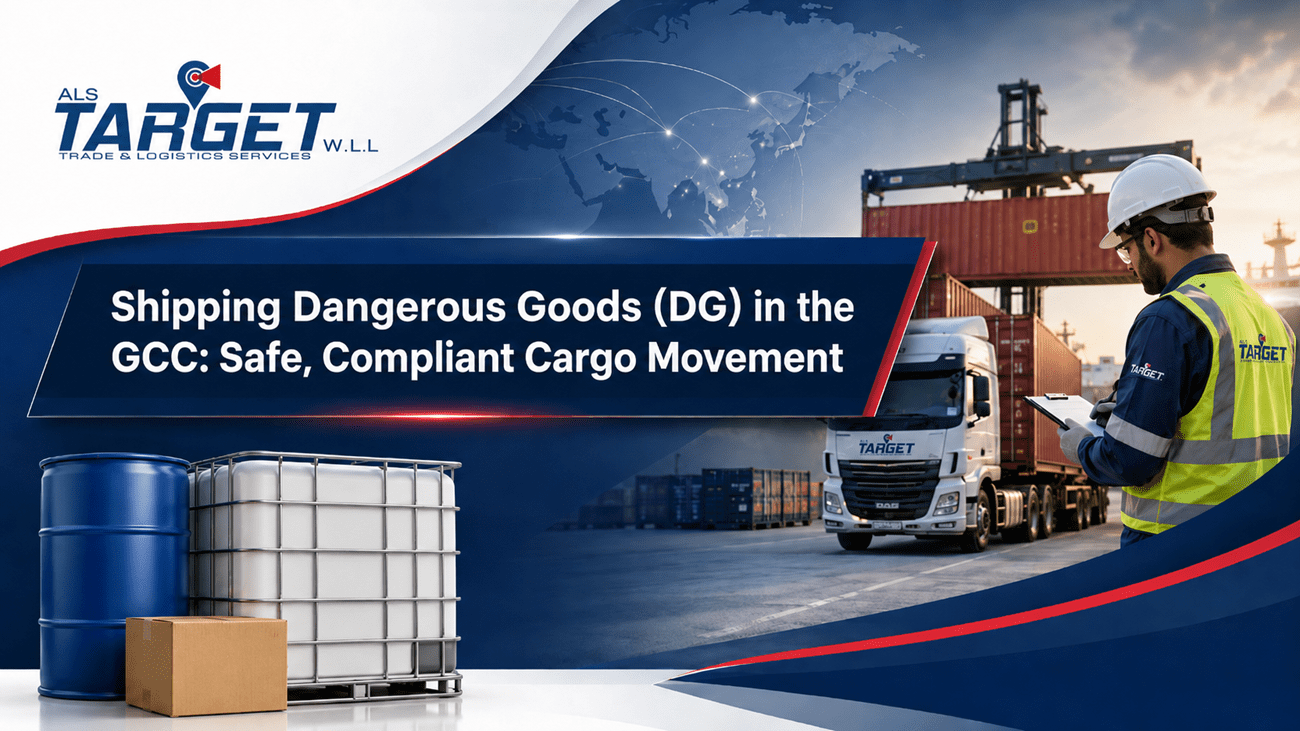
Transporting normal freight across the Gulf already has a lot of details. However, transporting dangerous goods (DG) in the GCC requires a much more refined approach. They cover things ranging from labelling, declaration, packing group, as well as the thorough knowledge of transport routes before shipping; An incorrect label or missing declaration could lead to the shipment being delayed or subject to penalties, which could also create a safety hazard.
Dangerous goods logistics is not just transport for importers, exporters, manufacturers, oil and gas suppliers, chemical traders, laboratories, healthcare distributors() and industrial companies in GCC countries. This includes classification, documentation, trained handling and regulatory coordination — as well as the correct carrier selection.
At ALS TARGET, we support businesses that need reliable movement of hazardous cargo, DG air freight, DG sea freight, and GCC cross-border dangerous goods trucking with practical planning and compliance-led execution.
What Are Dangerous Goods in GCC Shipping?
Dangerous goods are substances or articles that have the potential to poses a risk to people, property, equipment, transport assets and/or environment. The commodities, which do not seem to be unusual in commercial business but require unique controls (chemical, bodily or biological properties).
Common examples include:
- Paints, solvents, adhesives, and resins
- Lithium batteries and battery-powered equipment
- Compressed gases and aerosols
- Cleaning chemicals and disinfectants
- Laboratory chemicals and reagents
- Flammable liquids used in industry
- Corrosive substances
- Medical samples and infectious materials
- Pesticides and agrochemicals
- Oilfield chemicals and drilling additives
Additionally, many businesses do not realise that some regular-looking products fall under DG rules. For example, perfumes, power banks, certain cosmetics, spray cans, automotive batteries, and some temperature-control products may require DG handling. Get details on Air Freight Service in Bahrain.
Why DG Shipping in the GCC Needs Extra Care
The GCC region bridges international trade lanes which pass through Bahrain, Saudi Arabia, UAE, Qatar, Kuwait and Oman. As a result, many companies will be forced to transport dangerous goods across roads, oceans and air in the same supply chain.
Nevertheless, they all adhere to rigorous international standards. In the case of air cargo, IATA Dangerous Goods Regulations serve to guide airlines and forwarders in terms of classification, packing, marking, labelling and documentation for air transport. When it comes to sea freight, for DG cargo the rules apply according to (IMDG Code) and the 2024 Edition with Amendment 42-24 was implemented on 1 January 2026 as mandatory. In the field of international road transport, numerous edition systems refer to ADR principles that contain safety rules for transporting dangerous goods by road.
So for a Bahrain shipment to Saudi Arabia, the UAE or another Gulf market, customs clearance, transport approvals, MSDS checks assessment and packaging route may need to be arranged before loading.
The 9 Classes of Dangerous Goods
Every DG shipment starts with correct classification. Without proper classification, the entire shipment can fail compliance checks.
| DG Class | Type of Goods | Common GCC Trade Examples |
| Class 1 | Explosives | Industrial explosives, detonators |
| Class 2 | Gases | Aerosols, LPG cylinders, compressed gases |
| Class 3 | Flammable liquids | Paint, thinner, solvents, fuel samples |
| Class 4 | Flammable solids | Certain powders, self-reactive materials |
| Class 5 | Oxidising substances and organic peroxides | Pool chemicals, peroxide products |
| Class 6 | Toxic and infectious substances | Medical samples, toxic chemicals |
| Class 7 | Radioactive materials | Specialist industrial and medical isotopes |
| Class 8 | Corrosives | Acids, alkalis, battery fluid |
| Class 9 | Miscellaneous dangerous goods | Lithium batteries, dry ice, environmentally hazardous goods |
Moreover, each product may also have a UN number, proper shipping name, packing group, hazard label, and special handling instruction. As a result, generic descriptions like “chemicals” or “industrial liquid” will not work for DG logistics. Looking for a Sea Freight Service in Bahrain?
Key Documents Required for Shipping Dangerous Goods in the GCC
Documentation controls the shipment before the cargo even moves. In fact, many DG delays happen because the documents do not match the product, packing, label, or transport mode.
| Document | Why It Matters |
| Safety Data Sheet / MSDS | Confirms hazard details, handling, storage, and emergency measures |
| Dangerous Goods Declaration | Declares the DG classification for air or sea movement |
| Commercial Invoice | Supports customs valuation and product description |
| Packing List | Shows quantity, package type, weight, and dimensions |
| UN Packaging Certificate | Proves packaging meets DG standards where required |
| Certificate of Analysis | Often needed for chemicals or regulated products |
| Import / Export Permit | Required for certain controlled goods |
| Transport Emergency Card / Instructions | Helps drivers and handlers respond during incidents |
| Bill of Lading / Air Waybill / CMR | Confirms transport contract and shipment details |
Additionally, GCC customs and border authorities may ask for product-specific approvals. Therefore, importers should never wait until the truck reaches the border or the cargo reaches the terminal.
DG Air Freight in the GCC
If the air freight is urgent, high-value and time sensitive DG air freight will be your choice. But air transport has some of the most stringent controls applied since we need to ensure temperature, pressure and vibration levels at which items are flown, as well as risks to the safety of aircraft.
Some of the different types of DG air cargo involve lithium batteries, medical samples, chemical reagents (usually urgent), aerosols and a limited amount of hazardous items. However, not all DG classes are accepted by all airlines. While some commodities might only be allowed to move by cargo, others could have a limit on the amount of product or routes that can be flown.
Before booking dangerous goods air freight in GCC, businesses should confirm:
- Correct UN number and proper shipping name
- Passenger aircraft or cargo aircraft eligibility
- Quantity limits per package
- Approved packaging instruction
- DG declaration accuracy
- Airline acceptance requirements
- Airport handling restrictions
- Temperature or segregation needs
Furthermore, lithium battery shipments need extra attention because airlines often apply strict acceptance checks.
DG Sea Freight Across GCC Ports
The choice of DG sea freight suits more considerable LIB volumes, industrial chemicals, oilfield supplies, paints & resins, and non-urgent dangerous goods. Sea freight can carry larger quantities than air dropshipping. But accurate IMDG compliance is still mandatory for ports and shipping lines.
The IMDG Code provides the rules for classification, packing, marking, stowage and segregation of dangerous goods laid down in sea transport. With the IMDG 2024 Edition recently made compulsory from 1 January 2026, exporters should be prepared to question whether their product classifications and documentation are still valid before shipping in accordance with older assumptions.
For sea freight, the main checks include:
- Container compatibility
- Segregation from incompatible cargo
- Marine pollutant declaration
- Proper DG placarding on containers
- Terminal acceptance cut-off times
- Shipping line DG approval
- Emergency response information
- Temperature and ventilation needs
In addition, some ports may require pre-approval before DG cargo enters the terminal.
GCC Cross-Border DG Road Transport
Road transport remains essential for DG movement between Bahrain, Saudi Arabia, UAE, Kuwait, Qatar, and Oman. Many businesses use road freight for regional distribution, project cargo support, oil and gas supply, industrial chemicals, and urgent stock transfer.
It does require a trained driver, the right vehicle, correct placards, emergency equipment and customs ready documentation for a GCC cross-border dangerous goods truck. Furthermore, due to local safety controls, some cargo may require route approvals or escort arrangements or special timing.
| Transport Mode | Best For | Main Compliance Focus |
| Air Freight | Urgent, small, high-value DG cargo | IATA DGR, airline acceptance, package limits |
| Sea Freight | Bulk chemicals, industrial cargo, container loads | IMDG Code, stowage, segregation, port approval |
| Road Freight | GCC distribution and cross-border movement | Vehicle safety, driver training, customs documents |
| Multimodal Freight | Complex supply chains across GCC | Matching rules across air, sea, road, and customs |
Therefore, a good DG forwarder does not simply book a truck. Instead, they review the cargo, route, documentation, border requirements, and emergency planning before movement starts.
Common Mistakes That Delay DG Cargo
Although DG rules are clear, businesses still face delays due to small but costly errors. For example, the MSDS may show one hazard class while the invoice uses a vague product name. Similarly, a package may carry the wrong hazard label or no UN marking.
Common mistakes include:
- Using old or incomplete MSDS files
- Not declaring lithium batteries correctly
- Confusing hazardous and non-hazardous chemicals
- Using non-approved packaging
- Missing UN numbers or packing groups
- Incorrect hazard labels or placards
- Booking with a carrier that does not accept that DG class
- Submitting documents too late
- Failing to check import permits
- Mixing incompatible goods in one shipment
As a result, the shipment may get held at origin, rejected by the airline, stopped at port, or delayed at the border. Get details on Dangerous Goods (DG) Logistics.
DG Packaging, Labelling, and Marking
Packaging protects the cargo, handlers, vehicles, aircraft, vessels, and the environment. Therefore, DG packaging must match the product’s hazard level and transport mode.
For many DG shipments, businesses need UN-approved packaging. Additionally, packages may need inner packaging, absorbent material, cushioning, leak-proof closures, orientation arrows, and overpack labels.
Proper marking and labelling may include:
- UN number
- Proper shipping name
- Hazard class label
- Subsidiary risk label
- Orientation arrows
- Cargo aircraft only label, where applicable
- Lithium battery mark, where applicable
- Marine pollutant mark, where applicable
- Overpack mark, where applicable
Importantly, labels must remain visible, durable, and placed correctly. A damaged or hidden label can still cause rejection.
How ALS TARGET Supports Dangerous Goods Shipping in the GCC
ALS TARGET helps companies move regulated cargo with a practical, documentation-first approach. Instead of treating DG as normal freight, our team reviews cargo details before arranging movement.
Our support may include:
- DG cargo assessment based on MSDS and product details
- Air, sea, and road freight planning across GCC routes
- Dangerous goods documentation guidance
- Carrier and shipping line coordination
- Customs clearance support
- Packaging and labelling coordination
- Cross-border transport planning
- Project cargo and industrial DG movement support
- Import and export shipment handling
Moreover, we work with businesses that need dependable support for chemicals, oilfield supplies, industrial products, batteries, and other regulated goods across the Gulf. Looking for a Land Freight Service in Bahrain?
DG Shipping Checklist for GCC Businesses
Before booking your next DG shipment, use this simple checklist.
| Step | Action |
| 1 | Confirm whether the product is dangerous goods |
| 2 | Collect latest MSDS from supplier or manufacturer |
| 3 | Identify UN number, DG class, packing group, and proper shipping name |
| 4 | Select air, sea, road, or multimodal freight |
| 5 | Check carrier acceptance before dispatch |
| 6 | Use approved packaging where required |
| 7 | Apply correct labels, marks, and placards |
| 8 | Prepare DG declaration and customs documents |
| 9 | Check GCC import permits or product approvals |
| 10 | Arrange trained handling and emergency instructions |
Additionally, share cargo details early. Last-minute DG bookings often cost more and face higher rejection risk.
Why Choose ALS TARGET for DG Logistics in the GCC?
Why Choose ALS TARGET — DG shipping is more than just the basics of freight forwarding. It has to be coordinated and clear, handled with care from the point of collection to the point of delivery.
Backed by regional logistics expertise and GCC market insights, ALS TARGET is a trusted partner that helps businesses avoid delays by picking documents right and identifying transport options appropriate for them. Additionally, we know that the logistics involving dangerous goods are often backing key business processes. For this reason we are centred on safe planning, open and honest communication and actionable execution.
Hence, ALS TARGET can steer you through the appropriate process for your shipment whether you are looking for DG air freight in Bahrain, dangerous goods sea freight across GCC ports or cross border hazardous cargo transport.
Related Articles:
» Shipping Dangerous Goods from Bahrain: What Businesses Should Check First?
» Complete Checklist: Documents Needed for Air Freight Clearance in Bahrain
» Bahrain Logistics Trends in 2026: Routing, Risk, and Supply Chain Flexibility
» Project Cargo in Bahrain: Planning Heavy or Oversized Shipments Properly
» Warehousing, Handling, and Last-Mile Delivery in Bahrain Supply Chains
Ensuring Safe & Compliant DG Shipping Across the GCC
To ship dangerous goods (DG) in the GCC, one must ensure proper classification, documentation, packaging and handling with a unified carrier. Yet, by working with the appropriate logistics company, firms can safely move dangerous products with limited hold-ups.
Whether it be from Bahrain, Saudi Arabia, UAE, Qatar, Kuwait and/or Oman or whether traveling by air, sea or road (multimodal), ALS TARGET provides DG freight solutions to those organizations who require a professional approach in meeting these goals.
Before your next shipment moves, talk to ALS TARGET for safe, compliant and well-planned dangerous goods logistics across the GCC.
FAQs About Shipping Dangerous Goods (DG) in the GCC
Dangerous goods are items or substances that may create safety, health, property, or environmental risks during transport. They include chemicals, gases, batteries, corrosives, flammable liquids, and infectious materials.
Yes, many DG items can move by air. However, the shipment must follow IATA Dangerous Goods Regulations, airline acceptance rules, package limits, and correct documentation.
All DG shipment requires an MSDS, commercial invoice, packing list, DG declaration/ transport document and most probably import permits or product approvals.
MSDS or Safety data sheet usually is the first document that you need. It assist to identify the hazard class, handling instructions, emergency measures and transport information.
Yes, lithium batteries can be shipped, but they need correct classification, packaging, labelling, and carrier approval. Air freight rules are especially strict.
A UN number identifies a dangerous substance or article for transport. It helps carriers, customs, and emergency responders understand the cargo risk.
DG air freight suits urgent and smaller shipments but has stricter package limits. DG sea freight suits larger volumes but needs IMDG compliance, port approval, and container segregation.
Yes, DG cargo can move by road across GCC countries when the vehicle, driver, documents, labels, permits, and route planning meet safety requirements.
DG shipments often get delayed due to missing MSDS, wrong labels, incorrect UN numbers, poor packaging, carrier rejection, or incomplete customs documents.
No, not all chemicals are dangerous goods. However, many chemicals need review because their properties may fall under flammable, corrosive, toxic, oxidising, or environmental hazard rules.
The shipper is generally responsible for declaring the goods correctly. However, a qualified freight forwarder can help review documents and guide the shipment process.
ALS TARGET supports DG cargo assessment, documentation coordination, air freight, sea freight, road transport, customs clearance, and cross-border logistics planning across GCC routes.