


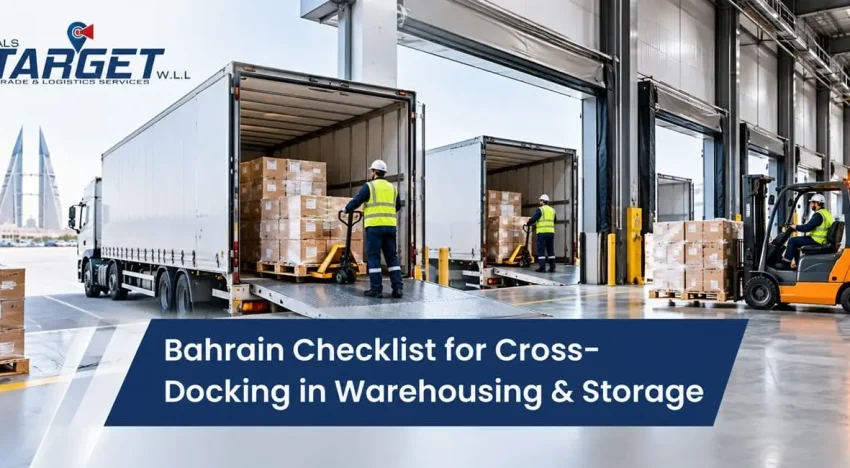
Cross-docking is a method where items being shipped are moved from an incoming vehicle directly onto an outgoing vehicle. Cross-docking requires some processing such as inspection, sorting, and/or bundling of items prior to their shipment.
For all those involved in the supply chain (importers, exporters, retailers, and distributors) the use of a well-organized cross docking checklist will help to minimize the number of times goods are handled unnecessarily; as well as to control costs associated with warehousing; and to provide more reliable delivery times.
At ALS Target we understand that for any company to be successful it must manage its cargo effectively, use its warehouse space efficiently, and deliver goods to both customers in Bahrain and across the GCC Region on-time.
The purpose of this guide is to outline the key things a business must do before it can start accepting, processing, and delivering products via cross-docking.
What Is Cross-Docking in Warehousing and Storage?
Cross-docking is a supply chain management method that involves moving goods from receiving areas to shipping areas without storing them for extended periods of time.
Unlike traditional storage, which stores goods until they are ordered by clients, cross-docking is designed to move freight quickly.
For instance, a shipment arriving at Khalifa bin Salman Port could have products for customers who live in Manama, Riffa and Saudi Arabia. A cross-docking facility can accept the products from the shipment and split them up based on where they need to go, then set up further travel for those items.
Therefore, companies have the opportunity to lower their storage needs and maintain a more agile supply chain. Get details on Warehousing & Storage Services in Bahrain.
Cross-Docking vs Traditional Warehousing
| Feature | Cross-Docking | Traditional Warehousing |
| Storage period | Usually hours to a short staging period | Days, weeks or months |
| Primary activity | Sorting and transferring cargo | Stockholding and order fulfilment |
| Inventory levels | Minimal temporary inventory | Planned storage inventory |
| Handling requirements | Receiving, sorting and dispatch | Receiving, put-away, picking and dispatch |
| Best suited for | Pre-allocated, fast-moving goods | Seasonal and unpredictable demand |
| Main advantage | Faster cargo movement | Greater stockholding flexibility |
The right approach depends on cargo type, order patterns, customs requirements and transportation availability.
Why Cross-Docking Matters for Bahrain’s Logistics Industry
Bahrain is located at a position where companies that provide goods to local and regional customers find that this is a good place to distribute from.
Businesses are linked through the Khalifa Bin Salman Port, Bahrain International Airport, and King Fahd Causeway, which connects Bahrain to Saudi Arabia.
Additionally, the Bahrain Logistics Zone is able to assist companies that are involved in storing products, moving products from point A to point B (cargo handling), and distributing products within a specific region. The proximity of the logistics zone to the largest transportation networks allows companies to manage their incoming and outgoing shipments.
With effective cross-docking services in Bahrain, businesses can minimise repeated cargo handling, improve vehicle utilisation and maintain better shipment visibility.
However, successful cross-docking requires preparation. Without accurate documentation, suitable equipment and reliable transport schedules, a warehouse may simply become another point of delay. Get details on Bonded Warehouse Rental in Bahrain.
Complete Bahrain Cross-Docking Checklist for Warehousing & Storage
1. Verify Shipment Details Before Arrival
The first thing to do is review each incoming shipment prior to the arrival of the truck at the facility.
Confirm that the details for the supplier, purchase order, cargo description, amount, weight and destination are correct.
Also, verify the expected arrival time and notify the warehouse supervisor about any adjustments to your schedule.
Teams can find out what information is missing before starting the process of unloading, with the help of early identification.
2. Prepare Customs Clearance Documents
Customs clearance in Bahrain for all international shipments is an essential step when preparing for cross-docking.
Depending on the shipment and customs procedure, the documentation may include:
- Commercial invoice and packing list
- Bill of lading or air waybill
- Certificate of origin, where applicable
- Customs declaration and supporting references
- Import permits or approvals for regulated goods
The Customs Document Framework of Bahrain requires the submission of precise data regarding both trade and transportation activities; however, the requirement for supporting documentation is dependent upon the nature of the product being imported/exported and the relevant procedure.
Moving products quickly from one vehicle to another will not eliminate your requirement for customs clearance. All businesses need to obtain authorization or release prior to on-going distribution of their products..
3. Confirm Warehouse Space and Dock Availability
In Bahrain, a well-managed warehouse management system (WMS) will include every part of the warehouse such as the loading docks, receiving areas, staging areas, and vehicle parking for shipping.
The employees who work in the warehouse need to make sure there’s enough room for the incoming shipment before it arrives.
In contrast to a pre-packaged product, an oversized machine will require a different means of transportation.
Planning the size of your warehouse depending on what method of shipping you will be using to send out your products can help to prevent crowding within the warehouse and unnecessary movement of items.
4. Inspect Cargo During Receiving
Warehouse workers must inspect each shipment’s condition right after unloading.
Physical quantities are to be checked with the shipping documentation to determine if there are any damaged packages, missing cartons, or incorrect labeling.
In addition to this, photographing the visible damage is beneficial for establishing accountability as well as providing evidence to support claims or investigations should they be required.
5. Sort and Consolidate Shipments
The products may be organized by where they will go, the customers orders, or how they will travel after being inspected.
The different suppliers who send products to the same retailer may have their separate product shipments combined into one single product shipment leaving the warehouse.
Businesses will be able to cut down on unnecessary trips being made by vehicles as well as make their transportation systems more efficient.
6. Maintain Accurate Inventory Visibility
Although cross-docking can reduce the amount of space needed for storage, managing inventory correctly is still a very important part of the process.
The Warehouse team needs to document when cargo arrives, how much of it is received, any issues with the way it was handled and when it has left.
Barcode scanning, or another suitable warehouse management system, will be able to help you complete this.
Furthermore, companies can utilize digital shipping records to track products as their customers inquire about the status of their orders.
7. Check Cargo Safety and Handling Requirements
Prior to transporting your shipment, the warehouse personnel must decide upon the appropriate equipment to utilize in order to safely move your shipment, as well as all other safety measures that will be implemented during this process.
Heavy cargo being transported may require the use of a forklift or other pallet handling equipment. Fragile items being transported should have additional protection.
Temperature-sensitive products may also require controlled handling conditions.
Properly educating employees about the safe manner of handling materials, appropriate loading techniques, and the correct use of equipment can help prevent employee injuries at work as well as prevent damage to items being transported.
8. Coordinate Outbound Transportation
Cross-docking works best when inbound and outbound transport schedules match.
Therefore, make sure that trucks are available for pickup, drivers have clear directions to their destinations, customers will receive their shipments on time and that the routes to be driven are known prior to shipping.
Operators who distribute GCC from Bahrain will need to take into account the documentation required for crossing borders, the limitations on transportation of goods and potential delays in clearing customs.
The smooth flow of communication between the warehousing department and transportation department will assist in preventing unnecessary delays for shipments.
9. Complete Dispatch Verification
The warehouse staff must conduct an end-of-process inspection prior to sending the outward bound vehicle off.
Confirm order number, delivery address, number of boxes/cartons, license plate number and proof-of-delivery/hand-over information.
Ensure also that staff appropriately secure the cargo, and accurately complete all required dispatch documentation.
This last checkpoint will help to eliminate misdelivered packages and improve the ability to track shipments.
10. Monitor Performance and Improve Operations
Finally, businesses should review their cross-docking performance regularly.
Track how fast you get your products shipped out, how accurate your orders are when they leave, if any products are damaged during the process of getting them to customers, and if there have been delays in getting products to customers.
A basic performance dashboard will help you see trends of common issues in your business, as well as enable warehouse managers to improve how they operate. Get details on Bonded Warehouse & Fulfilment Services in Bahrain.
Cross-Docking Performance: Example Operational Targets
The following figures are illustrative planning targets, not guaranteed industry standards. Actual performance depends on shipment volume, cargo type and customs requirements.
| Performance Indicator | Example Target | Business Benefit |
| Cargo receiving accuracy | 99% or higher | Fewer inventory discrepancies |
| Warehouse processing time | 2–6 hours | Faster shipment movement |
| Dispatch accuracy | 99% or higher | Fewer delivery errors |
| Cargo damage rate | Below 1% | Reduced replacement costs |
| On-time outbound dispatch | 95% or higher | Better delivery reliability |
Companies should establish their own targets using actual warehouse operating data.
Related Service:
» Cargo Shipping between Bahrain & Cambodia Ports
» Cargo Shipping Between Bahrain & Vietnam Ports
» Cargo Shipping between Bahrain & Thailand Ports
» Cargo Shipping between Bahrain & Japan Ports
» Cargo Shipping between Bahrain & Taiwan Ports
Common Cross-Docking Mistakes Businesses Should Avoid
Even a well-equipped facility may experience delays when planning is inadequate.
The two most frequent errors are when a company schedules its outbound truck before it confirms if all products will be ready for shipping, and when a company takes in a shipment but doesn’t correctly label the packaging and/or provide the correct delivery address.
In addition to the lack of sufficient staging space, ineffective communication, and the lack of customs documentation may also negatively impact the efficiency of warehouse operations.
Businesses can avoid these problems by maintaining accurate shipping records, verifying that their transportation schedule is up to date, and clearly delineating each individual’s responsibility within the system.
Related Articles:
» Bahrain Checklist for Long-Term Storage in Warehousing & Storage
» Bahrain Checklist for Short-Term Storage in Warehousing & Storage
» Warehousing, Handling, and Last-Mile Delivery in Bahrain Supply Chains
» Air, Sea, and Land Freight: Choosing the Right Shipping Method for Your Cargo
» Air Freight vs Sea Freight: Which is Right for Your Shipment?
How ALS TARGET Supports Warehousing and Logistics in Bahrain
Companies can better manage their cargo handling, customs processes and distribution functions when they choose a reliable logistics provider in Bahrain.
ALS TARGET is a logistics company that provides its customers with warehouse services, cargo handling services, customs coordination and transportation support. The target audience of ALS TARGET is companies that are based in Bahrain as well as companies that operate within the region.
Its published services include: Bonded Warehousing at the Bahrain Logistics Zone (BLZ) which supports import cargo; Customs Controlled Storage; Staged Release and; GCC Distribution Planning.
Businesses have options for selecting the best type of warehousing arrangement that will meet their shipping needs, cargo type, and delivery specifications.
For cross-docking operations, early communication with ALS TARGET will assist in determining whether to use direct transfer of cargo, short term storage (staging), or standard warehousing as the most efficient way to handle your shipment.