


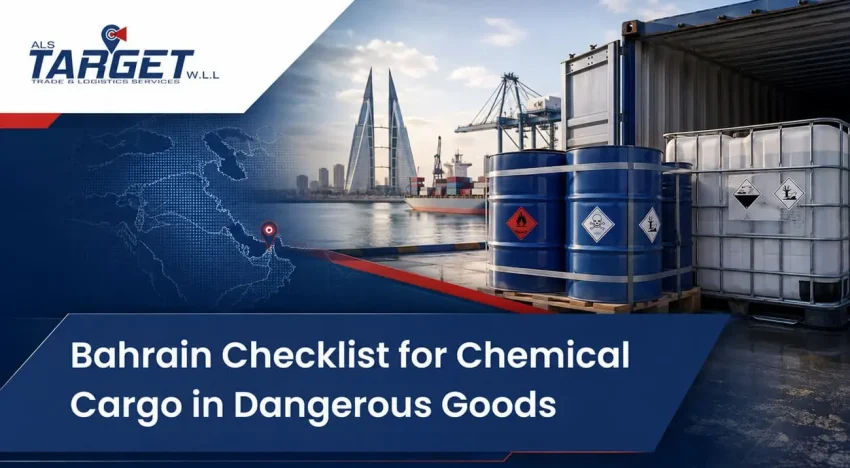
Transporting chemicals in Bahrain is different from transporting any regular commercial goods. An apparently innocuous product in a drum, bottle, IBC or carton can be classified as Dangerous Goods (DG) under international law because it is either flammable, corrosive, toxic (and therefore derived from Europe), oxidising or reactive.
From day one careful preparation matters for companies importing or exporting at Bahrain International Airport, Khalifa Bin Salman Port, or Bahrain’s road freight network. Bahrain also imposes local criteria regarding the import, customs release, storage and inland transport of chemicals. Hence it is not enough to check only for shipping lines or airline rules.
This Bahrain chemical cargo checklist promotes practical checklists for businesses that wish to eliminate delays, rejected bookings and customs issues.
What Counts as Dangerous Goods Chemical Cargo?
Dangerous Goods are substances or articles capable of presenting a risk to people, property, aircraft, vessels or the environment during transportation.
Common chemical cargo may fall within DG classes such as:
| DG Class | Typical Hazard | Chemical Cargo Examples |
| Class 2 | Gases | Aerosols, compressed gases |
| Class 3 | Flammable liquids | Paints, solvents, some adhesives |
| Class 4 | Flammable solids | Certain powders and reactive substances |
| Class 5 | Oxidising substances | Peroxides and oxidisers |
| Class 6 | Toxic substances | Certain industrial chemicals |
| Class 8 | Corrosives | Acids and alkalis |
| Class 9 | Miscellaneous DG | Environmentally hazardous substances and other regulated materials |
However, the trade name alone cannot reliably determine classification. Instead, shippers should identify the exact composition, UN number, Proper Shipping Name, DG class, subsidiary risk and packing group, where applicable. Get details on Dangerous Goods (DG) Logistics in Bahrain.
1. Start With an Updated Safety Data Sheet
The Safety Data Sheet (SDS/MSDS) should be one of the first documents reviewed before requesting a freight quotation.
Ideally, an SDS should clearly show information such as:
- Product and manufacturer identification
- Chemical composition
- Hazard identification
- Physical and chemical properties
- Transport classification
- UN number
- Proper Shipping Name
- Hazard class
- Packing group, when relevant
- Flash point, if applicable
- Emergency and spill information
This is particularly important in Bahrain. The Supreme Council for Environment’s chemical licensing service requires an MSDS showing 100% of the chemical composition when companies apply to import chemicals for sale or trade. An active Bahrain Commercial Registration covering the relevant chemical activity is also required.
Therefore, submitting a vague commercial data sheet instead of a proper SDS can cause unnecessary questions later.
2. Confirm the Correct UN Number and Proper Shipping Name
Never choose a UN number simply because another shipment used the same one.
For example, two cleaning liquids can have completely different transport classifications depending on their ingredients and concentration.
Your DG specialist should confirm:
UN Number → Proper Shipping Name → Class → Subsidiary Risk → Packing Group → Packing Instruction
These details affect virtually everything that follows, including packaging, labels, documentation, carrier approval and segregation.
Incorrect classification is one of those mistakes that can travel through the entire shipping process before somebody finally notices it at cargo acceptance.
3. Decide Whether the Cargo Will Move by Sea, Air or Road
The transport mode changes the compliance framework.
Chemical Cargo by Sea from Bahrain
Packaged dangerous goods carried by sea generally need to meet the International Maritime Dangerous Goods Code (IMDG Code). The 2024 Edition incorporating Amendment 42-24 became mandatory on 1 January 2026.
The IMDG framework covers areas including classification, packaging, container transport, stowage and the segregation of incompatible dangerous substances.
Chemical Cargo by Air from Bahrain
Air shipments follow stricter quantity and packaging limitations.
Bahrain’s aeronautical requirements state that transportation of dangerous goods must comply with the ICAO Technical Instructions together with applicable Bahrain Civil Aviation requirements. Some categories require prior permission from Bahrain Civil Aviation Affairs.
Additionally, airlines and freight forwarders commonly apply the IATA Dangerous Goods Regulations (DGR). The 67th Edition applies for 2026.
IATA DGR addresses classification, packing instructions, packaging specifications, marking, labelling, documentation, handling and training.
Consequently, a chemical shipment accepted for ocean freight cannot automatically be assumed to be acceptable for air freight. Looking for a 3PL Bonded Warehousing Services in Bahrain?
4. Check Whether Bahrain Import Approval Is Required
Before shipping chemicals into Bahrain, importers should determine whether approval from the Supreme Council for Environment (SCE) or another competent authority is required.
For SCE chemical import evaluation, Bahrain’s government service information lists requirements including:
- Active Bahrain Commercial Registration
- Completed application
- Appropriate chemical trading activity
- MSDS with complete composition information
Bahrain cites several legal instruments governing hazardous and restricted chemicals, including Ministerial Resolution No. 4 of 2006 regarding hazardous chemical management.
Some products can also fall under separate regulatory systems. For instance, pesticides have their own pre-import permit requirements.
So, do not send the cargo first and investigate the permit later.
5. Use Suitable UN-Specification Packaging
Dangerous chemicals need packaging suitable for their exact classification.
Depending on the commodity, the shipment may use:
- UN-approved drums
- Jerricans
- Combination packaging
- IBCs
- Cylinders
- Specialised chemical containers
- Absorbent and cushioning materials
The permitted package type also depends on the packing group.
Generally, Packing Group I represents a higher degree of danger than Packing Groups II and III. However, shippers should always follow the applicable packing instruction rather than choosing packaging based solely on the packing-group number.
Furthermore, inner containers should be compatible with their contents. A strong outer drum does little good if the chemical attacks the inner bottle, seal or closure.
6. Inspect Every Chemical Package Before Dispatch
Before cargo leaves the shipper’s facility, conduct a physical inspection.
Practical DG Packaging Check
| Checkpoint | What to Verify |
| Container | No cracks, corrosion or damage |
| Closures | Correctly fitted and tightened |
| Leakage | No visible seepage or staining |
| Packaging approval | Correct specification for commodity |
| Labels | Correct DG hazard labels |
| UN marking | Visible and accurate |
| Orientation arrows | Used where required |
| Overpack | Properly marked when applicable |
Even perfectly prepared documents cannot compensate for leaking or damaged DG packaging. Get details on Cargo Storage and Distribution Services in Bahrain.
7. Apply Correct Marks and Hazard Labels
DG packages normally need regulatory markings that communicate their risks quickly.
Depending on the material, these can include:
UN number, Proper Shipping Name, hazard label, subsidiary-risk label, package orientation arrows, environmentally hazardous substance mark and overpack markings.
For air cargo, IATA specifically incorporates requirements covering classification, packing, marking, labelling and documentation.
Do not cover hazard labels with wrapping film, shipping stickers or pallet bands.
Additionally, labels need to remain readable throughout handling and transportation.
8. Prepare Dangerous Goods Documentation Carefully
Documentation mistakes are a common reason DG shipments face rejection.
For shipping by sea, shippers may require the relevant IMDG-compliant dangerous-goods transport paperwork.
Most dangerous goods that are subject to the regulations via air freight require a Shipper’s Declaration for Dangerous Goods, in addition to the Air Waybill. IATA declaration requirements include shipper and consignee details, aircraft limitations, the nature and quantity of dangerous goods, packing details/resources/packing instructions/sealable bags/authorisations/shippers certification.
In March 2026, IATA also introduced DG Digital to further support electronic creation and validation of dangerous-goods declarations. According to IATA, improper or incomplete declarations still account for a large portion of shipments being rejected.
Therefore, document verification before cargo pickup is worth the extra time.
9. Do Not Ignore Segregation Rules
Some chemicals simply should not travel beside each other.
The IMDG Code includes detailed requirements for segregation of incompatible dangerous goods, and the individual Dangerous Goods List entry can override more general segregation provisions.
For example, acids, alkalis, oxidisers, flammables and other reactive substances may require specific separation depending on their classification.
This becomes especially important when consolidating several chemical products into one container.
A freight forwarder should check every UN entry rather than assuming that products within the same broad industrial category can share a container.
10. Arrange Bahrain Customs Clearance Documentation Early
For customs release of chemicals and refrigerants, Bahrain’s government service directory lists documents such as the:
- Customs declaration
- Commercial invoice
- Packing list
- Original insurance policy
- Inspection manifest
- Equipment catalogue, when applicable
The service is coordinated through the Supreme Council for Environment and Customs Affairs, and applications are handled through the OFOQ system. The government page currently lists a fee of BHD 5 per chemical for that particular chemical customs-clearance service.
Nevertheless, requirements and charges can vary depending on the commodity, authority and shipment type. Therefore, importers should confirm the applicable requirements before dispatch. Looking for a Bonded Warehousing Services in Bahrain?
11. Plan DG Transport After Port or Airport Clearance
Compliance does not finish when a container comes out of Khalifa Bin Salman Port or chemical cargo leaves Bahrain International Airport.
Certain vehicles used for transporting chemicals and hazardous materials in Bahrain need regulatory approval. Bahrain’s Civil Defence service lists requirements including a valid vehicle record, material import permit, technical documentation for tanks where applicable, emergency instructions and evidence of driver firefighting training.
Therefore, your Bahrain dangerous goods logistics plan should cover both international transport and the final inland movement.
12. Check Chemical Storage Requirements
If dangerous chemical cargo will stay in a Bahrain warehouse before distribution, confirm whether the storage location has the relevant approval.
Bahrain’s Civil Defence provides a no-objection licensing service for hazardous-material storage facilities. Documents can include the Commercial Registration, SDS, names and annual quantities of materials, storage-site information and location maps.
This step is sometimes overlooked when businesses focus mainly on customs clearance.
However, importing a chemical successfully does not automatically mean it can be stored anywhere.
Related Services:
» Cargo Shipping Between Bahrain & Australia Ports
» Cargo Shipping between Bahrain & New Zealand Ports
» Cargo Shipping Between Bahrain & Peru Ports
» Cargo Shipping Between Bahrain & Colombia Ports
» Cargo Shipping between Bahrain and Chile Ports
Quick Bahrain Dangerous Goods Chemical Cargo Checklist
Before releasing your chemical shipment, confirm:
| Requirement | Status |
| Current SDS/MSDS available | ✓ |
| Complete chemical composition confirmed | ✓ |
| UN number verified | ✓ |
| Proper Shipping Name checked | ✓ |
| DG class and subsidiary hazard identified | ✓ |
| Packing group confirmed | ✓ |
| Bahrain import approval checked | ✓ |
| Correct UN packaging used | ✓ |
| Marks and hazard labels inspected | ✓ |
| IMDG/IATA documentation completed | ✓ |
| Carrier DG acceptance obtained | ✓ |
| Segregation requirements checked | ✓ |
| Bahrain customs documents ready | ✓ |
| Inland DG vehicle requirements checked | ✓ |
| Storage approval confirmed where relevant | ✓ |
| Emergency contacts and procedures available | ✓ |
Related Articles:
» Bahrain Checklist for Urgent Commercial Cargo in Air Freight
» Bahrain Logistics Solutions: Seamless Air Freight, Sea Freight & Warehousing
» Bahrain Logistics Trends: Routing, Risk, and Supply Chain Flexibility
» Why Air Cargo Demand Is Surging in the GCC?
» Bahrain Checklist for LTL Groupage in Land Freight
Why Work With an Experienced Dangerous Goods Freight Forwarder in Bahrain?
Shipping dangerous goods in Bahrain may be more than just reserving space on an airline or a shipping line.
Shippers may have to organize classification, packaging, DG declaration, permits, customs clearance, carrier approval and port or airport handling as well as inland transportation (as domestic transport )and warehouse compliance.
ALS TARGET provides a complete suite of Dangerous Goods logistics services for businesses seeking systematic chemical cargo shipping in Bahrain. Cargo visibility before the booking also enables logistics teams to find building potential documentation or handling issues in order to mitigate unnecessary shipment disruption.
And regardless of whether your freight is heading from Bahrain to GCC states, Europe, Asia and the USA, or some new global objective, early DG arranging enables each stakeholder with a more clear perspective of what really is being transported.
And most importantly of all, never assume that just because a previous shipment was OK this time another shipment will be also fine. Details may vary, due to regulations, carrier restrictions and the composition & quantities of products.
To safely transport chemical cargo: classify first, document correctly and only book once the DG requirements are understood.
FAQs: Bahrain Checklist for Chemical Cargo in Dangerous Goods
Sometimes. However, their IMDG segregation requirements must first be checked because incompatible substances may require separation or may not be permitted together.