


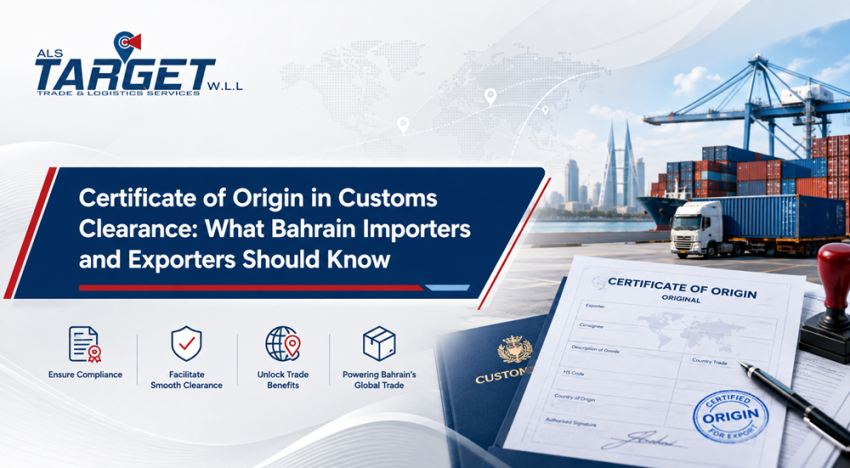
The amount of paperwork involved in moving goods across borders can sometimes be worse than the cargo itself for businesses. COO or Certificate of Origin is one of the documents that impacts customs clearance in Bahrain regularly. It indicates to the customs authorities where the goods were produced, manufactured or have undergone substantial transformation.
Bahrain importers and exporters the certificate is more than just regular shipping papers. Often, it assists customs in determining if the items being imported are eligible for preferential tariff treatment, is the subject of trade restrictions or whether shipments match what is declared on other commercial documentation. Goods subject to an applicable proof-of-origin requirement in accordance with regional and international trade agreements are still subject to the GCC Unified Customs Regulation for imported goods.
Hence learning the way a Certificate of Origin works may assist Bahrain corporations keep away from documentation queries, customs delays, evaluations of extra obligations or storage expenses.
What Is a Certificate of Origin?
A Certificate of Origin is a document used in the world of international trade that declares where goods have been sourced. It is, as explained by Bahrain Chamber of Commerce and Industry (BCCI), a commercially significant document that shows the origin of exported goods which are often required on imports in international trade transactions.
A consignment, for instance, would leave a warehouse in the UAE although it was really folded in Germany. This means: Depending on the applicable origin guidelines, Germany could still be a place of origin.
This is significant because customs authorities are generally concerned with the economic nationality of goods and not the port or country of dispatch. Get details on Duty-Suspended Warehousing in Bahrain.
Why Is a Certificate of Origin Important in Bahrain Customs Clearance?
The Certificate of Origin can influence several parts of the customs process. Most importantly, it helps authorities verify whether the goods qualify for a particular customs treatment.
For Bahrain traders, the COO may support:
- Customs duty assessment
- Preferential tariff claims
- Verification of the country of manufacture
- Compliance with trade agreements
- Import restriction checks
- Customs documentation consistency
- Buyer or bank requirements
- Export documentation and trade finance
Moreover, some importing countries may insist on an officially certified Certificate of Origin even when preferential duty is not being claimed.
As a result, exporters should always confirm the destination country’s documentation requirements before dispatching cargo.
Preferential vs Non-Preferential Certificate of Origin
Not every COO serves the same purpose.
|
Type of Certificate |
Main Purpose |
Typical Use |
|
Non-preferential Certificate of Origin |
Confirms where goods originate |
General imports and exports |
|
Preferential Certificate of Origin |
Supports reduced or zero customs duty where an agreement applies |
Trade under eligible FTAs or regional arrangements |
|
GCC Certificate of Origin |
Supports qualifying GCC-origin goods |
Trade between eligible GCC states |
|
Agreement-specific COO |
Confirms compliance with the origin rules of a particular agreement |
Eligible trade with agreement partners |
A non-preferential COO normally confirms origin but does not automatically provide any tariff reduction.
In contrast, a preferential Certificate of Origin may allow qualifying goods to receive customs concessions. However, simply presenting the certificate does not guarantee preferential treatment. The goods must also satisfy the relevant rules of origin. Looking for a Cargo Bahrain & Australia Ports.
GCC Certificate of Origin for Bahrain Businesses
Bahrain is a part of the GCC customs union framework. For businesses trading qualifying goods with other GCC states, therefore paying particular attention to GCC origin requirements is crucial.
According to Bahrain’s official eGovernment service, a Certificate of Origin (CO) for national GCC products may be used as supporting documentation for customs-duty exemption on the export of qualifying goods from one GCC country to another by virtue of economic ties established under the Unified Economic Agreement.
Traders should not presume however that simply because the product was shipped from Bahrain that every such good is automatically a Bahrain-origin or GCC-origin good.
It could depend on the actual manufacturing process, local value addition, production inputs, tariff classification and applicable rules.
Accordingly, enterprises involved with Bahrain-Saudi Arabia cargo, Bahrain-UAE shipments, or other GCC routes must ensure that there is product qualification before declaring preferential origin.
Bahrain’s Other Preferential Origin Arrangements
Bahrain businesses may also encounter different Certificates of Origin depending on the destination and relevant agreement.
For example, Bahrain’s government portal provides Certificate of Origin services related to trade arrangements between the GCC and the European Free Trade Association, covering Iceland, Switzerland, Norway, and Liechtenstein. Eligible traders may obtain customs exemptions subject to the agreement’s requirements.
Likewise, there is a special service for Certificate of Origin under the GCC-Singapore Free Trade Agreement.
Moreover, Bahrain issues origin certificates under the Arab agreement for trade facilitation between Arab countries thus permits customs-tax exemption on eligible exports to the different Arab markets that comply with the rule of origin.
Thus, which certificate is correct largely depends on the final destination of the cargo and how the goods meet with the applicable origin rules. Get details on Warehousing & Storage Services in Bahrain.
How to Obtain a Certificate of Origin in Bahrain
With regard to commercial Certificates of Origin, online services are available for Bahrain Chamber’s members.
The Bahrain Chamber mentioned that in its general guidelines for applicants, a validly-held membership is needed. Also, it should be signed by the merchant or authorized person in order to affirm that all information supplied was correct.
To initiate the digital process at the Chamber, applicants will need to enter details like the invoice number, date, amount of goods, currency and importer particulars. Then the applicant uploads the commercial invoice and submits it for assessment.
A typical workflow looks like this:
Prepare shipment details → Check origin eligibility → Prepare commercial invoice → Apply for COO → Obtain certification → Include COO in customs document set → Submit for customs clearance
Because different trade agreements have different conditions, exporters should identify the correct certificate before applying.
Certificate of Origin Fees in Bahrain
The Bahrain Chamber currently calculates COO service fees according to the value of the commercial invoice.
|
Commercial Invoice Value |
Published COO Fee |
|
BD 1 – BD 1,000 |
BD 5 |
|
BD 1,001 – BD 5,000 |
BD 10 |
|
BD 5,001 – BD 10,000 |
BD 20 |
|
BD 10,001 – BD 20,000 |
BD 30 |
|
BD 20,001 – BD 100,000 |
BD 40 |
|
BD 100,001 and above |
BD 50 |
These are the Bahrain Chamber’s published Certificate of Origin service fees as of 2026.
Nevertheless, businesses should check current charges when filing because service fees and administrative procedures can change.
Details That Should Match Across Customs Documents
One of the most common causes of customs queries is inconsistency between documents.
Therefore, importers and exporters should compare the COO against the commercial invoice, packing list, bill of lading or air waybill, customs declaration, and product description.
Key information should normally remain consistent:
|
Information |
COO |
Invoice |
Packing List |
Transport Document |
|
Exporter name |
✓ |
✓ |
Usually |
✓ |
|
Importer/consignee |
✓ |
✓ |
Usually |
✓ |
|
Country of origin |
✓ |
Often |
Sometimes |
Sometimes |
|
Goods description |
✓ |
✓ |
✓ |
✓ |
|
Quantity |
✓ |
✓ |
✓ |
✓ |
|
Invoice reference |
Usually |
✓ |
Sometimes |
Sometimes |
|
Gross/net weight |
If required |
Sometimes |
✓ |
✓ |
Even a small discrepancy can lead customs to request clarification.
For instance, if the invoice says “aluminium fittings” while the COO describes the cargo only as “metal products”, customs may ask for better product identification. Looking for a Bahrain to UAE Road Freight Service.
Common Certificate of Origin Mistakes
Several mistakes appear repeatedly in international shipments.
Declaring the shipping country as the origin
The country of export is not automatically the country of origin. Goods shipped from a Bahrain warehouse may have originated elsewhere.
Using the wrong preferential certificate
A company may apply for a standard COO when an agreement-specific certificate is required. Consequently, the importer could lose a potential customs preference.
Incorrect HS classification
Origin rules can depend on the HS code. Therefore, an incorrect tariff classification may also affect the origin assessment.
Mismatched invoice information
Differences in quantity, value, product description, exporter details, or invoice numbers can trigger document checks.
Applying too late
Waiting until the cargo reaches the destination port can create delays, particularly when the original or certified document is required before customs release.
Can Customs Reject a Certificate of Origin?
Yes. Customs may question or reject an origin claim if documentation appears incomplete, inconsistent, inaccurate, or does not satisfy the applicable trade agreement.
The GCC customs framework allows customs authorities to request relevant supporting documents where necessary.
Therefore, businesses should retain documents supporting how the origin was established. These may include supplier declarations, manufacturing records, bills of materials, production details, invoices, and other evidence.
Moreover, exporters should avoid making an origin statement purely because goods were purchased locally.
Related Services:
» GCC & Bahrain to Saudi Arabia Road Freight Service
» Bonded Trucking from Bahrain Airport to Warehouse
» Bonded Warehousing for Industrial Cargo in Bahrain
» Warehousing & Storage Services in Bahrain.
» Bonded Warehousing for Retail Cargo in Bahrain
How Certificate of Origin Problems Cause Customs Delays
A COO problem may appear small at first. However, it can quickly affect the overall shipment.
For example:
Incorrect origin → Customs query → Preferential duty held → Supporting documents requested → Cargo remains uncleared → Storage or demurrage risk increases
Consequently, document verification before shipment often costs far less than correcting paperwork after cargo reaches the port.
This becomes particularly important for high-value cargo, project shipments, industrial machinery, FMCG, raw materials, and time-sensitive commercial goods.
Why Bahrain Businesses Should Plan Origin Before Shipping
Companies frequently treat the Certificate of Origin as a document that can be prepared after the commercial invoice. However, businesses involved in regular international trade should consider origin much earlier.
Before accepting an overseas purchase order, exporters can ask:
Which origin certificate does the buyer require? Does the product qualify? Which authority issues it? Are supporting manufacturing documents available?
Likewise, Bahrain importers should verify origin documents with overseas suppliers before cargo departs.
This simple step can reduce clearance surprises significantly.
In fact, Bahrain Chamber reported issuing 6,497 Certificates of Origin during the first half of 2026, with more than half relating to exports to Saudi Arabia, the UAE, and Kuwait. The figures show how important origin documentation remains in Bahrain’s regional trade activity. Get details on GCC & Bahrain to Dubai trucking service.
How ALS TARGET Can Support Customs Documentation
For importers and exporters, smooth customs clearance depends on much more than transporting cargo from one point to another.
ALS TARGET can assist companies with shipment arrangements, document verification, freight forwarding processes and customs clearance in a smooth manner across Bahrain. With the ability to look up shipping documents prior to physical movement of cargo, companies are in a much better position to identify inconsistencies beforehand rather than after an item arrives.
Additionally, the past experiences have shown us that freight and customs assistance during shipments which involve multiple suppliers, several hs codes, cross border GCC transport, sea freight or urgent air cargo is where co-ordinated effort/directives clearly shine.
This means that whether your goods are entering into Bahrain through Khalifa Bin Salman Port, Bahrain International Airport or travelling through GCC road borders, the correct documentation needs to be kept a part of the shipment plan right from the beginning.
Related Articles:
» Customs Clearance in Bahrain
» Jeddah Port Customs Documents
» Shipping Dangerous Goods from Bahrain
» Cost-Saving Sea Freight for Small Businesses in Bahrain
» Land Freight from Bahrain to Saudi Arabia
Final Thoughts
Although the Certificate of Origin for Bahrain customs clearance may seem a clear and straightforward document, it could influence duty treatment, compliance, and cargo release directly.
Importers must confirm origin information prior to suppliers shipping the goods. Similarly, exporters should identify that they require Standard COO or prefer to get an agreement-specific preferential certificate.
When the COO, invoice, packing list, HS code, and customs declaration are all singing from the same hymn sheet then a smooth customs clearance is often close on its heels.
The Bahrain businesses that carry out this process regularly believe good origin management is hard work but far from merely complying. It is also risk control in practice.
FAQs: Certificate of Origin in Customs Clearance
A Certificate of Origin is a trade document that certifies the country in which goods were produced. It may be required during international trade by customs authorities, buyers, banks or overseas governments.
Some requirements will vary based on the product, destination, origin, trade agreement and customs procedure. Proof of origin is thus required when it must be established with certainty that imported goods originate from a certain country, or if preferential treatment is claimed.
Commercial Certificates of Origin are issued and attested for eligible members from Bahrain Chamber of Commerce and Industry. Bahrain Customs Affairs also offers specific origin-related eServices based on existing trade arrangements.
Published Bahrain Chamber COO fees currently range from BD 5 to BD 50, depending on commercial invoice value.
Although requirements vary, exporters often have to fill in shipment and invoice details. The Bahrain Chamber's popular digital application gives you invoices number, date, value, currency, and details of the Importer along with an uploaded invoice.
The country of origin is where goods qualify as originating under applicable rules. The country of export or dispatch is simply where the shipment departed from. They can be different.
A qualifying preferential Certificate of Origin may support reduced or zero duty under an applicable trade agreement. However, the goods must meet the relevant rules of origin.
Qualifying GCC-origin goods may require appropriate proof of origin to obtain customs benefits when traded between GCC states. Bahrain provides a specific Certificate of Origin service for GCC national products.
Yes. Customs may question the certificate when information conflicts with other documents, origin requirements are not satisfied, or adequate supporting evidence is unavailable.
Not automatically. Simple storage, resale, repacking, or re-export generally does not by itself establish Bahrain origin. Applicable origin rules determine whether processing or manufacturing creates a new origin.
Customs may request clarification or corrected documents. In addition, preferential tariff treatment could be delayed or denied until the inconsistency is resolved.
Verify the COO requirement before shipment, confirm the correct HS code and origin basis, check agreement eligibility, and make sure the invoice, packing list, transport document, and Certificate of Origin contain consistent information. Working with an experienced Bahrain freight and customs clearance provider can also help identify paperwork problems before cargo arrives.