


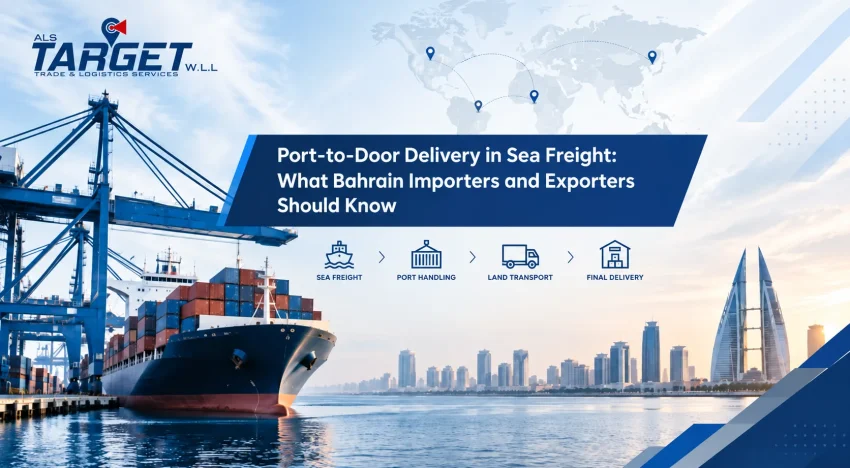
The international shipping supply chain does not end with a ship arriving at Bahrain. In fact, for many firms the most significant part of the shipment occurs after the cargo motions through customs at port. Port-to-door delivery type in sea freight refers to the transfer of cargo from the destination seaport through customs clearance to its consignees warehouse, office, shop, factory or any other delivery address.
This model can facilitate international shipping to such an extent that both Bahrain importers and exporters can manage the entire process outrageously effortlessly. But, flawless delivery comes from the right documentation, readiness with concern to customs, container planning, trucking arrangements and coordinated efforts of multiple participants.
ALS TARGET supports businesses that need organised sea freight services in Bahrain, customs coordination, container handling, and inland delivery. Therefore, understanding how port-to-door shipping actually works can help companies reduce unexpected costs and keep their supply chains moving.
What Is Port-to-Door Delivery in Sea Freight?
In port-to-door shipping the freight provider is in possession of your cargo and manages it from arrival at the door to its destination, which is a location designated by the buyer.
There are common transits wherein cargo enters through Khalifa Bin Salman Port (KBSP) in Hidd for Bahrain-bound imports. KBSP is owned and operated by APM Terminals Bahrain and offers services for containerised cargo as well as general cargo with LCL/FCL, containerisation, storage, vehicle handling and other landside logistics services.
The process normally covers:
Port arrival → Cargo availability → Customs clearance → Port release → Truck appointment → Container collection → Inland transport → Final delivery
Therefore, port-to-door freight provides more support than a basic port-to-port shipment. Get details on Cargo Shipping Between Bahrain & Colombia Ports.
Port-to-Port vs Port-to-Door Shipping
Choosing the correct service can make a major difference to both cost and workload.
|
Feature |
Port-to-Port |
Port-to-Door |
|
Ocean freight |
Included |
Included |
|
Destination port handling |
Limited or separate |
Coordinated |
|
Customs clearance support |
Usually arranged separately |
Can be coordinated |
|
Truck booking |
Importer arranges |
Freight provider arranges |
|
Final inland transport |
Not included |
Included |
|
Delivery to warehouse/site |
No |
Yes |
|
Coordination workload |
Higher for importer |
Lower |
|
Best suited for |
Experienced importers with own logistics setup |
Companies seeking end-to-end support |
Consequently, businesses without an in-house logistics department often prefer port-to-door freight services because one logistics partner can coordinate several stages.
How Port-to-Door Delivery Works in Bahrain
1. Shipment Planning Before Vessel Arrival
Good port-to-door logistics should start before the vessel reaches Bahrain.
The importer, exporter and freight forwarder should confirm:
- Bill of Lading details
- Commercial invoice
- Packing list
- HS code
- Cargo description
- Container number
- Country of origin
- Consignee information
- Required permits
- Delivery address
- Cargo weight and dimensions
In addition, regulated goods may require approvals from the relevant Bahrain authority.
Preparing these details early helps customs processing begin without unnecessary document corrections.
2. Cargo Arrives at Khalifa Bin Salman Port
Once the vessel reaches KBSP, the container is discharged and moved into the terminal.
The terminal provides digital services such as import availability checking, vessel schedules, payments, gate services and truck appointment booking.
Therefore, the logistics provider should monitor the container status rather than simply waiting for a manual arrival notification.
Early monitoring is particularly important because delays can eventually lead to storage, detention or demurrage-related costs. Looking for a Cargo Shipping Between Bahrain & Australia Ports.
3. Customs Clearance in Bahrain
Customs clearance is one of the critical steps that make port-to-door delivery in Bahrain.
As a general rule under the GCC customs rules, imported goods are liable to pay customs duties based on the relevant rate outlined in the applicable customs tariff (unless exempted or as otherwise provided for by a relevant agreement). The applicable duty is typically the rate in effect when the customs declaration is filed.
In addition, Bahrain Customs Affairs offers online services where customs tariffs and taxes can be paid. The export/importer identification may take the form of a Bahraini or GCC Commercial Registration number as one option from several accepted identity categories.
Typical clearance documentation can include:
|
Document |
Main Purpose |
|
Commercial Invoice |
Establishes transaction and product information |
|
Packing List |
Shows package count, weight and cargo details |
|
Bill of Lading |
Confirms sea shipment details |
|
Certificate of Origin |
Confirms manufacturing/origin country |
|
Customs Declaration |
Used for customs processing |
|
Import Permit |
Required for selected controlled goods |
|
Insurance Certificate |
May support shipment and valuation records |
However, exact documentation varies according to cargo type, origin and regulatory requirements.
How Customs Value Can Affect Import Costs
Another important issue is customs valuation.
Under GCC implementation rules, freight, insurance and other relevant charges up to arrival at the GCC destination port can form part of the customs value. Transaction value is generally the first valuation basis, although alternative valuation methods may apply where transaction value cannot be used.
Therefore, Bahrain importers should avoid looking only at the supplier’s invoice value when estimating landed costs.
A basic landed-cost calculation may include:
Product value + International freight + Insurance + Customs duty/taxes + Port charges + Customs clearance + Inland trucking + Other applicable handling costs
Getting this calculation right helps businesses price imported products more accurately. Get details on Dangerous Goods (DG) Logistics in Bahrain.
4. Port Release and Truck Appointment
After customs release and completion of required terminal formalities, the container becomes ready for collection.
At KBSP, truck movements are managed through terminal procedures and appointment systems. The terminal provides a truck appointment service, while import gate-out appointments may also operate during specified weekend and public-holiday periods.
Truck details also matter. APM Terminals advises that registration plates need to be correctly positioned so gate OCR systems can capture truck information. Incorrect positioning can prevent terminal entry.
Although this may appear like a minor detail, port logistics often depends on getting many small operational requirements correct.
5. Container Collection and Inland Transportation
Once the container is released, the truck enters the terminal, collects it and begins the inland leg.
Depending on the cargo, delivery may go to:
- warehouses,
- factories,
- retail stores,
- industrial facilities,
- construction sites,
- distribution centres,
- offices, or
- residential locations where suitable.
For FCL sea freight, the full container normally travels to the consignee’s delivery point, subject to site and equipment conditions.
Meanwhile, LCL sea freight usually requires cargo to be deconsolidated before individual shipments move onward.
FCL vs LCL for Port-to-Door Delivery
|
Factor |
FCL |
LCL |
|
Cargo volume |
Larger shipments |
Smaller shipments |
|
Container use |
Dedicated container |
Shared container |
|
Handling stages |
Usually fewer |
Usually more |
|
Inland delivery |
Container or unpacked cargo |
Individual shipment |
|
Cost basis |
Container based |
Volume/weight based |
|
Best for |
Regular/high-volume cargo |
Smaller commercial shipments |
Therefore, companies should choose based on shipment size, urgency, cargo characteristics and total landed cost rather than ocean freight price alone.
6. Final Delivery at the Customer’s Door
Delivery seems straightforward, yet it can create problems when access conditions are ignored.
Before dispatch, the logistics team should confirm:
- exact delivery location,
- receiver contact details,
- unloading arrangements,
- working hours,
- truck accessibility,
- forklift or crane requirements,
- loading dock availability, and
- whether container unloading can be completed within the permitted time.
For example, an industrial warehouse may easily receive a 40-foot container. However, a small commercial property may have restricted road access. As a result, cargo may need alternative vehicle arrangements. Good planning prevents the truck from arriving at a site that cannot physically receive the shipment. Looking for a Bonded Warehousing in Bahrain Logistics Zone.
Hidden Costs Bahrain Importers Should Watch
The cheapest ocean freight quotation does not always produce the cheapest shipment. Importers should consider the full port-to-door shipping cost.
Common cost elements may include:
- ocean freight,
- destination terminal charges,
- documentation,
- customs clearance,
- applicable customs duties and taxes,
- storage,
- demurrage,
- detention,
- inspection,
- container shifting,
- trucking,
- waiting time,
- special equipment, and
- unloading.
Consequently, asking for an itemised quotation is usually more useful than comparing only the headline freight rate.
Demurrage, Detention and Storage: Know the Difference
These terms frequently confuse new importers.
|
Charge |
Generally Relates To |
|
Port/terminal storage |
Cargo or container remaining at terminal beyond applicable free period |
|
Demurrage |
Container remaining within port/terminal beyond shipping line free time |
|
Detention |
Container kept outside the terminal beyond the allowed return period |
Actual free periods and charges depend on the terminal, carrier, equipment and commercial agreement.
Therefore, documents should ideally be ready before the vessel arrives, not after storage charges begin. Get details on Cargo Shipping Between Bahrain & Peru Ports.
Special and Hazardous Cargo Requires Additional Planning
Certain cargo types need much more preparation.
KBSP handles hazardous cargo subject to specific compliance requirements. For some IMO-classified dangerous goods, consignees or shippers must obtain relevant government approvals and submit required information ahead of vessel arrival or export gate-in. APM Terminals also requires MSDS and cargo manifests for hazardous containers/cargo to reach its planning team at least 72 hours before vessel arrival.
Therefore, dangerous goods should never be treated as an ordinary container booking.
Other shipments that may require extra planning include:
- oversized machinery,
- temperature-controlled cargo,
- chemicals,
- food products,
- pharmaceuticals,
- vehicles,
- fragile equipment, and
- high-value goods.
Why Tracking Matters After the Vessel Arrives
Many businesses track vessels during the ocean journey but stop paying attention once the shipment reaches Bahrain.
However, that is exactly when tighter tracking becomes important.
A useful sea freight tracking process should monitor:
Vessel arrival → discharge → customs status → cargo availability → customs release → truck appointment → gate-out → delivery
This visibility allows importers to prepare warehouse teams and avoid unnecessary truck waiting.
Moreover, exporters can use similar coordination in reverse when moving containers from a Bahrain facility to the port.
Related Services:
» International Cargo Shipping
» Cargo Shipping Between Bahrain & Peru Ports
» Cargo Shipping between Bahrain and Chile Ports
» Warehousing for FMCG Goods in Bahrain
» Cargo Shipping between Bahrain & New Zealand Ports
Port-to-Door Shipping for Bahrain Exporters
Although the term often describes imports, Bahrain exporters also benefit from connected inland and port logistics.
For exports, the flow generally works in reverse:
Cargo pickup → Container loading/stuffing → Export documentation → Customs formalities → Port gate-in → Vessel loading
Exporters should particularly monitor vessel cut-off times, container availability and documentation deadlines.
Furthermore, APM Terminals Bahrain has procedures for empty containers collected for stuffing at a shipper’s premises. Empty containers are subject to customs scanning arrangements before gate-out.
Therefore, export logistics should be planned well before the sailing date.
How ALS TARGET Supports Port-to-Door Sea Freight
Managing an international shipment requires communication between shipping lines, terminals, customs representatives, truck operators, exporters and importers.
ALS TARGET helps businesses coordinate these stages through one organised logistics process.
Support can include:
- international sea freight forwarding,
- FCL and LCL shipping,
- shipment documentation coordination,
- customs clearance support,
- container movement,
- Bahrain inland transportation,
- import/export logistics,
- commercial cargo shipping, and
- port-to-door delivery services.
Instead of dealing separately with every stage, businesses can work through a coordinated logistics partner that understands the shipment from origin planning to destination delivery.
Tips for Faster Port-to-Door Delivery
There are some practical steps that can be followed by businesses in Bahrain to mitigate delays.
First submit commercial documents pre-arrival of the vessel. Second, scrutinize HS codes and cargo descriptions. Third, see if the products in question require special approvals. Also, verify your customs-related costs early instead of on arrival itself.
Lastly, stay in close contact with the freight forwarder. It is simpler to address minor documentation or delivery-site concerns before the container has already arrived at the terminal.
Related Articles:
» Sea Freight to Bahrain: FCL vs LCL for Importers and Exporters
» Air Freight vs Sea Freight: Which is Right for Your Shipment?
» Bahrain Logistics Solutions: Seamless Air Freight Sea Freight
» Sea Freight Documentation Guide for Bahrain Importers
Final Thoughts
Port-to-door delivery in sea freight offers businesses in Bahrain an affordable option for linking international ocean transportation with customs clearance and local delivery.
Booking a vessel is only the start of a sustainable solution for reliable delivery. Necessary documents, precise customs declarations, terminal coordination, truck appointments, regulated approvals and destination planning are only a fraction of what it takes.
Organised planning, thus reduces storage charges and delivery delay for Bahrain importers. Similarly, exporters enjoy improved control over container pick up, cargo loading and port gate-in.
ALS TARGET handles the logistics coordination for you, you have a clearer picture of sea freight in Bahrain from port arrival to final delivery details.
FAQs: Port-to-Door Delivery in Sea Freight
Prepare documents early, arrange customs processing before or immediately after arrival, monitor container availability and book transportation promptly once cargo receives release.
Yes, provided the shipment meets applicable regulatory, port, transport and safety requirements. Some hazardous cargo requires approvals and advance document submission before vessel arrival.
Yes. ALS TARGET can coordinate Bahrain inland transportation as part of a broader port-to-door logistics arrangement, depending on the shipment type, destination and service requirements.
Yes. Manufacturers, wholesalers, retailers, contractors and other businesses can use commercial sea freight and port-to-door delivery for machinery, raw materials, consumer goods, equipment and many other permitted cargo categories.
ALS TARGET offers coordinated sea freight, customs support, container logistics and port-to-door delivery in Bahrain. By connecting multiple logistics stages, businesses gain clearer shipment coordination and can reduce the administrative effort involved in managing separate service providers.