


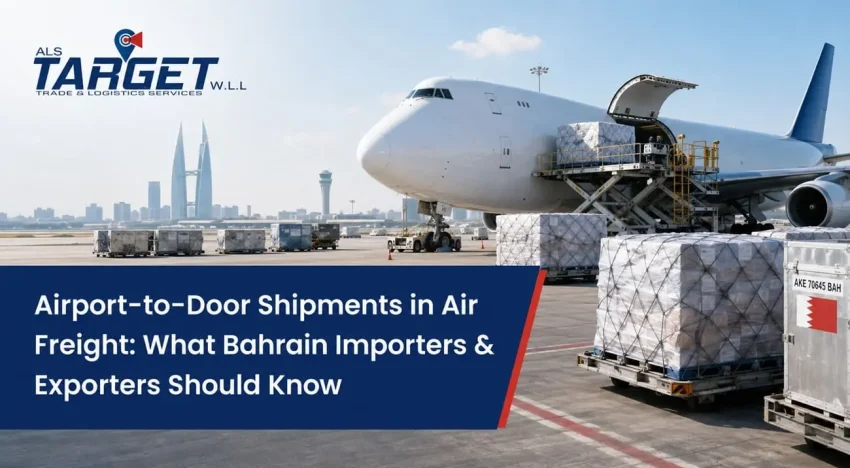
When your cargo is an urgent spare part, medical equipment, electronics, a sample or any other time-sensitive retail stock — speed matters. But getting cargo on an aircraft only covers one side of the equation. The consignment still needs to be transported through the airport, customs clearance and final delivery before it can get into the hands of a consignee.
This is when the airport-to-door air freight comes into play.
The freight partner will handle the entire shipment instead of requesting that an importer pick up cargo from Bahrain International Airport — arranging delivery from the arrival airport to your customer’s warehouse, shop, office or project site. Thus businesses get a more controlled and hassle-free delivery experience.
All shipments move on their own from airport to door. Improper paperwork, embargoed items, unpaid tariffs and ambiguous delivery addresses can still slow things down but you are at odds with terrible supply chain coordination. Bahrain Importer and Exporters must know all the steps associated with permutation before opting for it.
What Is an Airport-to-Door Air Freight Shipment?
An airport-to-door shipment consists of the transfer of goods from the destination air terminal to the receiver address. For imports to Bahrain, it typically starts following the aircraft’s arrival at Bahrain International Airport.
Depending on the agreed scope, the freight forwarder may handle:
- Airline or ground-handler coordination
- Cargo arrival monitoring
- Import customs documentation
- Customs declaration processing
- Duty and VAT coordination
- Inspection support
- Airport cargo collection
- Local transportation
- Final delivery confirmation
But an overseas supplier might still have to arrange transport between its factory and the airport of departure. Thus, airport-to-door service is different from door-to-door air freight which usually includes pickup at origin as well.
There is a cargo terminal of 25,000 square metre at Bahrain International Airport. Among other services, it supports export cargo sales, transshipment, inter-airport trucking and customs-clearance support. Get details on Warehousing Storage Service in Bahrain.
Airport-to-Door vs Door-to-Airport vs Door-to-Door
Businesses often use these shipping terms interchangeably. Yet each one assigns responsibilities differently.
| Air freight service | Starting point | Ending point | Best suited for |
| Airport-to-airport | Origin airport | Destination airport | Experienced importers with their own clearing and transport arrangements |
| Door-to-airport | Supplier’s address | Destination airport | Exporters managing collection at origin but leaving destination clearance to the buyer |
| Airport-to-door | Destination airport | Consignee’s address | Bahrain importers that need customs clearance and local delivery |
| Door-to-door | Supplier’s address | Consignee’s address | Businesses seeking one coordinated logistics solution |
A Bahrain engineering firm might therefore purchase an urgent machine part from Germany. It is possible that the German supplier would provide it to Frankfurt Airport on its own. From there, an airport-to-door freight forwarder in Bahrain will be able to arrange for arrival on site, customs clearance and delivery to the workshop at the company’s headquarters.
Thus, the importer can avoid sending personnel to handle various airport processes.
How Airport-to-Door Air Freight Works in Bahrain
Although each consignment differs, most airport-to-door shipments follow a similar process.
1. Shipment Planning
First, the importer provides cargo details to the freight forwarder. These details normally include:
- Commodity description
- Number of packages
- Gross weight
- Package dimensions
- Country of origin
- Invoice value
- Airport of departure
- Delivery address in Bahrain
- Required delivery date
At this stage, the forwarder should check whether the goods require special permits, temperature control or dangerous-goods handling.
2. Air Freight Booking
Next, the overseas shipper or its freight agent books space with an airline. Airlines calculate charges using either actual weight or volumetric weight, whichever is higher.
A common volumetric calculation for air freight is:
Length × Width × Height in centimetres ÷ 6,000
For instance, a carton measuring 100 × 80 × 75 centimetres produces a volumetric weight of 100 kilograms. Even if the carton weighs only 68 kilograms, the airline may charge it as 100 kilograms.
3. Pre-Arrival Document Review
The importer or clearing agent must examine all documents prior to the arrival of the aircraft in Bahrain. Checking early helps find those cases where the values might not match, or products are vaguely described or require approval and value comparison.
Furthermore, pre-alert documents help the Bahrain freight partner prepare to clear customs as opposed to waiting for the shipment to arrive.
4. Cargo Arrival at Bahrain International Airport
Post-landing, the airline or ground-handling agent will unload the cargo and relay it into the airport cargo facility. An arrival notification is then sent to the consignee or freight agent.
All air cargo bound for Bahrain and cargo transiting through the country continues to be subject to customs clearance prior to release.
5. Customs Declaration and Inspection
The customs broker then uses the shipment documents and commodity classification to prepare the correct declaration.
Cargo may be released by Customs against documentation Besides, officers can ask for inspection process, valuation evidence, technical approvals or further details regarding goods.
Because importers should refrain from the words like “pieces,” “samples”or “general goods.” For example, a description saying that it is a “stainless-steel replacement valve for an industrial water pump” provides much more useful information to customs and the clearing agent.
6. Payment of Charges
Before release, the importer may need to settle:
- Customs duty
- Import VAT
- Airline handling charges
- Documentation charges
- Customs brokerage fees
- Storage, when applicable
- Inspection or permit-related charges
- Local delivery costs
The National Bureau for Revenue administers VAT in Bahrain. Meanwhile, Customs Affairs manages the customs processes applicable to imported commercial cargo.
The exact duty treatment depends on the product classification, origin, declared value and any applicable exemption or trade agreement. Consequently, importers should not calculate landed cost using a general percentage alone.
7. Airport Collection and Final Delivery
Once customs releases the shipment, the local transport team collects it from the cargo terminal. The forwarder then delivers the goods to the consignee’s nominated address.
However, delivery planning remains important. Warehouses may have fixed receiving hours, vehicle restrictions, loading-bay rules or entry-permit requirements. In addition, project sites may require driver identification and advance vehicle registration. Bonded Warehouse Rental in Bahrain offers secure, cost-effective storage solutions for businesses handling imported goods, re-exports, and international shipments.
Essential Documents for Bahrain Air Cargo Clearance
Complete documents reduce the risk of unnecessary customs queries.
| Document | Main purpose | Common problem |
| Commercial invoice | Shows seller, buyer, goods, value and currency | Generic descriptions or inconsistent values |
| Packing list | Shows package count, weight and packing details | Weight does not match the air waybill |
| Air waybill | Confirms air-carriage information | Incorrect consignee details |
| Certificate of origin | Confirms the manufacturing origin | Missing authentication or unclear origin |
| Import permit | Approves regulated products | Permit requested after cargo arrives |
| Product certificate | Confirms conformity or technical standards | Model number differs from invoice |
| Customs declaration | Formally declares the shipment | Incorrect tariff classification |
| Insurance certificate | Supports insured value and claims | Coverage does not match invoice value |
Bahrain’s published trade guidance advises importers to follow Customs Affairs procedures and use the official trade systems for port and airport imports where required.
Additionally, the consignee name on the invoice, air waybill and import registration should match. Even a small difference in the company name can lead to document amendments.
Goods That Need Additional Attention
Some commodities move easily by air. Others require advance approval or specialised handling.
Dangerous Goods
Hazardous-goods legislation can apply to substances such as lithium-batteries (notably, powered devices), chemicals, aerosols, paints, perfumes and select industrial materials. In Bahrain, the ICAO Technical Instructions for the Safe Transport of Dangerous Goods by Air shall apply.
Consequently, not only does the shipper need sanctioned packaging but also labels, declarations and could even require capable handling staff.
Temperature-Sensitive Cargo
Some pharmaceuticals, diagnostic materials and food products must be kept under controlled temperature. In that case, companies must make sure:
- Required temperature range
- Packaging duration
- Data logger requirements
- Customs-clearance plan
- Weekend or holiday arrival risk
- Refrigerated final-mile transport
A fast flight does not protect temperature-sensitive cargo if it waits for documents inside the airport.
High-Value Goods
Electronics, luxury products, jewellery-related materials and specialised machinery may require stronger security procedures. Therefore, importers should arrange suitable insurance and avoid leaving cargo uncleared for long periods.
Food, Cosmetics and Medical Products
These products may require approvals from the relevant Bahrain authority. Furthermore, labels, ingredients, batch information or expiry dates may need review before importation.
Importers should confirm requirements before dispatch because an airline booking does not guarantee customs admissibility. Air Freight Service in Bahrain provides fast, reliable, and secure transportation solutions for businesses shipping goods locally and internationally.
Typical Airport-to-Door Cost Components
Air freight quotations can look simple at first. Nevertheless, a low airport rate may exclude several destination charges.
| Cost component | What affects it |
| Air freight | Chargeable weight, route, airline capacity and service speed |
| Fuel or security surcharge | Airline and route conditions |
| Terminal handling | Number of packages, weight and cargo type |
| Customs brokerage | Declaration complexity and commodity lines |
| Duty and VAT | Classification, origin, value and applicable rules |
| Storage | Time cargo remains uncleared |
| Special handling | Dangerous, fragile, oversized or temperature-controlled cargo |
| Final delivery | Distance, vehicle type, access and unloading needs |
For example, a 70-kilogram shipment may have a chargeable weight of 110 kilograms because of its dimensions. Moreover, a delivery to a restricted industrial area may need a dedicated vehicle rather than a standard van.
Consequently, importers should ask for a landed airport-to-door quotation, not merely an airline freight rate.
Common Causes of Air Freight Delays
Most avoidable delays begin before the cargo departs.
One common issue involves incomplete invoices. Customs needs a meaningful product description, quantity, value, currency and origin. Therefore, a document showing only “commercial samples” may trigger questions.
Another problem occurs when the importer does not hold the required licence or approval. Additionally, shipments can face delays because of:
- Incorrect consignee information
- Wrong HS classification
- Missing certificate of origin
- Unclear Incoterms
- Differences between invoice and packing list
- Late payment of duty or destination charges
- Arrival during weekends or public holidays
- Customs inspection
- Missing dangerous-goods documentation
- Delivery address restrictions
Storage can begin while the importer corrects these problems. As a result, a small document error may increase the total shipment cost significantly.
How Importers Can Prepare Before Cargo Departs
Bahrain importers should create a pre-shipment checklist rather than reacting after arrival.
First, send the commercial invoice and packing list to the Bahrain freight forwarder. Next, confirm the HS code and permit requirements. Additionally, verify that the consignee details match the company’s official records.
Importers should also confirm who will pay duties and destination charges. Under some Incoterms, the buyer remains responsible even when the seller arranged the flight.
Finally, share the exact delivery location, receiving hours and contact person. These details seem basic; however, they often determine whether delivery happens on the release day or the following working day.
What Bahrain Exporters Should Know
The same coordination matters for exports from Bahrain.
A Bahrain exporter may choose an airport-to-door service when it wants the overseas receiver to obtain the cargo at a final address. In this arrangement, the freight forwarder coordinates air transport and destination services through an overseas agent.
Certain customs declarations may apply before a shipment in the case of export cargo (e.g., duty drawback, deposits or other customs procedures).
Exporters are required to quote true and correct information pertaining to buyer particulars, commodity description & destination contact address. In addition, they should inquire about the rules of import in the destination country before taking on a last-minute order.
Exported from Bahrain without hindrance, a product may then be turned away or kept on hold once reaching its destination due to labelling, certification or importer-registration requirements.
Related Services:
» Bonded Warehousing for Industrial Cargo in Bahrain
» Bonded Warehousing for E-commerce Cargo in Bahrain
» Bonded Warehousing for Automotive Spare Parts in Bahrain
» Bonded Warehousing for FMCG Goods in Bahrain
» Bonded Warehousing in Bahrain Logistics Zone
Choosing an Airport-to-Door Freight Partner in Bahrain
A capable freight partner should do more than quote a price. The company should explain the likely clearance process, identify document gaps and coordinate each party.
Before confirming a booking, ask whether the provider offers:
- Pre-arrival document checking
- Customs-clearance coordination
- Shipment tracking
- Dangerous-goods support
- Temperature-controlled handling
- Duty and VAT guidance
- Airport storage monitoring
- Dedicated or consolidated delivery
- Proof of delivery
- Overseas agent coordination
Most importantly, request a written scope. A quotation should clearly state what the provider includes and excludes.
Related Articles:
» Air Freight vs Sea Freight: Which is Right for Your Shipment?
» Bahrain Logistics Solutions: Seamless Air Freight, Sea Freight & Warehousing
» Bahrain Checklist for Urgent Commercial Cargo in Air Freight
» Bahrain Checklist for High-Value Electronics in Air Freight
» Bahrain Checklist for E-Commerce Inventory in Air Freight
Make Air Freight Fast Beyond the Airport
Air freight offers speed, but the aircraft journey represents only one section of the supply chain. The shipment can still lose valuable time during documentation, customs clearance, cargo release and local transportation.
Thus, importers and exporters from Bahrain must plan the end-to-end route and nothing but the flight.
Well-prepared documentation, pre-clearance permits, accurate estimation of total costs incurred and strong logistics partner can transform airport-to-door air freight in Bahrain into a quick but encompassed solution to meet the soar demands for high-priority commercial freights.
Bahrain-based ALS Target also provides integrated air cargo services, customs-clearance support and final delivery planning for businesses in Bahrain and abroad. Consequently, importers and exporters are made able to control urgent shipments through one organized point of contact.