


When a factory needs a replacement component today—not next week—price becomes only one part of the shipping decision. The real question is whether the cargo can reach Bahrain quickly enough to prevent production losses, missed contracts or unhappy customers.
That pressure explains why urgent commercial air freight in Bahrain often costs more than a standard air cargo booking. This needs to be done with airlines, handlers, customs brokers and delivery teams working in a much tighter time frame. Moreover, priority slots, after hours pick ups as well as special handling or even direct flight connections may be needed for the shipment itself.
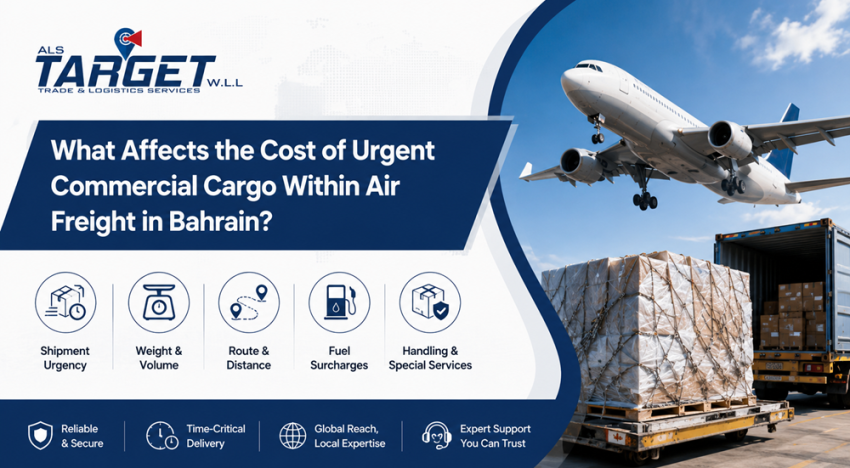
But urgency isn’t the only factor in deciding what ultimately gets into a bill. The quotation depends on the weight and dimensions of the cargo, route, product type, documentation and delivery location.
Finally, being knowledgeable about these elements helps businesses plan properly, evaluate freight proposals and eliminate charges that are discovered only after a shipment has already left.
Why Do Businesses Choose Urgent Air Freight?
In Bahrain, companies use urgent air cargo services when the cost of delay is greater than the increased freight cost.
For example, a manufacturing company may be desperately in need of a machine component to restart a production line. For example, a hospital supplier may need to restock medical equipment that has time constraints. Retailers will also use expedited freight if they run out of fast-moving products before a promotion or seasonal sales period.
Common urgent commercial shipments include:
- Industrial spare parts
- Automotive components
- Medical equipment
- Electronics and telecommunications products
- Oil and gas tools
- Laboratory materials
- Retail stock
- Legal or banking documents
- Product samples
- Perishable commercial goods
Services such as import, export, transshipment, customs clearance and processing of long-term bonded warehousing and temperature-controlled cargo will be offered by the airport. It also has designated areas for hazardous materials, delicate cargo, live animals and other specialized shipments.
Hence, Bahrain has all the facilities and infrastructure required for various types of commercial air cargo. However, each shipment has operational and compliance needs that impact the price directly. Get details on Re-Export Cargo Warehousing Services.
1. Actual Weight and Chargeable Weight
Weight remains one of the biggest cost factors in air freight pricing in Bahrain. Yet airlines do not always charge according to the weight shown on a weighing scale.
They compare two figures:
- The actual gross weight
- The volumetric or dimensional weight
The airline normally bills the higher figure. This becomes the shipment’s chargeable weight.
A widely used air cargo calculation divides the package volume in cubic centimetres by 6,000:
Length × Width × Height in centimetres ÷ 6,000
Suppose a carton measures 100 × 80 × 75 cm.
Its volumetric weight would be:
100 × 80 × 75 ÷ 6,000 = 100 kg
When a carton weighs 60 kg actually, the airline would be charging 100 kg if the carton occupied a place which could carry heavier cargo. As IATA explains, air freight costs are usually based on either the actual or volumetric weight and whichever is greatest.
As a result, large but lightweight items can be more expensive than smaller, dense freight.
2. How Quickly the Cargo Must Arrive
Not every urgent booking has the same deadline.
A shipment required within 24 hours needs a different service from cargo that can arrive within three or four days. Therefore, the requested transit time has a major effect on the quotation.
Typical urgency levels
Service level | Typical requirement | Relative cost |
Standard air freight | Flexible departure and transit time | Lower |
Expedited air freight | Earliest practical scheduled flight | Medium to high |
Next-flight-out service | First suitable available flight | High |
Direct-flight priority | Minimal connections and priority booking | High |
Aircraft charter | Entire aircraft arranged for the shipment | Very high |
These categories do not represent guaranteed universal transit times. Actual performance depends on airline schedules, origin airport procedures, customs clearance and final delivery requirements.
Still, one rule generally applies: the less flexibility the forwarder has, the higher the rate can become.
For example, a forwarder handling a normal shipment can compare several airlines and departure dates. On the other hand, an urgent booking may have only one workable flight. That limits negotiation and makes available capacity more valuable.
3. Origin, Destination and Flight Availability
The route has a direct impact on the cost of commercial air freight to Bahrain.
Cargo moving from a major international hub may have several direct or connecting services. As a result, the forwarder has more routing options. Shipments from smaller airports, inland cities or remote manufacturing zones often require additional road transport and airport transfers.
A typical urgent movement may include:
- Collection from the supplier
- Transport to the export airport
- Export customs clearance
- Airport handling
- International flight
- Arrival handling in Bahrain
- Import customs clearance
- Final delivery to the consignee
That is just one portion of the overall price, so the airport-to-airport rate is low.
A direct flight usually is higher than a connected one. However, it does lower the risk of transit and handling time. At the same time a cheaper passage could consist of two or three airports increasing the likelihood that you miss your connection, spend hours waiting for an unloading or get your cargo misdirected.
The cheapest air rate does not always lead to the least business risk when translating to urgent commercial goods. Get details on Import Cargo Storage in Bahrain.
4. Available Airline Capacity
Airlines price cargo space according to demand and available capacity. Rates may increase when many shippers compete for limited space.
For instance, capacity can tighten during:
- Major retail seasons
- Public holidays
- Manufacturing peaks
- Product launches
- Trade exhibitions
- E-commerce sales periods
- Weather disruptions
- Temporary flight schedule changes
In addition, passenger aircraft usually carry cargo in their lower-deck compartments. When passenger schedules change, available belly cargo space may also change.
Urgent shipments booked at the last minute can face a premium because airlines must confirm space close to departure. Larger cargo may become even more difficult to accommodate, especially when it needs specific pallet positions or loading equipment.
5. Cargo Dimensions and Packing Method
Two shipments with the same actual weight can receive very different quotations.
One may contain ten compact cartons that fit easily on an aircraft pallet. The other may consist of an oversized wooden case that cannot be stacked. Although both weigh 500 kg, the oversized case uses more aircraft space and may require special loading.
The following packing details can influence the rate:
- Total number of packages
- Length, width and height of each package
- Stackable or non-stackable status
- Pallet type
- Crate construction
- Centre of gravity
- Forklift access
- Tie-down requirements
- Ability to fit through the aircraft cargo door
Businesses should provide accurate dimensions before requesting a quote. Otherwise, the carrier may recalculate the chargeable weight after accepting the cargo.
In addition, poor packing can cause delays. If airport handlers decide that a crate cannot travel safely, the cargo may need repacking. That creates extra labour, material, storage and rebooking costs.
6. Type and Value of Commercial Cargo
General commercial goods usually cost less to handle than regulated, fragile or high-risk products.
Special handling may apply to:
- Dangerous goods
- Lithium batteries
- Chemicals
- Pharmaceuticals
- Temperature-sensitive products
- High-value electronics
- Jewellery or precious materials
- Live animals
- Perishable food
- Fragile instruments
- Oversized machinery
Bahrain’s cargo infrastructure includes cold storage, chillers, freezers and dedicated areas for dangerous, valuable and specialised cargo.
However, using these facilities may create additional charges. For example, temperature-sensitive cargo may require insulated packing, data loggers, active containers or priority transfer into cold storage.
Likewise, dangerous goods require correct classification, compliant packaging, labels and documentation. The airline may also apply a dangerous goods handling fee.
7. Customs Duties, VAT and Product Classification
Freight cost and import cost are not the same thing.
A freight quotation may include transportation and handling but exclude customs duty, VAT, inspection fees or permit-related expenses. Therefore, importers should confirm which charges fall inside and outside the offer.
The correct HS code determines the duty rate and whether a regulatory authority must approve the goods. Bahrain Customs provides an online tariff finder that allows users to check product classifications, duty rates and related permit requirements.
Besides duty, importers may need to account for taxes and customs processing charges. Bahrain’s government portal also provides a service for paying customs fees and taxes.
An incorrect HS code can lead to:
- Reassessment of duties
- Customs queries
- Shipment inspection
- Additional documentation
- Storage charges
- Delayed cargo release
For urgent goods, these delays can become more expensive than the original freight charge.
8. Quality of Shipping Documents
Documents have a major influence on both transit time and total cost.
A standard commercial air shipment may require:
- Air waybill
- Commercial invoice
- Packing list
- Certificate of origin
- Customs declaration
- Import permit, when applicable
- Product-specific approvals
- Dangerous goods declaration, when applicable
The cargo description, quantity, value, weight and consignee information must match across the documents. Even a small inconsistency can trigger a customs question.
For example, an invoice that says “machine parts” may not describe the goods clearly enough. A more precise description, such as “stainless-steel replacement valve for industrial water pump,” can support faster product identification.
Therefore, document preparation should begin before the goods reach the origin airport—not after they arrive in Bahrain.
Bahrain Customs also operates a 24-hour Air Cargo One Stop Center that provides integrated services related to air freight and customs clearance. Even so, round-the-clock availability cannot correct missing permits or inaccurate invoices instantly. Looking for a Air Freight Bahrain?
9. Collection and Final Delivery Requirements
Door-to-door urgent cargo includes more than air transportation.
The pickup vehicle may need to travel outside normal working hours. Likewise, the delivery may require a dedicated van or truck immediately after customs release.
Charges may increase when the shipment needs:
- Same-day supplier collection
- Night or weekend pickup
- Dedicated vehicle service
- Tail-lift truck
- Crane or forklift support
- Delivery to an industrial site
- Multiple delivery locations
- Security escort
- Timed delivery appointment
A delivery to a warehouse near Bahrain International Airport may cost less than transport to a restricted industrial facility with special entry procedures. Therefore, the full pickup and delivery address should appear in the quote request.
10. Airport Handling and Storage Charges
Every airport shipment passes through handling procedures.
Depending on the cargo, the quotation may include terminal handling, documentation, screening, loading, unloading and cargo release fees. However, some proposals show these as separate destination charges.
Storage becomes another concern when the consignee cannot clear the goods promptly. Charges may start after the airport’s permitted free period ends. Additionally, special cargo stored in a chiller, freezer or secure area may attract higher fees than ordinary goods.
Thus, companies should arrange customs paperwork, payment authority and delivery instructions before the flight lands.
11. Cargo Insurance
Airlines and freight forwarders operate under limited liability terms. Those limits may not equal the commercial value of the shipment.
For that reason, businesses often purchase air cargo insurance in Bahrain, particularly for high-value or time-critical products.
Insurance cost generally depends on:
- Cargo value
- Product type
- Packing quality
- Origin and destination
- Route
- Claims history
- Coverage terms
Although insurance adds to the initial cost, it protects the company from a much larger financial loss if the cargo suffers damage, theft or non-delivery.
Related Services:
» Bonded Warehouse Service in Bahrain
» Bonded Warehousing for Cargo in Bahrain
» Bonded Storage for Import Cargo
» Bonded Cargo Delivery in Bahrain
» Customs-Controlled Cargo Handling Services
Indicative Cost Impact of Common Factors
The percentages below illustrate possible cost pressure only. They do not represent fixed ALS TARGET or airline tariffs.
Cost factor | Possible effect on quotation | Why it matters |
Next-flight-out booking | Significant increase | Limited time to compare flights |
Bulky, lightweight cartons | Moderate to significant | Volumetric weight may exceed actual weight |
Non-stackable cargo | Moderate increase | Shipment occupies exclusive pallet space |
Dangerous goods | Moderate to high | Special packing, declarations and airline acceptance |
Temperature control | Moderate to high | Cold-chain equipment and priority handling |
Remote supplier pickup | Moderate increase | Longer road collection before departure |
Weekend or night handling | Additional charge | After-hours labour and vehicle costs |
Incorrect paperwork | Unplanned cost | Storage, amendment and delay expenses |
Direct flight request | Possible premium | Faster route with fewer handling points |
Customs inspection | Variable | May create handling and storage charges |
How Businesses Can Control Urgent Air Freight Costs
Urgent cargo will rarely cost the same as a flexible booking. Still, businesses can prevent unnecessary charges.
First, send complete shipment details when requesting the quotation. Include the weight, dimensions, commodity, cargo value, collection address, delivery address and required arrival date.
Next, confirm whether the cargo is stackable. Good packaging can reduce volumetric weight and improve loading options. However, do not weaken the packaging simply to save space.
Also, prepare documents early. The invoice, packing list, certificate of origin and permit details should be checked before collection.
Finally, ask for a complete door-to-door breakdown. A clear proposal should explain the freight rate, pickup, origin handling, destination charges, customs clearance, duties, taxes, storage terms and delivery cost.
Related Articles:
» Bahrain Checklist for Urgent Commercial Cargo in Air Freight
» Why 2026 Importers Are Routing US/Europe Cargo via Jeddah First
» Air Freight vs Sea Freight: Which is Right for Your Shipment?
» Complete Checklist: Documents Needed for Air Freight Clearance
» Construction Materials: Bulk Cargo Routing Strategy for NEOM
Why Work With ALS TARGET for Urgent Air Freight in Bahrain?
Urgent commercial cargo requires quick decisions, but those decisions still need accuracy.
ALS TARGET coordinates air freight services in Bahrain, customs clearance and inland delivery according to the shipment’s deadline and handling requirements. Our team assesses the available route, chargeable weight, documentation and cargo type before recommending a practical shipping plan.
Rather than treating every urgent shipment the same, we look at what the business actually needs. Sometimes that means a direct flight. In another case, a well-planned connection may meet the deadline at a more controlled cost.
For urgent industrial parts, retail cargo, electronics, commercial documents and other time-sensitive goods, early coordination makes a real difference.
FAQs: What Affects the Cost of Urgent Commercial Cargo Within Air Freight in Bahrain?
Chargeable weight, route availability and required delivery time usually have the greatest impact. However, cargo type, handling needs and customs requirements also affect the final price.
Not always. The airline compares actual weight with volumetric weight and normally charges according to whichever figure is higher.
Multiply the package length, width and height in centimetres, then divide the result by 6,000. The applicable divisor can vary by carrier or service, so confirm it during quotation.
A lightweight shipment may occupy a large amount of aircraft space. Therefore, its volumetric weight can exceed its actual physical weight.
A direct service may carry a premium because it reduces transit time and handling points. Nevertheless, the rate depends on capacity, route demand and airline schedules.
Not necessarily. Many quotations exclude customs duty, VAT, inspections, permits and government fees. Always request a detailed cost breakdown.
Common documents include an air waybill, commercial invoice, packing list, certificate of origin and customs declaration. Some goods also need import permits or regulatory approvals.
Yes. Door-to-door coordination can include supplier collection, export handling, air transport, customs clearance and final delivery in Bahrain, subject to the shipment requirements.
Usually, yes. Dangerous goods may require certified packing, labels, declarations, trained handling staff and advance airline approval.
Provide correct dimensions, use suitable space-efficient packaging, prepare documents early and avoid last-minute booking where possible. Also, compare the total landed cost rather than the airline rate alone.
Customs may request corrections, supporting documents or an inspection. Consequently, the shipment can incur amendment, storage and handling charges.
Send the request as soon as the cargo details become available. Early notice gives the freight forwarder more time to compare routes, reserve capacity and check customs documents before departure.