


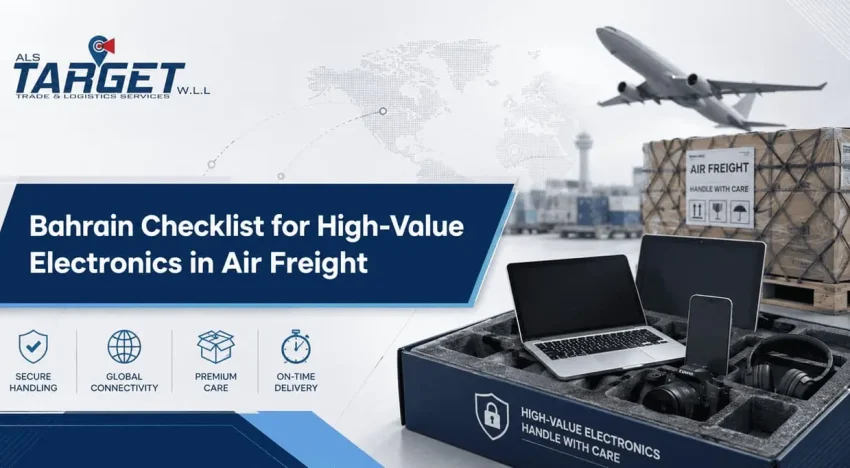
Advance scheduling Air-freight to ship a unit of basic products However, if the work involves things like moving servers, medical electronics, telecom equipment, semiconductor components, control systems or high-end consumer devices then you will need to have a much more stringent/rigorous process.
And this can be a costly error — a rapid one. Just one dropped crate could damage sensitive interior components. Likewise, in the event where goods are inaccurately described this could consequently result in a customs clearance delay or if lithium batteries are not included in the coverage then the airline may be forced to refuse entry of an entire shipment.
In Bahrain speed is certainly important, particularly for businesses importing or exporting high-value electronics but control is even more critical. So this handy very final last second checklist consists of paperwork packing power packs security insurance policies customs clearance and closing delivery
Why High-Value Electronics Need Special Air Freight Planning
Electronics have quite different risks from general cargo. Impact, vibration, moisture, electrostatic discharge, temperature changes and either poor stacking or unwanted handling can cause damage to them.
Furthermore, a number of electronic devices contain lithium-ion batteries. Due to the risk of overheating or fire from damaged, defective, or improperly packed cells, airlines also classify these batteries as dangerous goods.
Shipments of high-value items are also at risk of theft and substitution. Hence the shipper should also own everything starting from flight booking till every handover between supplier, transporter, warehouse, airline, customs broker and end customer.
Bahrain International Airport has a well established cargo and logistics network, with leading express & logistics operators operating from the airport. The airport said it handled over 350,000 tonnes of cargo in 2023, reflecting the extent of its freight ecosystem. Get details on Air Freight Service in Bahrain.
High-Value Electronics Air Freight Checklist
| Checkpoint | Action required | Main risk controlled |
| Product identification | Record model, serial number and HS code | Customs disputes and substitution |
| Battery review | Confirm battery type, capacity and configuration | Airline rejection or safety incident |
| Export packing | Use anti-static and shock-resistant protection | Physical and electronic damage |
| Documentation | Match invoice, packing list and airway bill | Clearance delays |
| Customs permits | Check whether the item needs approval | Detention or penalties |
| Insurance | Insure for the correct replacement value | Financial loss |
| Security | Use seals, restricted handling and tracking | Theft or tampering |
| Final delivery | Arrange secure, direct transport | Last-mile damage |
1. Identify Every Item Before Booking
Start with an exact inventory. Avoid descriptions such as “electronic items,” “computer parts,” or “equipment.” Customs officers, airlines, insurers, and freight handlers need more detail.
Your inventory should include:
- Product name and intended use
- Brand and model number
- Individual serial number
- Country of origin
- Quantity
- Unit and total value
- HS classification
- Battery details, where applicable
- New, used, repaired, returned, or demonstration status
For example, write “rack-mounted network server, model X, without battery” rather than simply writing “IT equipment.”
Additionally, photograph each item and serial number before packing. These images can support an insurance claim if the cargo arrives damaged or if one unit goes missing.
2. Check Whether Bahrain Import Approval Is Needed
Not every electronic product can enter Bahrain using standard commercial documents alone. Certain goods may require approval from a relevant government authority.
Telecommunications equipment deserves particular attention. Bahrain Customs lists a permit for importing telecommunications equipment into the Kingdom. Therefore, routers, transmitters, radio equipment, specialised antennas, communication modules, and similar products may require additional review.
Before dispatch, ask your Bahrain customs clearance agent to confirm:
- Whether the HS code is correct
- Whether the item is restricted
- Whether an import licence applies
- Whether telecommunications approval is required
- Whether technical certificates must accompany the shipment
- Whether the importer has valid registration details
Bahrain Customs distinguishes restricted goods from prohibited goods, so importers should verify the product category before the cargo leaves its origin. Looking for a Bonded Trucking from Bahrain Port to Warehouse?
3. Confirm Lithium Battery Classification
Lithium batteries are a common component of a lot of higher-value electronics, even when you cannot tell right away that a battery is involved. These are laptops, handheld scanners, medical monitors, drones, testing devices, data loggers, cameras and backup units as well as tracking equipment.
The shipper must identify whether the cargo contains:
- Lithium-ion batteries installed in equipment
- Lithium-ion batteries packed with equipment
- Lithium-ion batteries shipped separately
- Lithium-metal batteries
- Sodium-ion batteries
- Damaged or defective batteries
- Prototype or low-production batteries
According to IATA guidance, lithium-ion batteries packed with equipment must be offered for transport at a state of charge generally not exceeding 30% from 1 January 2026 (unless an approved deviation applies).
That said, battery guidelines tend to vary by watt-hour rating, lithium content, packaging configuration, quantity, airline process/plan and aircraft type. As a result, the shipper should not speculate on classification.
Request the following from the manufacturer:
- Battery chemistry
- Watt-hour rating
- UN number
- UN 38.3 test summary
- Safety Data Sheet, when relevant
- Confirmation that the battery is not damaged or recalled
Lithium batteries are classified as dangerous goods for air transport, so the applicable packing, marking, labelling, and documentation rules must be followed.
4. Use Electronics-Specific Export Packing
No typical cardboard containment can really offer protection for expensive devices. Rather, you should engineer the packaging around sensitivity, weight, size and replacement value of the device in question.
To begin, put circuit boards, processors, drives and delicate components into anti-static shielding bags. Anti-static materials work to limit the risk of electrostatic discharge that can potentially harm components without obvious visual impact.
Go for closed-cell foam or purpose built padding. The object should not be touching the outer wall of the box or crate. Also, make sure to leave buffering space all around for shock absorption.
For heavier equipment, use a heat-treated wooden crate with:
- Internal foam supports
- Moisture-barrier wrapping
- Desiccant packs
- Shock indicators
- Tilt indicators
- Tamper-evident seals
- Forklift access points
- Clear lifting instructions
Do not use loose polystyrene pieces around heavy equipment. They can shift during transport, leaving the product exposed.
5. Control Moisture and Temperature Exposure
Bahrain’s heat and humidity can pose a second hurdle, especially with moving cargo between an air-conditioned warehouse, aircraft hold, outdoor ramp and delivery vehicle.
Condensation can occur inside packaging due to sudden temperature changes Consequently, moisture-sensitive electronics must be protected as per sealed barrier protection in the right desiccants and humidity indicator cards.
Temperature-controlled air freight can also be required for some products, such as specific laboratory devices, sensors during development and factory testing, diagnostic equipment, specialised batteries used in certain electronic goods and calibration instruments.
Before booking, establish:
- Acceptable temperature range
- Maximum exposure time outside controlled storage
- Humidity tolerance
- Whether active or passive thermal packaging is needed
- Whether a data logger will travel with the shipment
The shipper should also check whether the selected data logger contains a battery and whether that device complies with air cargo regulations. Get details on Bonded Warehousing Near Khalifa Bin Salman Port.
6. Prepare Matching Commercial Documents
Document inconsistency causes many preventable customs delays. The commercial invoice, packing list, airway bill, certificate, permit, and insurance record should describe the same shipment.
A standard document set may include:
- Commercial invoice
- Detailed packing list
- Airway bill instructions
- Certificate of origin
- Import permit, if required
- Export declaration
- Insurance certificate
- Dangerous goods declaration, when applicable
- Battery test summary
- Product specification sheet
- Purchase order or contract
- Serial-number schedule
Bahrain Customs requires the customs or import declaration to be completed electronically by the importer, an authorised representative, or a licensed customs broker.
Additionally, make sure the invoice clearly states the transaction type. A permanent sale, temporary import, repair return, warranty replacement, and exhibition shipment should not all be declared in the same manner.
7. Declare the Correct Customs Value
Never reduce the invoice value simply to lower customs costs. Customs may request proof of payment, purchase agreements, catalogues, or previous invoices.
The declared amount should reflect the correct transaction value under the applicable customs valuation method. Also, remember that freight and insurance may affect the customs value, depending on the import calculation.
For temporary imports, Bahrain Customs provides procedures that involve an electronic customs declaration and supporting documentation. Therefore, exhibition equipment, demonstration units, testing devices, and machinery arriving for temporary use should be planned before shipment. Looking for a Bonded Warehousing in Bahrain Logistics Zone?
8. Buy Cargo Insurance Based on Replacement Risk
Airlines and carriers usually operate under limited liability terms. As a result, their standard liability may fall far below the real value of a server, medical device, control panel, or semiconductor shipment.
Purchase all-risk cargo insurance where available, and check whether the policy covers:
- Theft
- Accidental impact
- Water damage
- Loading and unloading
- Concealed damage
- Temporary storage
- War and strike risks
- Temperature deviation
- Electrical or mechanical derangement
- Door-to-door transit
Do not insure only the purchase price without considering freight, duties, installation, testing, lost production, and urgent replacement costs.
For example, a device purchased for BHD 15,000 may cost considerably more to replace after emergency transport, recalibration, and installation.
9. Create a High-Security Handling Plan
High-value cargo should not move through the network like low-cost general freight.
Ask your freight forwarder whether they can provide:
- Secure pickup vehicle
- Verified driver details
- GPS vehicle tracking
- Sealed truck or van
- Restricted-access storage
- CCTV-monitored handling
- Numbered tamper seals
- Priority breakdown and loading
- Minimal transfer points
- Proof of handover at every stage
Additionally, avoid placing brand names or product descriptions on the outside of the crate. A plain handling label reveals less about the value of the contents.
For extremely valuable shipments, consider splitting the cargo into separate consignments. However, assess whether splitting will create extra customs entries, handling events, or installation delays. Get details on Bonded Warehousing for FMCG Goods in Bahrain.
10. Select the Flight Route Carefully
The cheapest air freight route is not always the safest route. Each connection increases the chance of offloading, mishandling, delay, exposure, or loss.
Compare routes based on:
| Routing factor | Preferred approach |
| Number of transfers | Direct flight or one controlled connection |
| Transit time | Short but operationally realistic |
| Handling stations | Experienced cargo terminals |
| Security | Restricted and traceable handling |
| Battery acceptance | Confirmed before pickup |
| Weekend arrival | Avoid unless clearance is arranged |
| Delivery timing | Match receiver availability |
Additionally, check the airline’s own dangerous goods restrictions. An item accepted under general IATA rules may still face a stricter airline limitation.
11. Plan Bahrain Customs Clearance Before Arrival
Pre-clearance preparation reduces airport storage, demurrage, and urgent document requests.
Before the aircraft departs, the importer and broker should already have:
- Final invoice
- Packing list
- Airway bill copy
- Importer registration details
- Product permits
- HS code confirmation
- Certificate of origin
- Battery documents
- Authorisation letter
- Payment arrangement for duties and taxes
Also, schedule the shipment around working days, permit processing times, and the receiver’s warehouse hours. A Friday or public-holiday arrival may add storage time if no clearance team is available. Looking for a Bonded Warehousing for Electronics Goods in Bahrain?
12. Inspect the Cargo Before Signing
The receiving team should inspect the external packaging before accepting final delivery.
Check for:
- Broken security seals
- Crushed corners
- Forklift punctures
- Water staining
- Activated shock indicators
- Activated tilt indicators
- Missing cartons
- Repacked sections
- Incorrect serial numbers
Take photographs before opening the crate. Then, compare the received serial numbers with the packing list.
If damage appears, write a clear exception on the delivery receipt. Do not sign “received in good condition” when the packaging shows signs of mishandling.
Related Services:
» Re-Export Cargo Warehousing in Bahrain
» Customs-Controlled Cargo Handling Services in Bahrain
» Short-Term and Long-Term Bonded Warehouse Rental in Bahrain
» Bonded Warehousing for Industrial Cargo in Bahrain
» Bonded Warehousing for Retail Cargo in Bahrain
Final Pre-Flight Checklist
Before releasing high-value electronics for air transport, confirm all of the following:
- Product descriptions and HS codes are accurate
- Serial numbers are recorded
- Import permits have been checked
- Battery classification is confirmed
- UN 38.3 records are available
- Packaging protects against shock and static
- Moisture controls are installed
- Invoice and packing list match
- Insurance covers the full journey
- Security seals and tracking are active
- The airline has accepted the cargo
- Bahrain customs documents are ready
- Final delivery and inspection are scheduled
Related Articles:
» Import Duties + VAT: How Jeddah Routing Impacts Total Landed Cost for GCC Buyers
» Customs Clearance: Jeddah Port vs Port Khalifa vs Jebel Ali for EU Goods
» Why 2026 Importers Are Routing US/Europe Cargo via Jeddah First?
» Incoterms for Jeddah Route: CIF, FOB, DDP Explained for GCC Importers
» Jeddah Port Customs Documents Checklist for US & EU Exporters
How ALS TARGET Supports High-Value Electronics Air Freight in Bahrain
High-value electronics need more than a flight reservation. They need coordinated packing, documentation, customs planning, controlled handling, and secure delivery.
ALS TARGET helps businesses organise air freight in Bahrain for sensitive and valuable commercial cargo. The team can coordinate export packing, shipment documentation, airline booking, customs support, cargo insurance arrangements, and local delivery according to the shipment’s needs.
If you are moving telecom hardware, industrial controls, servers, medical electronics or premium devices — take time planning each checkpoint before pickup to preserve your equipment as well as your delivery date.