


It is rare that a construction shipment fails because the vessel can’t carry it. The problems arise more frequently when the commercial team chooses an incorrect gateway, ignores inland restrictions, or groups all building materials together as general cargo.
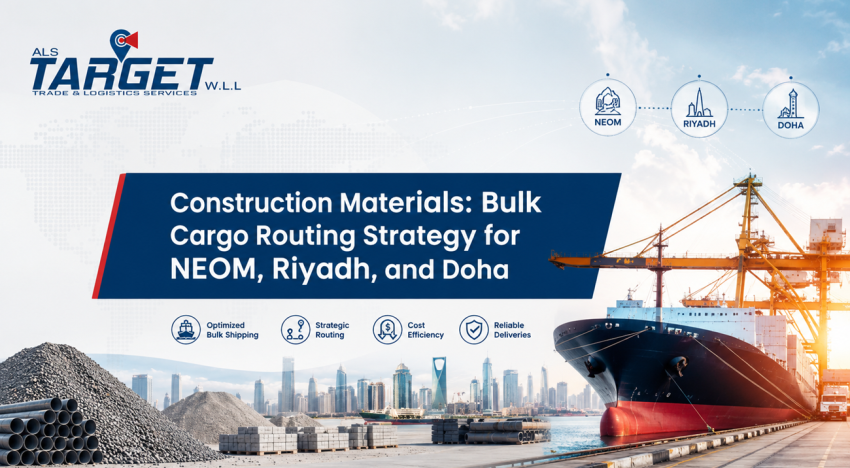
This method can prove especially dangerous when catering to large-scale projects in NEOM, Riyadh as well as Doha. While these markets reside in the broader GCC region, each one represents a different routing model. NEOM depends on the Red Sea, and a highly orchestrated approach to final-mile delivery. Because the Saudi capital, Riyadh, is inland; rail and road coordination are as important as ocean freight. Doha however has the advantage of direct access via Hamad Port but Delivery appointment and project site controls still dictate final date.
The question for contractors, manufacturers, and procurement teams is not simply “Which port is closest?” Rather, they need to ask what route simultaneously delivers the best combination of cost, protection of cargo, customs efficiency, availability for short or long-term storage and reliable delivery time.
How ALS TARGET structures a real-world bulk cargo routing strategy for GCC construction projects.
Why Construction Cargo Needs a Dedicated Routing Plan
Standard containerised consumer goods do not provide the same problems presented by construction materials. The steel beams could go higher than a normal truck frame. Another common affliction of cement products is moisture. Glass panels require some kind frame to handle it. Pipes statically must be lashed securely; some machines may require cranes, low–bed trailers or pre-approved transport routes from police.
Also, project demand exhibits barely constant rate. A civil contractor might be asking for 300 tonnes this week, delay the next batch and then suddenly come calling for another 700 tonnes when the site opens up. The logistics plan, therefore, should give some room for flexibility but it should not let storage and demurrage costs run rampant.
A proper routing strategy should consider:
- Cargo weight, dimensions, and lifting points
- Port handling equipment and berth capability
- Breakbulk, dry bulk, RoRo, or container suitability
- Customs documentation and product conformity
- Temporary storage requirements
- Road and rail connections
- Site delivery windows
- Weather and seasonal risks
- Oversized-load permits
- Return transport for empty racks or equipment
When teams review these factors before booking, they reduce handling delays and protect the overall construction schedule.
Comparing the Three Destination Markets
The following table provides a broad operational comparison. Actual transit times and costs will vary according to origin, vessel schedules, customs clearance, permit requirements, and project location.
| Destination | Typical Maritime Gateway | Main Inland Mode | Suitable Cargo Types | Primary Routing Concern |
| NEOM | Port of NEOM or another approved Red Sea gateway | Heavy road transport | Steel, modular units, machinery, pipes, project cargo | Remote-site delivery and controlled final-mile access |
| Riyadh | King Abdulaziz Port, Dammam, or Jeddah Islamic Port | Rail and road from Dammam; long-haul road from Jeddah | Steel, tiles, equipment, cement products, MEP materials | Selecting the correct coast and inland corridor |
| Doha | Hamad Port | Short- and medium-haul road transport | Steel, machinery, dry bulk, precast items, building materials | Port release timing and scheduled site delivery |
This table should support initial planning only. Before dispatch, the logistics provider must calculate the route using the exact cargo profile.
Routing Construction Materials to NEOM
For cargo intended for northwest Saudi Arabia, Port of NEOM provides a strategically located Red Sea entry point. Its location can reduce unnecessary inland movement compared with discharging cargo at a distant Saudi port and trucking it across the country.
But nearness is not the answer to each operational problem. For contractors, the nominated vessel should ensure that they call at the port and that the terminal can accommodate those dimensions in its normal operating hours; be sure to establish if appropriate equipment for storage or lifting will still be available on arrival day.
Cargo Types Suited to the NEOM Route
The direct Red Sea route may work well for:
- Structural steel and fabricated components
- Construction machinery
- Oversized pipes and utility equipment
- Modular building units
- Renewable-energy equipment
- Cranes and heavy vehicles
- Palletised finishing materials
- Containerised mechanical and electrical supplies
For project cargoes heavier than a simple pallet, ALS TARGET is also able to assist with vessel discharge, cranes necessary for unloading as well as customs clearance, temporary storage space and transportation to the final destination. This consolidated treatment minimizes the possibility of transmission or blame-shifting between suppliers if a delay happens.
Final-Mile Delivery Requires Extra Control
The last leg into a NEOM project area may involve controlled access, security checks, limited delivery windows, and specialised trailers. Therefore, dispatchers should avoid releasing trucks merely because customs has cleared the cargo.
Instead, they should confirm the following before gate-out:
- The project site has approved the delivery appointment.
- The receiving crane or forklift is available.
- The driver holds all required access documents.
- The load complies with road limits and permit conditions.
- A safe unloading zone has been prepared.
- The site can accept the complete shipment.
Without these checks, trucks may wait outside the project zone while detention charges continue.
Routing Bulk Cargo to Riyadh
Riyadh is a tougher one because it is landlocked, i.e., no seaports to speak of. Importers then have to decide between an eastern port—usually King Abdulaziz Port in Dammam—or a western Red Sea port, such as Jeddah Islamic Port.
Dammam usually makes sense as a gateway for cargo from Asia, or the Gulf states and surrounding regional markets. Additionally, by placing it in Riyadh’s inland logistics system allows for the bundling of sea cargo with rail or road.
At the same time, Jeddah might work for cargo incoming from Europe or North Africa (or Mediterranean) ports where ocean service has better frequency or rates. However, the overland route to Riyadh can drive up freight prices with higher fuel costs and demand for trailers along the way, as well as raise delivery risk.
Dammam Versus Jeddah for Riyadh Cargo
| Decision Factor | Dammam Gateway | Jeddah Gateway |
| Inland distance to Riyadh | Generally shorter | Generally longer |
| Rail potential | Stronger for suitable cargo movements | Usually road-focused for Riyadh delivery |
| Best ocean origins | Asia, Gulf and eastern trade lanes | Europe, Mediterranean and Red Sea routes |
| Suitable strategy | Regular cargo and planned replenishment | Project-specific cargo with favourable vessel connection |
| Main risk | Port congestion or inland capacity pressure | Higher long-haul trucking exposure |
The cheapest ocean rate does not always produce the lowest delivered cost. For example, saving money on freight through Jeddah may make little sense if the cargo then needs expensive cross-country heavy transport.
Consequently, ALS TARGET evaluates the total landed logistics cost, including port charges, handling, storage, rail or truck transport, permits, escort costs, and site unloading.
Routing Construction Cargo to Doha
Doha benefits from direct maritime access through Hamad Port, which handles several categories of non-containerised cargo, including steel, machinery, dry bulk, and building materials.
Because the port sits relatively close to Doha’s urban and industrial zones, the inland leg may appear simple. Yet contractors should not underestimate local delivery controls. Major projects often impose fixed time slots, vehicle registration rules, safety inductions, and restrictions on daytime heavy-vehicle movements.
When Direct Doha Routing Works Best
Direct routing through Hamad Port usually suits:
- Steel coils, plates, and structural sections
- Bagged or palletised construction products
- Heavy plant and machinery
- Precast construction components
- Pipes and fabricated metal products
- Dry bulk commodities
- Containerised electrical and plumbing products
The port’s cargo-handling infrastructure provides flexibility, although importers must still book the correct handling arrangement. A steel shipment, for example, may require different lifting gear from precast concrete units or fragile stone slabs.
For urgent construction phases, cargo can move from the terminal to a nearby staging yard. The project team can then call off smaller quantities according to the installation schedule. Although this adds one handling stage, it often prevents site congestion.
Choosing Between Container, Breakbulk, and Dry Bulk
The right transport method depends on the material, shipment size, origin facilities, and receiving-site capability.
| Shipping Method | Best Used For | Main Advantage | Key Limitation |
| Full-container load | Tiles, fittings, tools, bagged materials and MEP products | Security and regular sailing options | Payload and dimension restrictions |
| Flat rack or open-top container | Machinery, steel frames and oversized pieces | Combines container-network access with special handling | Higher securing and special-equipment costs |
| Breakbulk shipping | Beams, pipes, modules and heavy units | Suitable for large or irregular cargo | More handling and weather exposure |
| Dry bulk vessel | Cement raw materials, aggregates, gypsum and similar commodities | Efficient for very large homogeneous volumes | Requires specialist discharge and storage systems |
| RoRo shipping | Mobile cranes, trucks and wheeled machinery | Faster loading and reduced lifting | Cargo must be mobile or mounted on suitable equipment |
In some cases, a mixed-mode plan gives the best result. A contractor might send steel structures as breakbulk, machinery by RoRo, and smaller fittings in containers. Although this creates separate documentation streams, it prevents one unsuitable shipping method from controlling the entire project.
Customs and Compliance Planning
Construction cargo often requires more paperwork than buyers initially expect. Commercial invoices and packing lists remain essential, but they may not be enough.
Depending on the commodity and destination, documentation may include:
- Certificate of origin
- Product conformity documents
- Mill test certificates for steel
- Safety data sheets
- Technical catalogues
- Serial-number lists
- Packing and lifting plans
- Import permits
- Duty-exemption documents
- Temporary import records for machinery
- Wood-packaging compliance evidence
Descriptions must match across invoices, packing lists, bills of lading, and certificates. Even a small difference can trigger a customs query.
For instance, “construction accessories” provides very little detail. A clearer description such as “galvanised steel pipe supports for commercial building installation” helps customs officials identify the product and tariff classification.
Storage and Delivery Sequencing
Construction sites are not warehouses. They may lack covered storage, heavy-lifting equipment, or enough space to separate materials by installation zone.
Therefore, the logistics strategy should divide cargo into delivery batches. Critical-path materials should arrive first, while later-phase items can remain at a controlled warehouse or staging yard.
ALS TARGET can structure delivery around:
- Project phase
- Building or zone number
- Installation sequence
- Cargo weight
- Crane availability
- Contractor priority
- Weather sensitivity
- Customs status
This approach improves visibility and reduces unnecessary material movement. More importantly, it prevents essential items from sitting beneath cargo that the project will not use for another three months.
Cost Risks That Procurement Teams Often Miss
Freight quotations sometimes look attractive because they exclude several destination expenses. However, construction cargo may generate substantial additional costs after arrival.
Common examples include:
- Vessel or terminal demurrage
- Container detention
- Heavy-lift surcharges
- Crane mobilisation
- Special trailer charges
- Oversized-load permits
- Escort vehicles
- Waiting time at project sites
- Additional lashing
- Storage and re-handling
- Customs inspection costs
- Empty equipment return
Accordingly, procurement teams should compare quotations on a door-to-site basis, not only port-to-port freight.
Building a Resilient GCC Routing Strategy
No single route remains perfect throughout a long construction programme. Vessel schedules change. Project priorities move. Border procedures evolve, and ports may experience temporary pressure.
For that reason, ALS TARGET recommends maintaining at least one approved alternative route for critical materials. A Riyadh project may use Dammam as its primary gateway but keep Jeddah as a contingency. Likewise, a NEOM shipment may require an alternative Red Sea solution when the preferred service cannot accommodate the cargo.
A resilient plan also includes buffer stock for high-impact materials. However, the buffer should reflect actual project risk rather than guesswork. Storing six months of low-value material can waste money, while failing to hold two weeks of a critical imported component may stop the entire job.
Why Work With ALS TARGET?
ALS TARGET supports construction logistics across Saudi Arabia, Qatar, Bahrain, and the wider GCC. Rather than treating the ocean shipment, customs process, and inland delivery as separate jobs, the team coordinates them as one connected cargo movement.
Services can include:
- Breakbulk and project-cargo planning
- Sea, road, and multimodal freight
- Port handling coordination
- Heavy and oversized transport
- Customs-clearance support
- Cargo staging and warehousing
- Delivery scheduling
- Route and permit planning
- Shipment tracking
- Cross-border GCC logistics
It covers wherever — whether that be a distant NEOM construction site, a central Riyadh development or a high-value project in Doha — early route design can preserve both cost and schedule.
Final Thoughts
For cargo specialists, the process of moving construction materials into NEOM and Riyadh — or Doha for that matter — extends well beyond just booking space. Destinations have their own gateways, restrictions inland, requirements for handling and rules on project-delivery.
NEOM benefits from a strategically located Red Sea gateway, yet final-mile planning remains critical. Riyadh demands careful comparison between eastern and western ports, with inland cost playing a major role. Doha offers direct port access, although controlled urban delivery and site coordination still need attention.
Ultimately, the strongest strategy starts before the supplier packs the cargo. When ALS TARGET reviews dimensions, shipment volume, port capability, customs requirements, and installation schedules early, the entire supply chain becomes easier to control.
For dependable bulk cargo routing, project logistics, heavy transport, and GCC construction-material delivery, contact ALS TARGET and develop a route built around the realities of your project.
FAQs: Construction Materials
Port of NEOM can provide a direct gateway for many shipments serving northwest Saudi Arabia. However, vessel availability, cargo dimensions, handling equipment, and the final project location should guide the final decision.
Dammam often provides a shorter inland connection to Riyadh and offers rail-linked logistics options. However, Jeddah may work better for cargo arriving from Europe or Mediterranean routes when vessel frequency and overall delivered cost remain competitive.
Suitable cargo can use rail-supported logistics between Dammam and Riyadh. Nevertheless, the freight forwarder must confirm equipment availability, cargo acceptance rules, terminal schedules, and final road delivery arrangements.
Hamad Port can handle steel, machinery, building materials, dry bulk commodities, fabricated products, containers, and other general cargo. The correct terminal and handling plan will depend on the cargo’s dimensions and weight.
Breakbulk works well when beams, pipes, modules, machinery, or precast items exceed standard container limits. It may also suit large project volumes that require direct lifting between vessel, terminal, and specialised trailer.
Yes. Flat racks can carry oversized machinery, fabricated structures, and industrial equipment. However, the cargo requires professional lashing, accurate dimensions, carrier approval, and suitable lifting facilities.
They should submit documents early, arrange customs clearance before arrival where possible, pre-book transport, secure project delivery appointments, and confirm that unloading equipment will be available.
Typical documents include a commercial invoice, packing list, certificate of origin, bill of lading, product conformity records, and mill test certificates. Requirements can change according to the steel product and intended use.
Yes. ALS TARGET can coordinate route planning, trailer selection, permits, escorts, lifting arrangements, port handling, customs support, staging, and scheduled project-site delivery.
A staging warehouse holds imported cargo until the site is ready. It allows the logistics team to separate materials by phase, building, installation area, or contractor, which reduces congestion and handling problems on site.
Planning should begin before the purchase order becomes final, especially for oversized or heavy units. Early review allows engineers to adjust packing, lifting points, shipping dimensions, and delivery sequences before production finishes.
ALS TARGET considers cargo origin, volume, weight, dimensions, vessel schedules, port capability, customs requirements, inland distance, permit needs, storage, site access, and total delivered cost before recommending a route.