


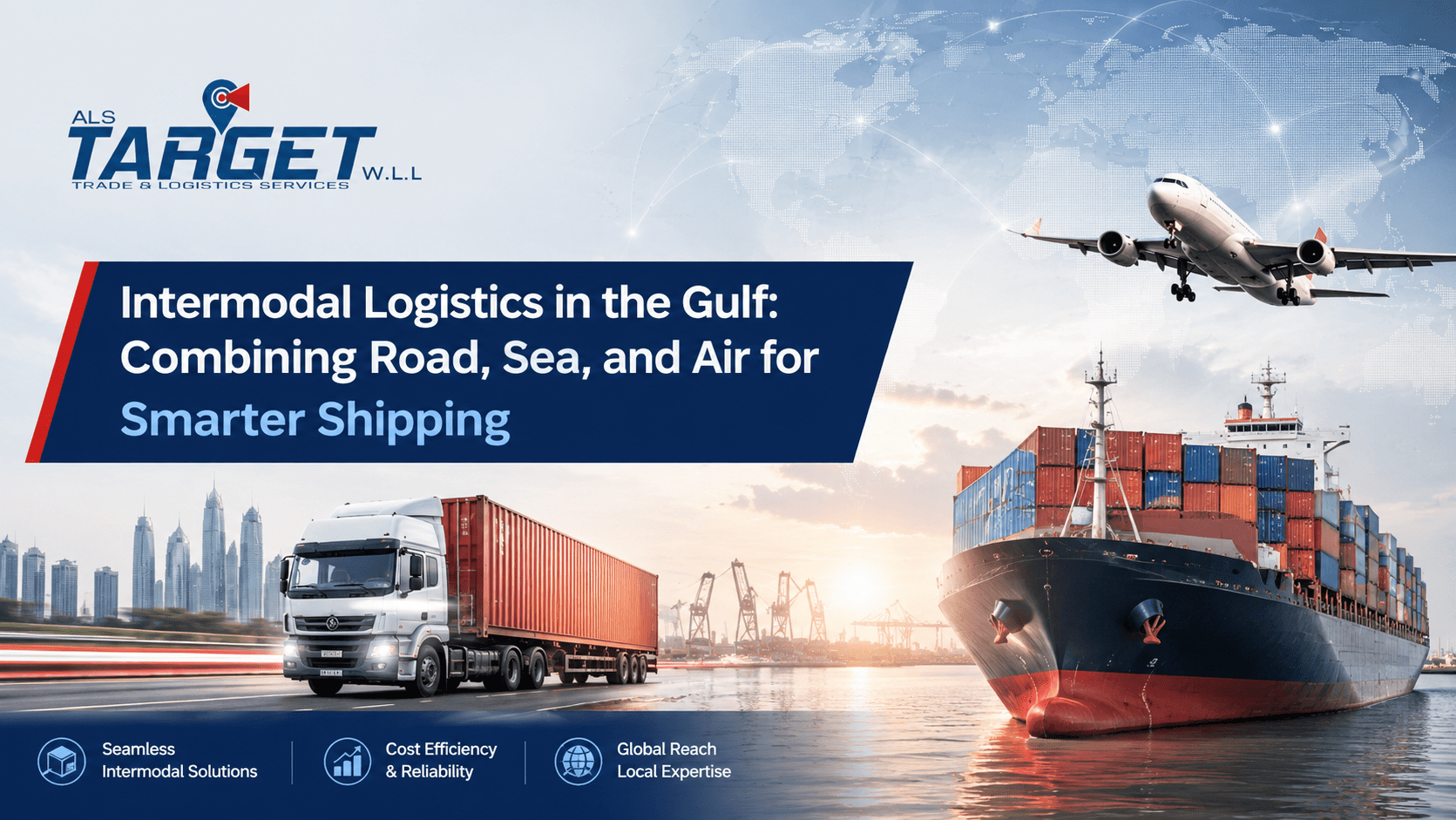
The Gulf has historically been a trading region. But within the GCC, shipping is no longer about getting a container from port A to port B. Importers, exporters, manufacturers, e-commerce sellers, oilfield suppliers and project cargo teams today need faster routing, tighter documentation and better cost control. This is where intermodal logistics in the Gulf begins to play an important role.
Basically, intermodal logistics is to put two or more transport models — typically road freight, sea freight and air freight into one planned supply chain. In contrast to only picking the cheapest or quickest route, businesses seek out the most efficient. It may, for instance, arrive by sea at Jebel Ali, carry on by bonded truck to Bahrain or Saudi Arabia and fly from there if the shipment is time-sensitive. Similarly, cargo might go from a GCC factory to a seaport by road and then sail an ocean or two to hit India, Europe, Africa or Asia.
The GCC freight and logistics market continues to be large and high growth. According to a Mordor Intelligence report, the GCC freight and logistics market in 2026 is USD 89.32 billion which is expected to grow to USD 120.21 billion by 2031. With growth comes the demand for smart multimodal planning that enables companies to gain speed whilst retaining cost control. Get details Sea Freight Service in Bahrain
What Is Intermodal Logistics?
Intermodal logistics is the planned movement of cargo using different transport modes while keeping the cargo unit, documentation, and delivery plan coordinated. In many cases, the cargo stays inside the same container or handling unit. As a result, the shipment moves from road to sea, or sea to road, with fewer handling points.
For Gulf businesses, the most common combinations include:
| Intermodal Route | Best For | Main Benefit |
| Road + Sea Freight | Containerised cargo, retail goods, machinery, building materials | Cost-effective regional and international movement |
| Sea + Air Freight | Urgent parts, high-value goods, emergency stock | Faster than sea, cheaper than full air freight |
| Air + Road Freight | Time-sensitive cargo from airports to GCC cities | Fast delivery across Bahrain, Saudi Arabia, UAE, Kuwait, Oman, and Qatar |
| Road + Sea + Air | Complex supply chains, split shipments, project cargo | Flexibility, contingency planning, and better control |
Therefore, intermodal logistics is not just a transport method. It is a planning strategy.
Why Intermodal Logistics Matters in the Gulf
The Gulf region has an unfair advantage. Located in the heart of Asia, Europe and Africa but also firmly in Saudi Arabia, UAE, Bahrain, Qatar, Kuwait and Oman local market. That geographical positioning allows corporations to facilitate more intelligent movement of cargo through using the GCC ports, airports, free zones and highways.
Moreover, various ongoing infrastructure developments are improving connectivity within the region. The GCC Railway project is designed to move citizens of Gulf nations and allow for passenger and freight movement, raising analysts who see it not only as a way to boost supply chain resilience but also as an opportunity for economic integration in the region.
Road corridors are also vital. Saudi Arabia is connected to Bahrain only through the King Fahd Causeway, which carries a significant amount of goods flowing in-between the two kingdoms. The King Hamad Causeway may additionally strengthen Saudi–Bahraini cargo transportation, with the proposed link bringing a four-lane, 25-km highway capacity and railworth capacity.
This regional setup has a tangible benefit to ALS TARGET customers: shipments can be forwarded through the best gateway, not just the closest one.
Road Freight: The Backbone of GCC Cargo Movement
Road freight throughout the Gulf remains the logistics backbone of the region. Trucks are the connecting link between Ports, Airports, Industrial Zones, Warehouses, Free Zones and Customers Sites Furthermore, road transport provides support for last mile and cross border deliveries particularly for goods being traded between Bahrain, Saudi Arabia, UAE,Kuwait, Qatar and Oman.
Road freight works best for:
| Cargo Type | Why Road Works Well |
| Palletised goods | Easy loading, flexible delivery, good for regional trade |
| Retail and FMCG cargo | Frequent movement and predictable routes |
| Industrial spare parts | Faster response for factories and plants |
| Exhibition cargo | Flexible schedule and direct venue delivery |
| Project cargo support | Useful for site-to-site movement |
However, road freight needs proper documentation. Customs papers, HS codes, commercial invoices, packing lists, certificates of origin, and permits must match the cargo details. Otherwise, delays can happen at border points.
That is why a logistics partner must not only arrange the truck. The partner should also understand GCC customs clearance, cross-border trucking rules, cargo permits, and delivery coordination.
Sea Freight: The Cost-Efficient Base for International Shipping
For larger cargo volumes, sea freight in the Gulf remains the most economical choice. Full container load, less-than-container load, breakbulk, RoRo, and project cargo often move through major Gulf ports.
Sea freight is ideal when the shipment has enough lead time. It suits importers and exporters who move goods in volume, including building materials, household goods, machinery, retail inventory, raw materials, and commercial equipment.
The main advantages include:
| Sea Freight Advantage | Business Impact |
| Lower cost per CBM or container | Better for large-volume cargo |
| Multiple container options | Suitable for 20ft, 40ft, reefer, flat rack, and open-top cargo |
| Strong global port connectivity | Easier international trade links |
| Flexible consolidation | Useful for SMEs with smaller shipments |
But even sea logistics may not be a panacea. While others require services like inland trucking, warehouse storage, customs clearance, or repacking and delivery. To this end, sea-road intermodal logistics is often a good compromise between price and reliability.
Air Freight: Speed for Urgent and High-Value Cargo
In the GCC where time matters more than cost, air freight plays a significant portion. Supports urgent spare parts, medical supplies, electro-technologies, high-value cargo, samples documents, fashion goods and time loss replacement.
Air freight usually works best when:
| Situation | Why Air Freight Helps |
| Production line is waiting for parts | Reduces downtime |
| High-value cargo needs faster movement | Shorter transit exposure |
| Retail stock must arrive before a deadline | Prevents lost sales |
| Samples or documents need quick delivery | Supports business continuity |
| Sea shipment is delayed | Air can recover time |
Still, full air freight can be expensive.Therefore, numerous enterprises utilize sea-air logistics. A combination of ocean and air, this model sees cargo moving via the sea for part of the route before switching to air for the more time-sensitive leg. This provides a middle ground, faster than full sea freight but cheaper than full air freight.
Sea-Air Logistics: A Smart Middle Option
Sea-air, in the Gulf, has developed a certain relevance because companies are squeezed from both ends. Customers require faster deliveries, and finance teams prefer to reduce logistics costs. Sea-air logistics answers both demands.
For example, cargo may move by sea from Asia to a Gulf hub, then continue by air to Europe, Africa, or another Middle East destination. Likewise, urgent cargo may arrive by sea in the UAE and continue by truck or air to Bahrain or Saudi Arabia.
This works well for:
- Electronics and IT equipment
- Fashion and seasonal retail goods
- Automotive spare parts
- Medical and healthcare cargo
- E-commerce stock
- Urgent replacement items
- High-value industrial components
Additionally, Dubai has invested heavily in multimodal connectivity. The logistics corridor between Jebel Ali Port and Dubai World Central supports sea-air cargo movement through a bonded road connection, giving shippers a faster way to transfer cargo between port and airport operations.Get details on Air Freight Service in Bahrain.
How Intermodal Logistics Reduces Risk
Many businesses look only at freight rates. However, smarter companies look at total risk. A cheap route can become costly when cargo misses a project deadline, sits at customs, or arrives without proper documents.
Intermodal shipping in the Gulf reduces risk because logistics teams can create backup plans. For example, if sea freight faces congestion, urgent cartons can move by air. If one border route faces delay, another road route may work better. If a consignee cannot receive cargo immediately, warehousing can bridge the gap.
| Risk | Intermodal Solution |
| Port congestion | Shift urgent cargo to air or alternative gateway |
| Border delay | Pre-check documents and plan buffer time |
| Inventory shortage | Use sea-air or air-road movement |
| High freight cost | Combine sea for bulk and air for urgent stock |
| Delivery deadline | Plan route by cargo priority |
Therefore, intermodal logistics is not only about transport. It is about supply chain control.
Documentation: The Hidden Key to Smooth Multimodal Freight
In the Gulf, documentation can decide whether a shipment moves smoothly or waits for correction. Even the best transport plan can fail if the paperwork does not match the cargo.
Common documents include:
| Document | Purpose |
| Commercial Invoice | Shows value, buyer, seller, and goods description |
| Packing List | Details cartons, weight, dimensions, and marks |
| Bill of Lading / Air Waybill | Confirms sea or air carriage |
| Certificate of Origin | Confirms manufacturing or export origin |
| HS Code Classification | Supports customs duty and clearance |
| Import Permit / Approval | Needed for controlled or regulated goods |
| Insurance Certificate | Supports claims in case of loss or damage |
For this reason, ALS TARGET focuses not only on cargo movement but also on freight forwarding, customs documentation, cargo coordination, and GCC shipping compliance.
Choosing the Right Mode Combination
There is no single best route for every shipment. The right choice depends on urgency, cargo value, weight, volume, delivery deadline, customs requirements, and final destination.
| Business Need | Recommended Mode |
| Lowest cost for large cargo | Sea + Road |
| Fastest delivery | Air + Road |
| Balanced cost and speed | Sea + Air |
| Regional GCC distribution | Road Freight |
| High-value urgent cargo | Air Freight |
| Project cargo | Sea + Road + special handling |
| E-commerce replenishment | Air + Road or Sea + Air |
Also, the route must match the receiving location. A cargo plan for Bahrain may not work the same way for Riyadh, Doha, Muscat, Kuwait City, Dammam, or Dubai. So, a Gulf logistics partner should understand port access, airport handling, road permits, border procedures, and local delivery conditions.
Related Articles:
» Documents Needed for Air Freight Clearance in Bahrain
» Bahrain Logistics Trends in 2026: Routing, Risk, and Supply Chain Flexibility
» Commercial Cargo Shipping in Bahrain: Air, Sea, or Land
» Sea Freight to Bahrain: FCL vs LCL for Importers and Exporters
» Air Freight in Bahrain: When to Choose Speed Over Cost
Sustainability and Cost Efficiency
Better sustainability planning can also be facilitated by intermodal logistics. More often than not, sea freight has lower emissions per tonne-kilometre than air freight, and road freight provides flexible access to final destinations. By using modes appropriately, companies are minimizing ad hoc emergency air shipments and empty movements.
The region is also working on rail and integrated corridors that have the potential to enhance freight modalities over time. An example of which is the recent UAE-Oman Hafeet Rail project, intended to connect Abu Dhabi with Sohar Port and enhance cross-border logistics between the UAE and Oman.
Thus, in future Gulf-wide sourcing may cater for rail-linked cargo planning via intermodal logistics and road, sea and air. Looking for a Land Freight Service in Bahrain?.
Why ALS TARGET for Intermodal Logistics in the Gulf?
ALS TARGET helps companies that require an efficient, professional moving of their cargo across the GCC and global markets. ALS TARGET does not consider freight as a one-way booking but rather follows the complete Shipping chain: from collection to documentation, freight mode, customs clearance, transit time and cargo safety amongst others things till the final delivery.
If properly planned, businesses can minimize delays while maintaining an ideal freight spend instead of random supply chain disruptions. However, even more important is that they can choose the best way of making each shipment fit, rather than the most obvious way of making it work.
Whether you need road freight in Bahrain, sea freight from Gulf ports, air freight for urgent cargo, or a complete intermodal logistics solution in the GCC, ALS TARGET can help plan smarter shipping from start to finish.
Conclusion
It is a new age of the Gulf being more connected, competitive and logistics-oriented. Given the relative increase in transport volumes, companies are unable to rely on one mode of transport alone. They require dynamic routing, increased visibility, and expedited customs clearance.
Hence, why intermodal logistics in the Gulf is so significant. As a result, businesses can transport their cargo with the appropriate mix of price, speed, and control by combining road freight & sea freight as well as air freight. With all the ports, airports, highways, free zones and impending rail corridors that move global trade in this territory — clever shipping is no longer discretionary. It is a business advantage.
FAQs: Intermodal Logistics in the Gulf
Intermodal logistics operating in the Gulf refers to transporting freight via pre-planned road, sea and air routes through GCC countries and international trade.
There's intermodal shipping that is utilized by many businesses to strike a balance between price, conveyance speed, documentation and delivery point reliability. It is more flexible when one route gets delayed.
Yes, in many cases. If you have a very high volume, a good price per piece is sea-air or sea-road combination with a one-step loss of cost compared to full air freight.
Opt for air freight when you need to ship spare parts urgently, transport high-value cargo, medical products, documents and samples or goods requiring fast delivery.
Sea-Air freight Note that sea-air simply means cargo travels partly by way of the ocean and partly by air. It provides quicker delivery than sea freight and a lower price than full air freight.
Yes. Port, Airport & Road Freight — Bahrain Saudi Arabia UAE Kuwait Oman Qatar connects all ports and airports to warehouses, factories, free zones and final delivery locations through road freight.
Common documents include commercial invoice, packing list, bill of lading, air waybill, certificate of origin, HS code details, permits, and insurance documents.
It can help when documents are checked early and the route is planned properly. However, customs clearance still depends on correct paperwork and regulatory compliance.
Sea freight suits containers, machinery, building materials, retail goods, household goods, industrial cargo, and other large-volume shipments.
ALS TARGET, you can handle GCC cargo planning, enabling documentation coordination and freight-forwarding for road shipments as well as Multi-Modal route selection for both sea & air.
Project cargo usually requires additional services for special handling, port transit, road permits, cranes, escorts and staged delivery as per client specifications. Intermodal preparation helps arrange these procedures correctly.
For time sensitive cargo, air freight from one airport to another with road delivery is the fastest routine. But when you want a middle point between fast and cheap, there is sea-air.