


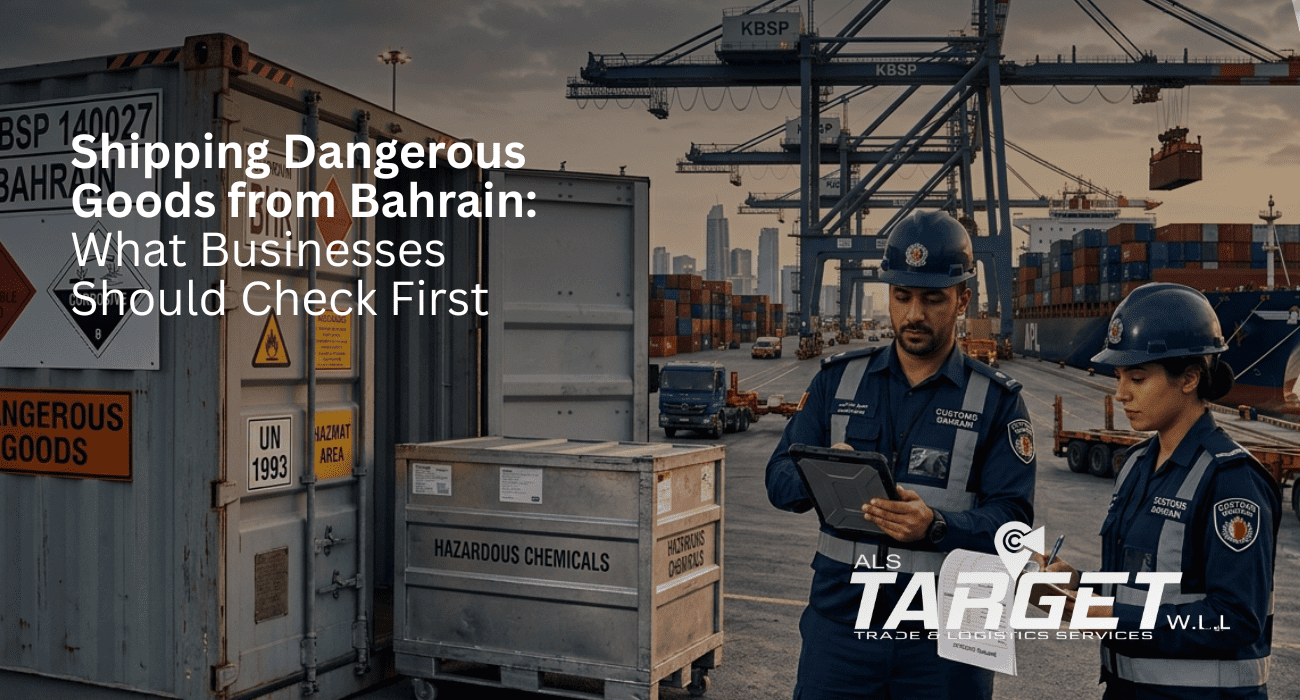
Transporting specifically dangerous goods from Bahrain is by no means your everyday shipping task. It requires planning, correct classification, prepared documents and appropriate way to transfer from the very beginning. The entire shipment can be delayed, fined, blocked or become a safety issue If even one detail is omitted by the business. Which is the reason for companies that ship chemicals; aerosols; paints; batteries; industrial liquids; cleaning agents or other regulated cargo must have stricter processes in place prior to booking a freight.
In Bahrain, that first check becomes all the more critical as businesses frequently operate throughout GCC supply chains, port movements and industrial zones as well as on urgent air cargo routes. Regardless of whether a shipment is leaving by sea freight, air freight or road-linked regional logistics, the sender must ascertain if the goods are banned, whether permits apply and which transport code governs the cargo. In addition to this info, Bahrain Customs also supplies with tariff records that reveal the supplied regulatory authority requirements for certain items, and national law and licensing conditions still apply for restricted and prohibited items.
For businesses, the safest approach is simple: do not ask, “Can we ship it?” until you first ask, “What exactly are we shipping, how is it classified, and what regulations apply?”
What are dangerous goods in shipping?
Dangerous goods are substances or articles that can pose a risk to health, safety, property, or the environment during transport. In practice, that can include:
- Flammable liquids
- Compressed gases
- Corrosive chemicals
- Oxidising substances
- Toxic materials
- Lithium batteries
- Paints, solvents, and adhesives
- Certain medical and industrial materials
According to IATA, the Dangerous Goods Regulations assist shippers with the classification, marking, packing and documentation of hazardous shipments for air cargo. The IMDG Code sets out the specific requirements for each substance including packing, stowage, container traffic and segregation of incompatible goods. Accordingly, the IMO states that for sea freight. Get details on Land Freight Service in Bahrain.
The first thing businesses should check: correct classification
Before pricing, packing, or booking, businesses must identify the product correctly. This is where many shipping problems begin.
Some products might look non-hazardous while in a warehouse and then find itself within dangerous goods class once it reaches transport. For example, special handling may need to be taken for some paints, cleaning agents, pressurised containers or battery powered appliances.
If the cargo is classified wrongly, everything that follows can also go wrong:
- Wrong packaging
- Wrong labels
- Wrong declaration
- Wrong carrier acceptance
- Wrong storage arrangement
IATA’s DGR covers classification, packing instructions, documentation, handling, and limitations for air transport, while the IMDG Code governs packaged dangerous goods carried by sea.
Check whether the cargo is restricted, prohibited, or permit-controlled
The second major check is legal acceptability. Some goods are not freely exportable or importable. Others can move only after approval from the correct authority.
Bahrain Customs states that prohibited goods cannot be exported or imported where national laws restrict them, and its customs tariff system allows businesses to search HS codes, duty rates, and the related regulatory authority when a permit is required.
That means businesses should verify:
- The HS code
- Whether the item is restricted
- Whether a permit or licence is needed
- Whether the consignee country has additional controls
- Whether the chosen carrier accepts that commodity
This step is especially important for exporters dealing with chemicals, industrial inputs, automotive fluids, laboratory products, or battery shipments. Looking for a Sea Freight Service in Bahrain?
Choose the right transport mode before you pack
Not every dangerous shipment should go by air. Not every product suits sea freight either. The transport method changes the compliance requirements.
Dangerous goods by air
Air freight is more expedient but tends to be more stringent. The DGR is known as the industry reference used by airlines, freight forwarders, ground handlers and shippers per their respective IATA website; they note that it is published each year due to changes in regulations and procedures.
Dangerous goods by sea
Sea freight is commonly more suitable for larger bulk quantities, commercial consignments and products requiring container mobilisation. IMO notes that the IMDG Code 2024 Edition, including Amendment 42-24, has been made mandatory as of1 January 2026.
Dangerous goods by road
Where road transport forms part of the wider movement chain, dangerous goods rules also matter. UNECE notes that ADR 2025 remains the framework for the international carriage of dangerous goods by road.
Packaging is never just a box
Many businesses focus on the product but forget the packaging standard. That is risky. Dangerous goods packaging must suit the substance, withstand transport conditions, and meet the relevant code.
A weak drum, poor inner packaging, loose cap, or incorrect absorbent material can turn a routine shipment into a rejected consignment. For some products, UN-specification packaging may be required. For others, inner and outer packaging combinations matter just as much as the product itself. Get details on Air Freight Service in Bahrain.
Quick compliance table for businesses
| Checkpoint | Why it matters | Common business mistake |
| Product classification | Determines the shipping rules | Using a trade name instead of technical classification |
| HS code verification | Helps identify customs and permit needs | Choosing a generic tariff code |
| SDS review | Confirms hazards, handling, and composition | Using an outdated safety data sheet |
| Packaging standard | Prevents leaks, damage, and rejection | Using normal commercial cartons |
| Marking and labelling | Alerts handlers and carriers | Missing hazard labels or orientation marks |
| Shipping documents | Supports legal movement and acceptance | Incomplete declaration details |
| Carrier approval | Confirms shipment acceptance | Booking before compliance review |
| Route review | Prevents transit or destination issues | Ignoring transit-country restrictions |
Review the Safety Data Sheet before booking
The Safety Data Sheet (SDS) is one of the most useful documents in dangerous goods shipping. It helps identify:
- Chemical composition
- Hazard class indicators
- Flash point
- Handling guidance
- Emergency measures
- Packaging and storage advice
However, businesses should not treat the SDS as the only document they need. It supports the process, but it does not replace proper classification, documentation, or carrier review.
Check labels, marks, and declarations
Once the goods are classified and packed correctly, the next step is visible compliance. Dangerous goods often require:
- Hazard labels
- UN number marking
- Proper shipping name
- Handling labels
- Orientation arrows where required
- Shipper declarations for specific transport modes
IATA specifically lists documentation such as the shipper’s declaration and air waybill among core DGR requirements, together with handling, storage, loading, inspection, and training.
Do not ignore staff training
One of the biggest business risks is assuming warehouse or dispatch staff can handle dangerous goods because they already ship standard cargo. Dangerous goods shipments require trained personnel who understand acceptance checks, segregation rules, packaging limits, and emergency response basics.
This matters because the risk is not only regulatory. It is also operational. A poorly prepared dangerous shipment can affect flights, containers, storage locations, insurance exposure, and customer trust.
Insurance and liability should be checked early
Businesses often ask about freight rates first. A smarter question is: what happens if the shipment leaks, gets rejected, or causes damage in transit?
Dangerous goods can carry higher liability exposure. So before dispatch, companies should confirm:
- Cargo insurance scope
- Dangerous goods exclusions
- Carrier conditions
- Declared value requirements
- Claims process in case of incident
Related Articles:
» Air Freight in Bahrain: When to Choose Speed Over Cost
» Sea Freight to Bahrain: FCL vs LCL for Importers and Exporters
» Customs Clearance in Bahrain: Common Shipping Documents That Prevent Delays
» Land Freight from Bahrain to Saudi Arabia: What Businesses Need to Know
Why businesses in Bahrain should plan earlier, not later
Bahrain’s trading environment supports fast regional and international movement, but speed only works when compliance starts early. In dangerous goods logistics, delays usually happen because the business waits too long to classify the product, confirm restrictions, or gather the right paperwork.
That is why the safest workflow is:
- Identify the product technically
- Verify classification
- Check Bahrain customs and permit needs
- Match the cargo to air, sea, or road rules
- Use compliant packaging
- Complete labels and documents
- Confirm carrier acceptance before dispatch
Safe, Secure, and Compliant Shipping from Bahrain
When businesses approach compliance as the initial step in shipping dangerous goods from Bahrain rather than the last, it can become a lot more streamlined. All of these work together: Classification, permits, packaging, labels on goods and documentation along with trained handling. If one link is unable to make the shipment move, everything stops.
Shippers moving everyday products, chemical shipments, batteries, industrial products such as paints or those for regulated materials are all well-advised to pre-screen every shipment early and partner with a capable freight provider. This way cuts down on wait times while also protecting people and keeping cargo flowing with confidence.
FAQs About Shipping Dangerous Goods from Bahrain
Dangerous goods can be defined as materials and items which are capable of posing risk to human health, safety or property of the environment when they are transported over land; these mainly include chemicals (poison etc), flammable liquids and gases and lithium batteries.
In a place where the shipment is qualified under applicable air cargo rules for classifying, packing and package marking of dangerous goods and preparing documents therefore (also known as Air Cargo.
Yes. From shipper’s declaration, SDS, commercial invoice to packing list and other transport-specific paperwork depending on the goods within that shipment.
Certain restricted goods may need approvals or licenses and not all. Prior to shipping, businesses should check what the HS code is and the regulatory authority responsible.
This is generally the case, however lithium batteries are heavily regulated and need to be presented, labelled and declared correctly.
The shipment may be delayed, rejected, fined or inspected. At more extreme levels, safety hazards and legal risk come into the mix.
But this varies by product, urgency, quantity and what is allowed under regulatory limits. Sea freight typically caters to industrial shipments and is bulkier than air freight, which is faster but more regulated.
In short, IMDG–International Maritime Dangerous Goods Code is the up to standard regulatory guide for transport dangerous goods in packaged shape through the sea.
The IATA Dangerous Goods Regulations represent the industry standard used for air transport of dangerous goods.
In many cases, yes. The SDS also assists with identification of hazards, composition and handling requirements for the product.
Not always. Depending on the substance and transport mode, most dangerous goods will need to be packaged in tested and approved or UN specification packaging.
They must validate the precise product classification, permission condition, means of transport requirements and packaging compliance ahead of reserving freight.