


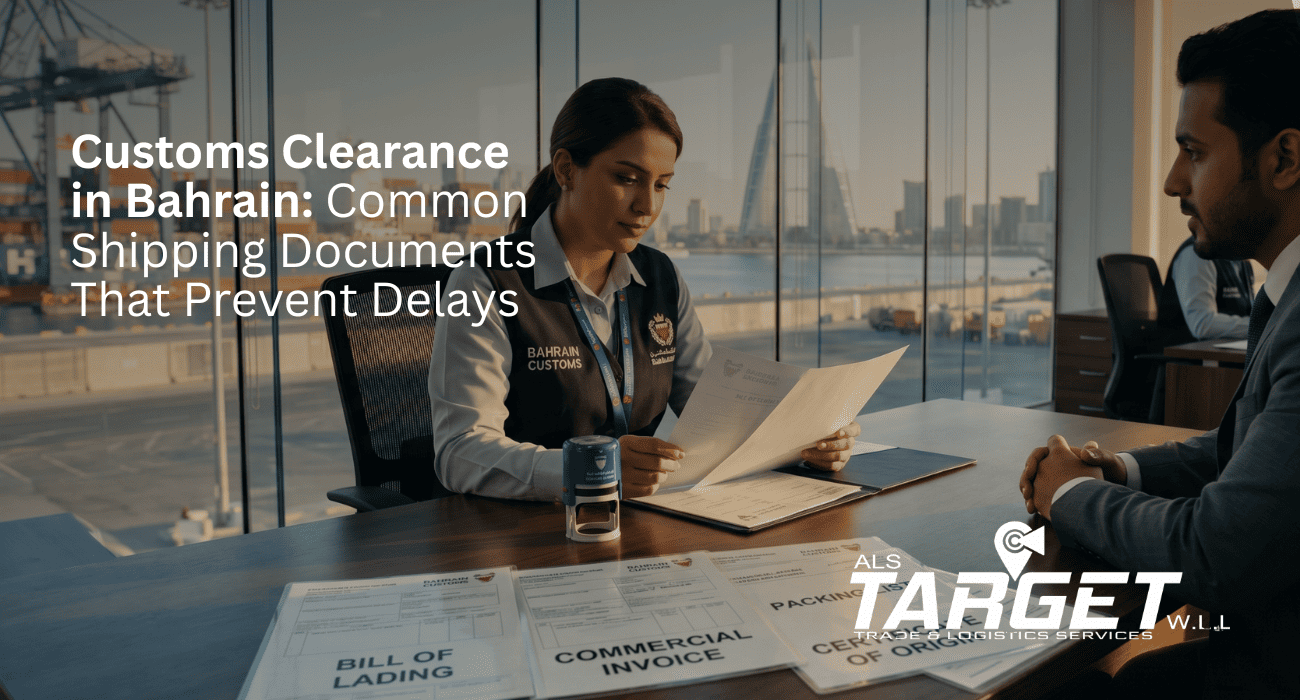
Upon shipment’s arrival in Bahrain, speed is not a matter of chance. It depends on paperwork. Cargo gets delayed because a single document is missing, a single product detail does not match, or a single permit was not acquired prior to arrival in many cases. Bahrain Customs specifies essential attachments like the invoice and bill of lading for import clearance, and its commercial-import and service pages reference supporting document facilitators, including the certificate of origin and other documents when necessary. The OFOQ single-window system is also used by Bahrain Customs, and Tayseer platform assists importers and agents in identifying whether or not goods require approvals from other government agencies.
This means even more to businesses moving freight through Bahrain, where the local trade environment is fast, regional, and compliance-driven. A container arriving through Mina Salman, air cargo touching down for urgent delivery or cross-border freight entering the GCC supply chain can all slow up should paperwork be incomplete. Thus, importers, exporters and clearing agents require documents to be precise, consistent and prepared before the cargo reaches the border. Bahrain Customs also specifies that restricted goods require permits from the appropriate authority — which is precisely why preparing relevant documents should commence long before dispatch.
Why shipping documents matter in Bahrain customs clearance
Cargo identification is just one thing customs documents provide. They assist customs in verifying the value, origin, quantity, classification and if a shipment requires additional approvals. Bahrain’s guidance under AEO lists auditing of declared values, HS codes, invoices, bills of lading, certificates of origin as well as quantities to review compliance. Which means it’s easy to raise questions, conduct inspections or have hold-ups even with a small mismatch.
In practical terms, good documentation helps with:
- Faster document review
- Fewer customs queries
- Lower risk of re-submission
- Smoother inspection handling
- Better coordination with transporters, brokers, and consignees
So, while freight mode matters, document accuracy often matters more. Get details on Land Freight Service.
The most common shipping documents that prevent delays
1. Commercial Invoice
The commercial invoice is one of the most important customs documents in Bahrain. Bahrain Customs import guidance lists invoices among the required attachments for commercial import and general importing procedures.
This document should clearly show:
- Seller and buyer details
- Invoice number and date
- Product description
- Quantity and unit price
- Total shipment value
- Currency used
- Incoterms if applicable
- Country of origin
If the invoice description is vague, customs may not be able to match the goods to the correct tariff treatment or permit requirement. As a result, clearance can stall.
2. Bill of Lading or Air Waybill
Customs of Bahrain states the Bill of Lading is stated as a core shipping document, specifically for sea and air importation. On some entries of the customs service, the bill of lading is a required document that must be attached with an invoice and other documents.
This transport document confirms:
- Carrier details
- Port of loading and discharge
- Shipper and consignee
- Cargo details
- Number of packages
- Gross weight
If the bill of lading does not match the invoice or packing list, then customs officials may seek clarification before releasing the goods. Get details on Sea Freight Service.
3. Packing List
A packing list might seem basic, yet it repeatedly saves us from significant delays. However, although invoice may provide the economic worth of the goods, the packing list shows how these items actually packed. In some instances, Tayseer entries for products which are subject to control also add entry invoice, packing list and entering declaration as supporting documents.
A strong packing list usually includes:
- Number of cartons, pallets, or crates
- Net and gross weight
- Dimensions
- Product-wise packing breakdown
- Marks and numbers on packages
This helps customs, warehouses, and transport teams inspect or locate cargo quickly.
4. Certificate of Origin
The certificate of origin can be critical for customs treatment, trade compliance, and supporting product origin claims. Bahrain Customs service guidance names the certificate of origin among required attachments where applicable, and government service pages also refer to it for imported goods in certain categories.
This document matters because it helps customs confirm:
- Where the goods were produced
- Whether preferential treatment may apply
- Whether origin declarations match the invoice and declaration
If the certificate is missing, inconsistent, or not properly issued, the importer may face delays or extra scrutiny.
5. Customs Declaration
The customs declaration is an official submission that informs customs of what the goods are, how they have been classified, their value and in some cases which duties or controls may apply. Bahrain Customs service pages mention the unified customs declaration, while Tayseer and other sector-specific approval pages talk about attaching such customs declaration in case of any regulatory processing.
This declaration needs to be consistent with the supporting documents. Even minor discrepancies in terms of quantity or a misplaced HS code can lead to further scrutiny.
6. Import Permits and Other Government Approvals
Not all cargo can move with only transport and commercial documents. Bahrain Customs clearly states that restricted goods require permits from the competent authorities, and the Tayseer platform exists to show importers, exporters, and customs agents which goods fall under other government agency controls.
Examples can include:
- Health-controlled products
- Tobacco-related imports
- Veterinary pharmaceuticals
- Chemicals
- Live animals
For instance, Bahrain government service pages for tobacco shipment release require documents such as the bill of lading, a customs declaration copy, a Ministry of Health certificate of conformity, and other health-related attachments before release. Get details on Air Freight Service.
Quick comparison table: documents and their role
| Document | Main purpose | Common delay risk if missing or incorrect |
| Commercial Invoice | Confirms value, seller, buyer, and goods description | Wrong value, vague item description, mismatch with declaration |
| Bill of Lading / Air Waybill | Confirms shipment movement and cargo details | Transport data mismatch, consignee errors |
| Packing List | Shows packing structure, weights, and package details | Inspection delays, counting disputes |
| Certificate of Origin | Confirms manufacturing origin | Origin queries, trade-treatment issues |
| Customs Declaration | Official customs filing for classification and clearance | Re-submission, assessment delays |
| Import Permit / OGA Approval | Proves approval for restricted goods | Shipment hold until authority clearance |
Common document mistakes that cause customs delays in Bahrain
Even experienced importers make avoidable documentation errors. The most common ones include:
Inconsistent product descriptions
When the invoice says one thing, the packing list says another, and the declaration uses a broader label, customs may pause clearance.
Incorrect HS code usage
Since customs compliance review includes HS codes, using the wrong code can affect duty treatment, approvals, and inspection decisions.
Missing permits for restricted goods
A shipment might appear approved on paper, but even that can be halted if sign-off from the correct ministry or agency wasn’t secured in advance. Bahrain Customs particularly cautions that restricted items require relevant permits.
Late document preparation
If documents are created after cargo arrival, corrections become slower and more expensive.
Unsigned or uncertified supporting papers
Some product categories or transaction types may require documents issued or endorsed by recognised bodies, especially when proving origin or regulatory conformity.
Best practices to avoid customs clearance delays in Bahrain
Businesses can reduce delay risk by following a simple document-control process:
- Prepare the invoice, bill of lading/air waybill, and packing list before cargo dispatch.
- Check that names, weights, quantities, and descriptions match across all papers.
- Confirm whether the cargo is restricted through the Tayseer guidance process.
- Secure all permits early if the cargo falls under health, chemical, veterinary, or other regulated categories.
- Review HS classification and declared value carefully.
- Upload and submit documents through the proper customs process, including OFOQ where applicable.
- Work with an experienced customs clearance partner in Bahrain for pre-arrival checking.
How ALS TARGET helps reduce documentation delays
Smooth customs clearance at ALS TARGET begins with optimum document preparation. Rather than waiting on customs to sweep doors and find an issue, an active logistics partner reviews the shipping file pre-cargo arrival. That includes checking commercial paperwork, spotting missing permits, communicating with shippers and consignees and helping ensure the customs submission accurately represents the cargo.
This method is particularly beneficial for the GCC trade routes, urgent cargo, commercial imports and controlled shipments where timing is crucial. Because in Bahrain, delays hardly ever begin at the port. Usually, they begin the paperwork.
Related Articles:
» Air Freight in Bahrain: When to Choose Speed Over Cost?
» Sea Freight to Bahrain: FCL vs LCL for Importers and Exporters
» Land Freight from Bahrain to Saudi Arabia: What Businesses Need to Know?
Ensuring Smooth Customs Clearance Starts with the Right Documents
When the document file is complete, accurate and in alignment from the beginning, customs clearance gets faster for Bahrain. The key papers include (but are not limited to) the commercial invoice, bill of lading or air waybill, packing list, certificate of origin, customs declaration and any permits required for prohibited goods. Bahrain Customs’ own documentation indicates that these documents are vital to the clearance process, whereas OFOQ and Tayseer enable digital submission and visibility of approvals.
For importers and exporters, the message is clear: improved documentation translates to less bottlenecking, greater predictability and smoother freight movement across Bahrain.
FAQs: Customs Clearance in Bahrain
Typical documents include commercial invoice, bill of lading / air waybill, packing list, certificate of origin and customs declaration. Some shipments also need permits.
While every shipment is not the same, certificate of origin is generally required where around the world origin proof or trade treatment is important.
OFOQ is Bahrain Customs’ single-window program for customs-related services and trade processing.
Tayseer assists importers, exporters and customs agents when importing goods subject to the control of other government agencies as well as requiring permits.
It aids in verifying the counts, weights and packing information of parcels for customs and logistics teams, especially while inspecting the items.
Yes. HS Codes are also involved as part of customs compliance review, so any misclassification can really delay assessment or raise queries.
Yes. According to Bahrain Customs, restricted goods must be permitted by the relevant authorities.
Yes. Customs clarification requests are often due to mismatched descriptions, quantities, or consignee details.
Yes. Some products may require documentation and approvals related to health or sector-specific regulations (e.g. tobacco, veterinary goods, regulated products).
Yes. It minimizes late corrections and keeps the customs file complete prior to cargo arrival.
Inconsistencies between documents (mainly between invoice, declaration and transport papers) are the biggest issue.
ALS TARGET can assist with document review, permit coordination, shipment planning and customs-clearance preparation to avoid unnecessary delays.